China still has no timetable for launching its much-hyped sovereign digital currency, with limited public trials that will begin soon just “routine parts of the research and development process,” China’s central bank governor said.
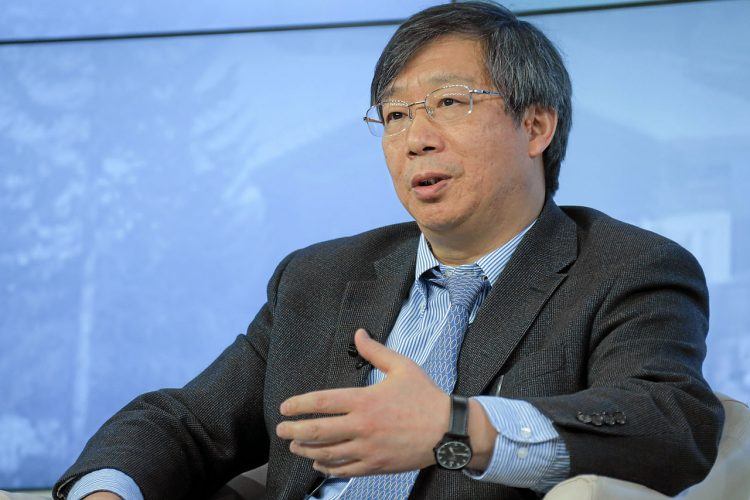
People’s Bank of China governor Yi Gang / Photo credit: Remy Steinegger
People’s Bank of China chief Yi Gang said China had “basically completed” the top-level design, standard setting, research on functions, and integration tests of the digital yuan.
But Yi cautioned that the central bank still needed more time to verify “the reliability of theories, stability of the system, usability of its functions, convenience of the process, applicability in different sites, as well as the ability to control risks.”
“[The tests] don’t mean the official launch of a digital yuan” and “there’s no timetable for an official launch,” Yi said in an interview published by the central bank publication, China Finance, on Tuesday.
Speculation of an imminent launch of China’s sovereign digital currency heated up in April after a screenshot of the user interface for the digital yuan emerged.
At the same time, Chinese media reported that trials would start in a district in the Western city of Suzhou as well as in the city of Xiong’an in Hebei province with a dozen local businesses, including American chains Starbucks, McDonald’s, and Subway, reportedly included in the pilot program involving small transactions.
But Yi’s latest comments poured cold water on expectations that China’s sovereign digital currency would be launched soon, while they will also temper theories that Beijing could use the digital form of the yuan to undermine the US dollar.
Yi confirmed that China had approved a number of state-owned banks and financial institutions to conduct research on the digital yuan at the end of 2017 and that “internal closed pilot tests” are currently being conducted in Shenzhen, Suzhou, Xiong’an, Chengdu, and will also take place later at the sites for the 2020 Winter Olympic Games in Beijing.
He added that China’s sovereign digital currency would be a digitalized form of cash that will be able to be used in “retail payments.”
The Chinese government work report delivered to the National People’s Congress by Premier Li Keqiang last week, though, did not mention China’s sovereign digital currency plan, a sign that the project is not at the top of Beijing’s agenda.
China was the first major economy to study the application of a sovereign digital currency having started work on the project in 2014.
At the same time, the Chinese government has also continued to crack down on the trading of cryptocurrencies such as bitcoin, regarding them as risks to the country’s financial stability.
Libra was originally designed to be anchored by a basket of currencies, although Facebook announced in April that it would create multiple digital units tied to individual currencies to clear international regulatory obstacles.





Stay updated on the go with our mobile app.
Get latest insights with smoother, more personalized experience through TIA mobile app.