- Premium Content It takes our newsroom weeks - if not months - to investigate and produce stories for our premium content. You can’t find them anywhere else.
 Scott Shuey · · 9 min read
US-China tensions may be cooling, but chips remain a hot issue
A recent charm offensive launched by senior US officials could indicate the country is considering narrowing the scope of its restrictions on tech exports to China.
Over the past month, US Secretary of State Antony Blinken, US Treasury Secretary Janet Yellen, and even Henry Kissinger, a former secretary of state under Richard Nixon, have visited China.
These trips were aimed at cooling down an increasingly hostile relationship between the world’s two biggest economies. Prior to the visits, the tech industry was preparing for the possibility of a full technology decoupling between the US and China.
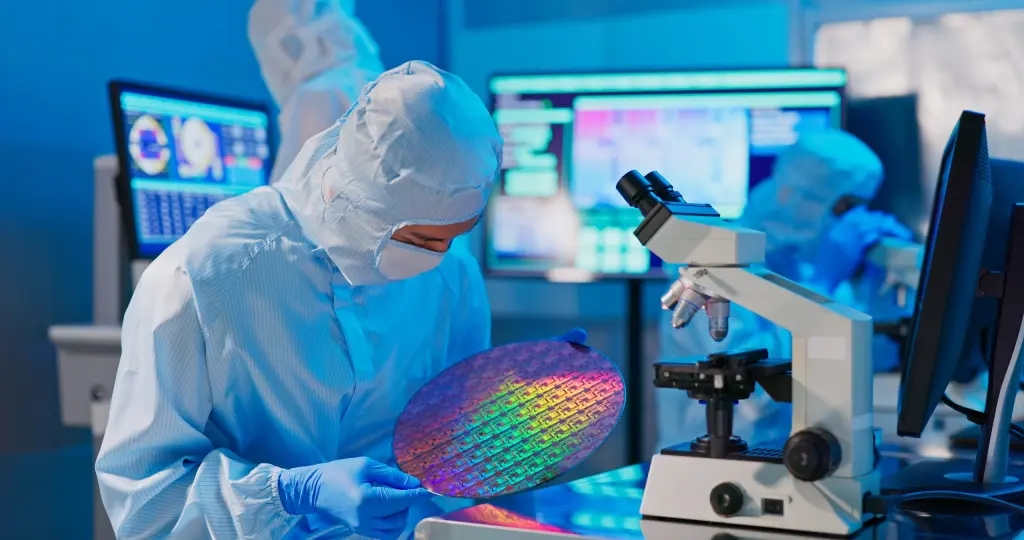
The effects of US tech sanctions are most visible in the semiconductor industry. / Photo credit Shutterstock
Along with the visits, the US is also toning down its rhetoric. Discussions about the technological decoupling of the world’s two largest economies have been changed to a narrative focused on “de-risking,” Vivek Mishra, a fellow with the Observer Research Foundation’s Strategic Studies Programme, tells Tech in Asia.
Mishra said this means the US will likely focus its restrictions “on a very limited strata of high-end technologies and not spread the sanctions across a whole range of technologies.”
Biden’s gambit
After four years of broad sanctions against China by former US President Donald Trump, observers had expected that US President Joe Biden would roll back some of these measures after his election.
But Biden instead doubled down. On June 7, 2021, he signed Executive Order 14032, which marked a significant change in the US policy toward China.
Instead of the broad sanctions of the Trump era, the Biden administration began using sanctions to target China’s growing tech economy. It claimed that the restrictions – which appear to target everything from social media to drones and semiconductors – were aimed at limiting the technological prowess of the country’s military.
The order was also noted for its broad reach within the US. It prohibited “a United States person” – which includes US resident aliens – from owning or investing in anything that operates in the “surveillance technology sector of the economy” of China.
These restrictions are already having an impact. They are believed to have influenced Sequoia Capital’s decision to break up the company into three separate entities.
The US Congress is also investigating investments made by four US venture capital firms – including Qualcomm Ventures – into Chinese tech companies.
As of March 2023, the US Treasury Department’s Office of Foreign Assets Control has placed export restrictions on 479 Chinese companies. The list of banned businesses includes those operating in the aerospace and aviation, software, hardware, oil and gas, railway construction, satellite, ship building, semiconductor, and telecommunications sectors.
Economics or surveillance?
Analysts argue that the US has another motivation for issuing these sanctions, namely protecting its own interests. A technologically dominant China could challenge the US in both business and in foreign affairs.
Escalating battle over semiconductors
The rise of chiplets
China’s trump card
De-risking versus decoupling
The effects in Southeast Asia
Stay ahead in Asia’s tech landscape
This is premium content. Subscribe to read the full story.
The US and China may be backing down from a full “decoupling,” but fights over chip production and supply chains still threaten the tech industry.
We know this is not ideal. ⌛ Sign up in 20 seconds. Cancel anytime.
Our subscriber community includes professionals from these companies:





Stay updated on the go with our mobile app.
Get latest insights with smoother, more personalized experience through TIA mobile app.










📅 Upcoming Events
22 October 2026
Payoneer x CSPN Summit 2026