- Insights This article was written by a TIA community member. Insights pieces undergo the same rigorous editorial process that newsroom-produced articles have.
 Jay Kim · · 6 min read
The fintech firm that wants to bring cross-border payments into the future
This article is from an episode on The Jay Kim Show. It’s heavily revised from the original show transcript. For the full interview, go here.
I was recently invited to attend Ripple’s annual conference, Swell, which was held in Singapore this year. Ripple is a US-based fintech company whose main goal is to enable banks and financial institutions to easily send money across the globe by leveraging blockchain technology.
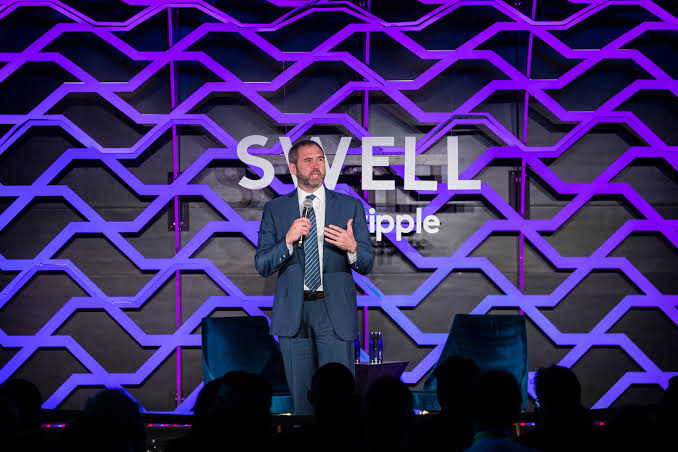
Ripple CEO Brad Garlinghouse / Photo credit: Ripple
I was able to interview Brad Garlinghouse, the CEO of Ripple. He gives us a solid background of the current banking system, an overview of Ripple’s business model, and the big problem that Ripple is trying to solve. Prior to Ripple, Brad held various senior executive positions at Hightail, AOL, and Yahoo.
Let’s get some background on you quickly for people out there that don’t know who you are.
I grew up in the United States in Kansas and went to the University of Kansas. I have always gravitated toward technology. My dad bought us a TRS-80 computer – some of your listeners will know what that is, but most won’t. I got exposed to computing and programming at a very early age, and it stuck with me.
So I spent part of my career on the infrastructure doing network stuff – telco, coaxial cable stuff – but I ended up at Ripple. In large part, I’ve always gravitated toward the leading edge, and at times, the bleeding-edge areas I thought could in some way change the world.
But, for me, blockchain represents a 10- or 20-year evolution, where I think it’s going to impact more industries and in more ways. That’s why I wanted to get involved with it.
Let’s hear the one-liner, elevator pitch if you will: What is Ripple as a company, and what problem are you trying to solve?
Ripple is a software company selling software to banks. The tech stack we use includes both an open-source digital asset called XRP, as well as some product on-ramps and off-ramps – they’re proprietary blockchain capabilities that allow for banks to do real-time settlement.
So today, as many are familiar, cross-border financial transactions – whether it’s remittances or corporate – they tend to be very slow and very expensive. Since the beginning of Ripple, we have talked about the idea of an “internet of value.” How do we let value move the way information moves today?
One of our panelists here at the Swell conference made this comment: “We put a man on the moon. We found water on Mars, yet you can’t send a wire on Sunday.”
It’s pretty crazy that our global financial infrastructure is four to five decades old in terms of how it operates – air rate, speed, costs – and we think it’s time to bring that to a modern infrastructure.
Were the founders of Ripple from the payment industry? How would they even look to overturn the stone and say, “OK, this needs disruption”?





Stay updated on the go with our mobile app.
Get latest insights with smoother, more personalized experience through TIA mobile app.