- Insights This article was written by a TIA community member. Insights pieces undergo the same rigorous editorial process that newsroom-produced articles have.
 Santanu Mitra · · 5 min read
Why it may be hard for e-wallets in Indonesia to transform into super apps
This article was co-authored by Sachin Mittal.
E-wallets are booming in Indonesia. Transaction values rose by over 200% in 2019, and the country is home to almost 50 digital wallet players vying for customers.
Even neighborhood mom and pop shops – known locally as warungs – accept e-wallet payments due to the negligible transaction fees as compared to credit cards, which have a penetration rate of less than 5% in Indonesia.
Given this, it might be easy to think that operating e-wallets in the country is a very lucrative business. But that’s not really the case: Customer and merchant acquisition costs are quite high in Indonesia, while customer loyalty remains low.
On top of this, the country’s central bank is likely to impose fixed transaction fees for e-wallets at just 0.7%. This does not look favorable when compared to China, where transaction fees are fixed at roughly 0.5% in a two-player market with no intermediaries.
Indonesia’s e-wallet market is more fragmented and even with a higher fixed transaction fee, it will be split among many parties: operators, payment processors, and a consortium of major Indonesian lenders. For us at DBS Bank, digital wallet players are likely to keep burning cash for a few years.
Outlook for e-wallets over the next five years
Breaking the bank will be the norm across the industry in the near to medium term. While we project e-wallet transaction value to rise fivefold to US$50 billion by 2025, many players will face a severe cash burn.
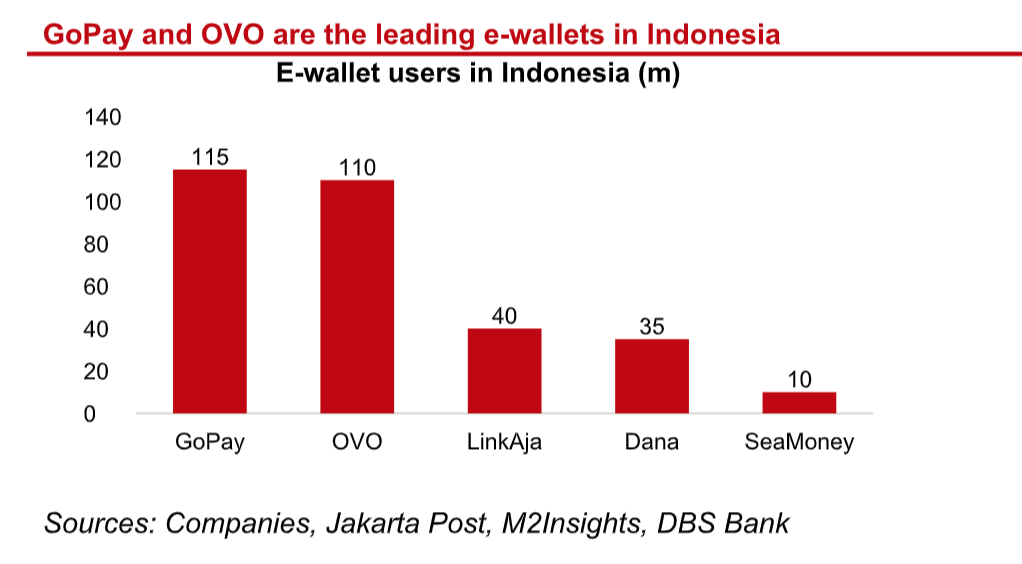
Take SeaMoney, for example. The digital payments provider incurs a loss of almost US$10 per user on US$3 revenues due to heavy promotions. Meanwhile, Indonesia-based Ovo is said to be merging with Dana in a bid to solidify its no. 1 position, while LinkAja has joined Gojek’s ecosystem. Clearly, both Ovo and GoPay are jostling to extend their lead over other players.
But if profit is not the driver, then what is fueling the frenzy for e-wallets?
Transaction fees are just the low-hanging fruit. The real aim of an e-wallet is often to transform into a super app – a one-stop place for e-payments, ecommerce, ride-hailing, food delivery, and other services.
In China, WeChat and Alibaba showed that this model is possible. Naver in Korea and Line in Japan are also hailed as super apps in the making.
However, if an e-wallet isn’t interested in becoming a super app, it may also expand into offering various financial services with a bigger profit pool. These services may range from providing quick loans to wealth management products in the future.
Who could emerge as an e-wallet winner in Indonesia?
GoPay is numero uno in terms of number of users. Being integrated into the Gojek app, it also benefits from access to the ride-hailing and food delivery verticals, among others.
The battle for the super-app crown has intensified, but will a super app emerge?
Conclusion





Stay updated on the go with our mobile app.
Get latest insights with smoother, more personalized experience through TIA mobile app.