Li Tao · · 5 min read
China’s Greater Bay Area still has hurdles to clear to become a Silicon Valley challenger
The “Greater Bay Area,” touted as China’s answer to Silicon Valley, may serve as a symbol of China’s determination to match US technological might. But a shortage of top-notch talent and schools, along with the simmering trade war between the US and China, have clouded its prospects in the short term, according to analysts.
Beijing wants this proposed integrated area, which links nine cities in Guangdong province – including Shenzhen and Guangzhou – with the Hong Kong and Macau special administrative regions, to become an economic powerhouse that can match any other technology hub on the planet. This may take time, though.

An aerial view of Guangzhou, China / Photo credit: Pexels
The detailed bay area plan, released by state-owned press agency Xinhua on Monday evening, vows to develop an international innovation and technology hub.
That will leverage the region’s scientific research and development capabilities, which includes a number of universities, research institutes, high-tech enterprises, and national science programmes, according to the plan.
It said China aims for the bay area to deepen high-tech cooperation between Guangdong province, Hong Kong and Macau by pooling resources and promoting policies that foster innovation. In addition, the bay area will focus on improving the commercial application of new technological achievements and becoming a major source of emerging industries.
“Whether China’s technological ambition can be realized will largely depend on investment in basic research,” said Ouyang Liangyi, an associate professor at Peking University HSBC Business School. “Most of China’s technological innovations are application-oriented, which needs support from foreign suppliers, in areas such as chips … the development of the underlying technology is decided by the entire environment, not something that the Great Bay Area alone can change.”
The country has been trying to reduce its dependency on imported technology by developing its own. Beijing’s “Made in China 2025” program is explicitly aimed at lifting the country’s industries – from robotics and aerospace to new materials and new energy vehicles – up the value chain, replacing imports with local products and building global champions able to take on Western tech giants in cutting-edge technologies.
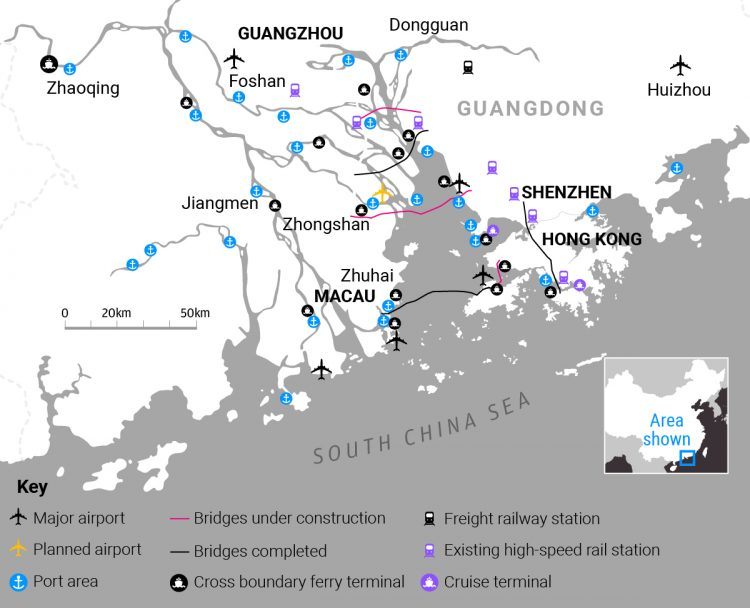
A map of China’s Greater Bay Area / Photo credit: South China Morning Post
Although the bay area was officially announced by Chinese Premier Li Keqiang in March 2017, the Pearl River Delta region in southern China has been the focus of reforms over the past four decades. Shenzhen is now a well-established electronics manufacturing zone and home to several of China’s most famous tech names, such as Huawei Technologies, Tencent Holdings, ZTE Corp, drone-maker SZ DJI Technology, and battery and electric vehicle maker BYD Co.
Shenzhen, once a small fishing village with a population of around 300,000, benefited from liberalization under paramount leader Deng Xiaoping. Today, it has grown into a city of around 12 million people known for its spirit of entrepreneurship and innovation. Many of the city’s talented engineers are products of apprenticeship programs under which students learn the necessary skills from a mentor before becoming owners or vendors themselves in the popular Huaqiangbei electronics market, where hundreds of stalls sell electronic products.
The bay area’s formation is aimed at erasing barriers between cities in the region in areas such as policy, financing, logistics, and talent, and greatly enhancing the overall technology focus of the region, said Witman Hung, principal liaison officer for the Hong Kong, Shenzhen Qianhai Authority, which facilitates cooperation between the two cities.
“The Greater Bay Area is meant to work as an integrated value chain,” said Hung. “In the future, research results from a Hong Kong lab will be made into a prototype by a Shenzhen company and sent back to Hong Kong for the design. Factories in Dongguan will then start production, and the products will be shipped overseas immediately.”





Stay updated on the go with our mobile app.
Get latest insights with smoother, more personalized experience through TIA mobile app.