 Sumit Chakraberty · · 7 min read
Lab to oilfield: how student entrepreneurs hooked the world’s largest refinery
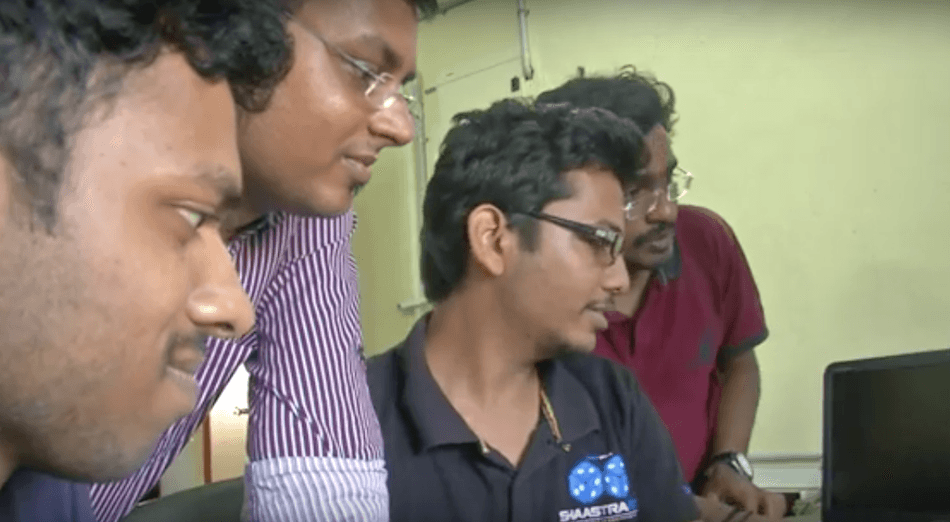
The young entrepreneurs of Detect. Photo credit: Detect.
It was a winter afternoon, but scorching hot for this bunch of students perched on a scaffold an arm’s length from an elevated pipe in an oil refinery. The pipe radiates heat as the processed oil flowing through it can be over 300 degrees Celsius.
The students were from premier engineering college IIT Madras in south India. They had made sensors out of a patent-pending material that can withstand temperatures up to 350 degrees C. Attached to oil pipelines, these internet-enabled devices use ultrasonic signals to measure the pipe’s thickness and hence, the degree of corrosion. The signals can be constantly monitored and analyzed on the cloud in real time for pipe replacement alerts.
Pitching to a large corporation when you’re a bunch of 22-year-olds is difficult.
Daniel Raj David, leading the student group, was exhausted. He needed a chilled drink but that meant a trek through the refinery for a kilometer and back. He decided to give it another ten minutes to see if the system would finally work in the field like it did in the lab.
They had spent the day attaching the sensors and monitoring their signals in an oscillograph on the scaffold. The signals, plotted like a heart rate chart, hadn’t looked right – just as in previous trials during a frustrating nine months of field testing. They had had to find better vendors when the connectors for the sensors melted, even though they were supposed to be heat-proof. Vibrations from loose fittings had interfered with the signals. Then the cables relaying the sensor signals had turned out to be faulty.
This time they thought they had got everything sorted, but the signals were still not right. On the verge of calling it a day, David recalls seeing the machine turned off and snapping at his friend Harikrishnan. “Dude, switch it on, what are you doing?” David told him. “He switches it on … and we saw the most beautiful signal, like we would see in the lab. Hari was almost in tears… It was a life-changing moment.”
Ready to conquer the world
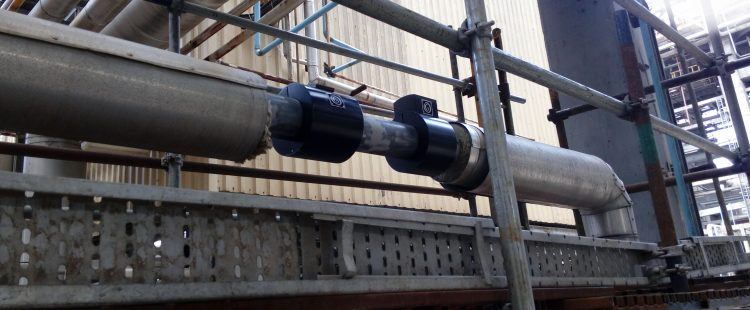
Detect sensors attached to oil pipelines. Photo credit: Detect.
That was in January. Months of validation followed to make sure it wasn’t a one-off. Now the student startup, Detect Technologies, is negotiating orders to deploy thousands of its sensors at the world’s largest oil refinery in Jamnagar, Gujarat, operated by India’s biggest private corporation, Reliance Industries, as well as other public sector oil and gas corporations.
The startup, incorporated last year, was incubated in IIT Madras and supported with a grant of US$7,780, followed by a loan of the same amount. This year, it was in the summer cohort of Bangalore accelerator Axilor. Now, with the product validated, it’s time to scale up.
Today, it announced seed funding of an undisclosed amount from AJ Ventures of the Refex Group, Keiretsu Forum, Axilor, and the Centre for Innovation, Incubation, and Entrepreneurship of the Indian Institute of Management, Ahmedabad. The funding will help streamline manufacturing for big orders. Once the sensors are up and running on a large scale in Reliance and other refineries in India, the hope is that global corporations like Chevron and Shell will be interested too.
See: Traveloka reveals $500m fundraise; Expedia, Sequoia, JD among new investors
The problem of overcoming high temperatures for testing oil and gas pipelines while they’re in operation is a long-standing one, David explains. The practice is to shut the refinery down for a 45-day period once every two or three years for manual checks and pipe replacement. This means millions of dollars lost in downtime. Besides, there’s the risk of a blowout in the intervening time when the refinery is running and the pipes are not under real-time monitoring.
Arduous journey from lab to field
The drones that kept them going





Stay updated on the go with our mobile app.
Get latest insights with smoother, more personalized experience through TIA mobile app.









📅 Upcoming Events
22 October 2026
Payoneer x CSPN Summit 2026