Terence Lee · · 3 min read
Entrepreneurial society not needed for strong startup culture, says Saul Singer, author of Start-up Nation
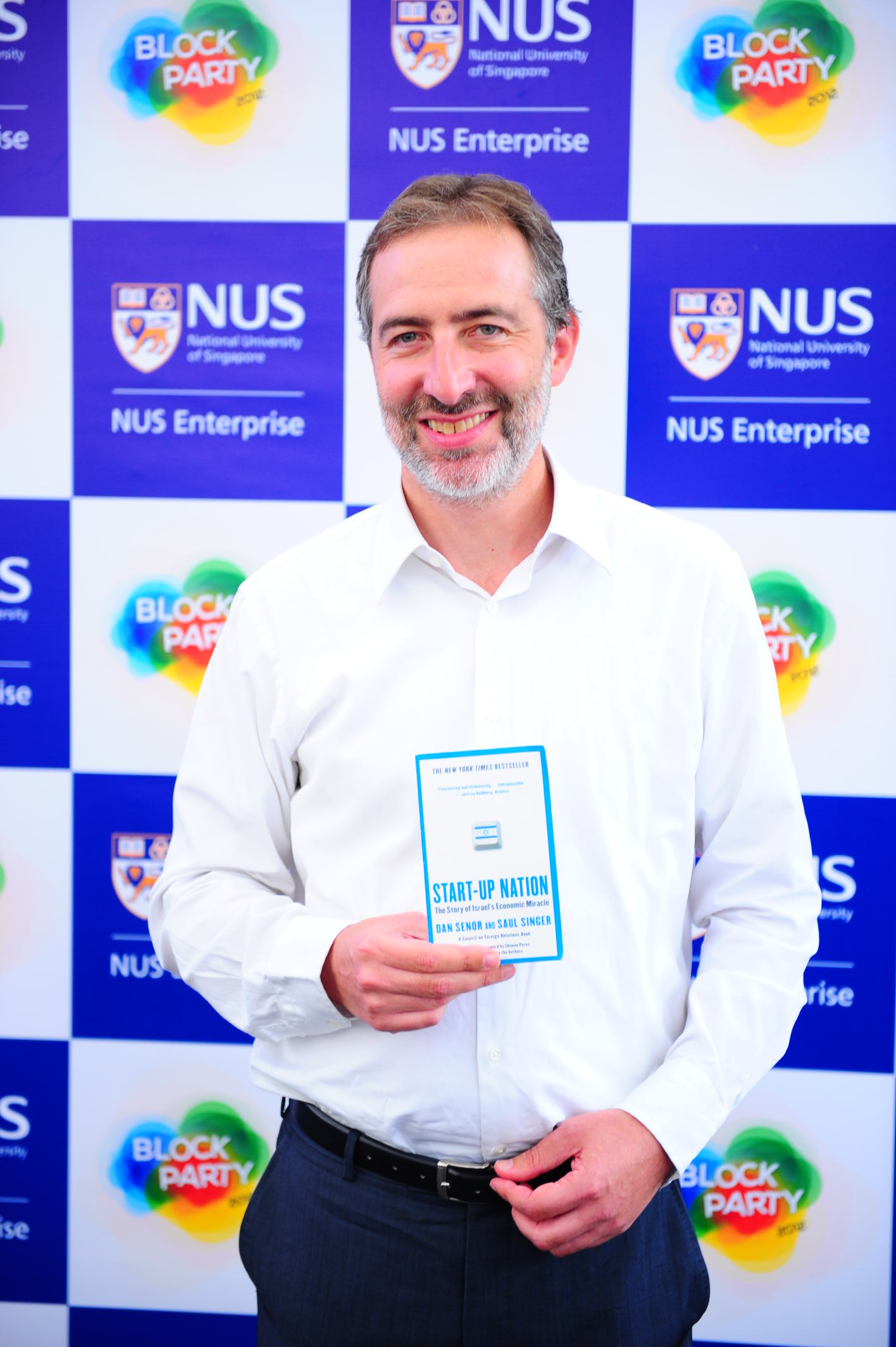
Saul Singer, author of Start-up Nation, checked out a block party held at Block 71 recently. Photo: NUS Enterprise
Saul Singer, in his critically acclaimed book, Start-up Nation, describes Israel as a top entrepreneurial nation with the most tech startups per capita than any other country in the world.
Yet in his visit to Singapore, Saul emphasized that a startup nation is the result of a strong subculture of entrepreneurship rather than a country of entrepreneurs.
“You don’t need to change the whole culture,” he said while visiting Plugin@Blk71, a startup incubator space run by NUS Enterprise.
That was certainly the case in Israel, where an estimated 1 out of 1,900 people are in a startup, even if that minority is larger than those of other countries.
Saul then pointed to Silicon Valley’s subculture, where it’s okay to fail and take risks. This is very different from the rest of America.
To build a subculture, physical locations like Block 71 are crucial for Singapore, since entrepreneurs can find validation and support, much like how local entrepreneur Steve Sng, who recently secured funding for LoveByte, tided through his startup’s bootstrapping phase with support from peers.
“Just being around other entrepreneurs is important, since there’s so much peer-to-peer learning, which is sometimes more important than even the mentors,” said Saul.
It is because of peer learning that Saul is advocating for Israeli and Singaporean entrepreneurs to work together more intimately.
He believes Israeli entrepreneurs can learn from Singaporeans on how to be more organized and plan ahead, noting that the Israeli’s impatience and disrespect for hierarchy, while useful helpful in startups, also prevent these companies from becoming the next Apple or Microsoft.
Singapore, on the other hand, can learn from Israel’s strong startup culture and technological excellence.
Saul lamented that Israelis aren’t coming to Asia more because of their singular focus on making it big in the United States. Asia, after all, is where the world’s headed. It’s also a region with the most interesting and pressing problems.
He is currently seeking ways for entrepreneurs from both parts of the world to collaborate more deeply, perhaps even be part of the same startup.
“The way you build startups is to form a team with a group of people who complement one another. But we don’t think this way in terms of countries. Why not combine countries with different strengths? We’re good at certain things, but we’re terrible at all kinds of other things… we need to look at the synergies across countries and innovate together,” he said.





Stay updated on the go with our mobile app.
Get latest insights with smoother, more personalized experience through TIA mobile app.