- Premium Content It takes our newsroom weeks - if not months - to investigate and produce stories for our premium content. You can’t find them anywhere else.
 International Consortium of Investigative Journalists · · 10 min read
Crypto giants moved billions in illegal funds despite crackdown
Editor’s note: The Coin Laundry is a cross-border investigation led by the International Consortium of Investigative Journalists that spanned 10 months of reporting with 37 media partners, including Tech in Asia, in 35 countries. This story was edited for length and clarity, in accordance with TIA’s standards.
When US President Donald Trump pardoned Changpeng Zhao in October, the White House press secretary painted the founder of the world’s largest cryptocurrency exchange as the victim of a political witch hunt.
“The Biden administration’s war on crypto is over,” declared Karoline Leavitt.
Illustration credit: ICIJ
Zhao and his company, Binance, had both pleaded guilty in November 2023 to operating without basic safeguards to prevent money laundering. Authorities alleged that the company authorized transactions bound for “terrorists, cybercriminals, and child abusers.”
Following the pleas, Zhao agreed to step down as CEO, and Binance pledged to change its ways.
Between the guilty pleas and Zhao’s pardon, Binance continued to profit from hundreds of millions of dollars in cryptocurrency transactions linked to some of the world’s most notorious organized crime groups, according to an analysis by the International Consortium of Investigative Journalists (ICIJ).
See also: Binance’s dominance grows in FTX’s absence
While Binance was under the supervision of court-appointed monitors, at least US$408 million worth of digital currency flowed to the company’s accounts from the Huione Group, a Cambodia-based financial firm used by Chinese crime gangs to launder proceeds from human trafficking and industrial-scale scam operations, ICIJ’s analysis showed.
Binance was not the only crypto exchange involved in these transactions. In February, Seychelles-based OKX pleaded guilty in the US to operating as an illegal money transmitter and agreed to retain a court-mandated compliance consultant.
Despite that oversight, customer accounts at OKX continued to receive hundreds of millions of dollars from Huione, including more than US$161 million after the US Treasury Department labeled Huione a “primary money laundering concern” in May, ICIJ found.
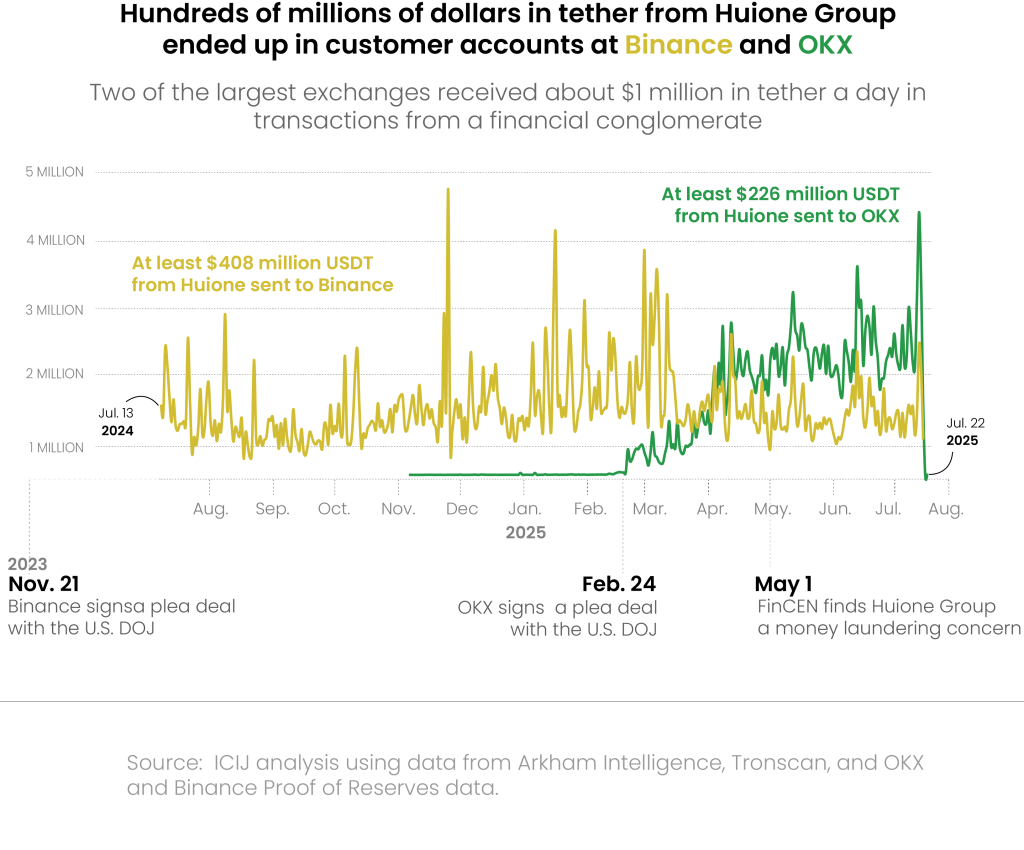
Image credit: ICIJ
“Normally, that halts everything,” said Ross Delston, a lawyer and anti-money laundering specialist. “If the federal government just told you that this entity is a high risk for money laundering or terrorist financing, you’d be crazy to continue any financial dealings with them.”
The investigation
The impact of illegal crypto
The pushback
Limited resources and incentive
Coda
Stay ahead in Asia’s tech landscape
This is premium content. Subscribe to read the full story.
The International Consortium of Investigative Journalists traced thousands of transactions and found major crypto exchanges awash with dirty money.
We know this is not ideal. ⌛ Sign up in 20 seconds. Cancel anytime.
Our subscriber community includes professionals from these companies:





Stay updated on the go with our mobile app.
Get latest insights with smoother, more personalized experience through TIA mobile app.












📅 Upcoming Events
22 October 2026
Payoneer x CSPN Summit 2026