- Insights This article was written by a TIA community member. Insights pieces undergo the same rigorous editorial process that newsroom-produced articles have.
 Nathan Thompson · · 3 min read
Is DeFi about to replace traditional banks?
This article is part of Crypto Insights, a segment by major crypto exchange Bybit that dives into the latest and most pertinent issues in the crypto space.
What can be said about stablecoins that hasn’t already been thrashed out on Twitter or shouted from YouTube soapboxes? Tell us something new, I hear you say.
Well, I might have something for you.
Greybeard investors have an investment thesis: Think 18 months ahead. So let’s imagine the bear market has subsided, the Federal Reserve has pivoted, and the crypto market is surging once again.
Obviously, there are numerous scenarios describing how crypto might evolve. But Andy Singleton, founder of blockchain financial services firm Maxos, makes a compelling case for the integration of centralized finance (CeFi) and decentralized finance (DeFi) being a prime mover of the next bull market. He argues that to date, DeFi has mainly powered other crypto projects, with limited impact on wider society.

Photo credit: max_carpenter / 123RF
This is an important point – if DeFi is to thrive and fulfill its true potential, it must compete with traditional banking. Say what you want about traditional banks, but they do invest in assets that are productive for society, such as loans for small businesses and mortgages for would-be homeowners. As such, they ultimately provide a public service.
“Crypto speculation is a small market with limited social benefit,” writes Singleton. “DeFi should support the real economy. [A] new decentralized banking architecture [will] take on the difficult task of funding ‘real-world assets’ – off-chain loans and investments.”
To expand on this idea, the process we are looking for as DeFi matures is an evolution from being inwardly focused on funding Web3 projects to becoming a finance provider for more real-world operations. And DeFi has a number of unique features that give it an advantage over CeFi when it comes to fulfilling this role.
For example, DeFi can draw on a much wider pool of liquidity – be it a Laotian shop owner or a Tel Aviv family office – and connect these “savers” with “borrowers.” By using smart contracts that hold collateral, the loans are backed and secured trustlessly, without the need for expensive intermediaries to enable the process.
Furthermore, decentralized banks run on smart contracts and can tap into capital from a diverse set of providers. And with fewer overheads, DeFi protocols can undercut their traditional rivals in terms of fees and rewards.
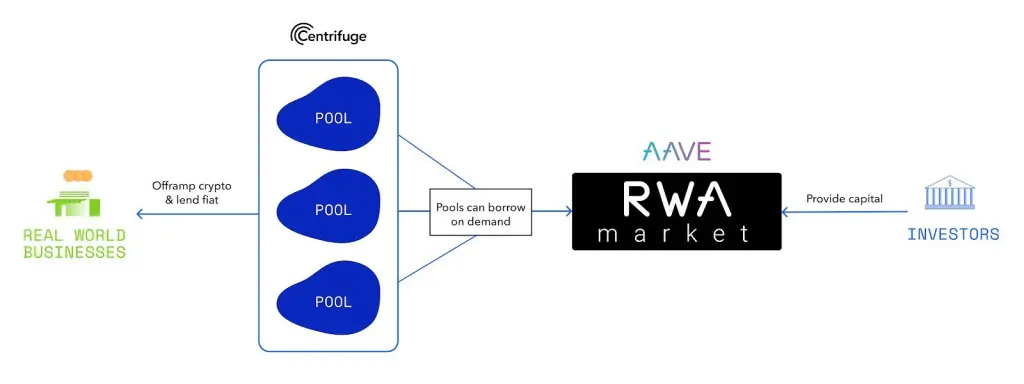
Two protocols that are making moves in this area are Aave and Centrifuge. In late 2021, they teamed up to launch the Real World Asset (RWA) market on Aave.
The architecture is similar to other projects that seek to link CeFi and DeFi. Aave is a lending protocol that allows users to take out loans by depositing collateral, which earns yield. Interest rates on the loan depend on the utilization of the market.





Stay updated on the go with our mobile app.
Get latest insights with smoother, more personalized experience through TIA mobile app.