 Kaya Domingo · · 6 min read
How this startup aims to drive sustainable finance in Asia

When investors look at where to put their money, high returns isn’t the only element they’re concerned with. Environmental, social, and governance (ESG) factors rank high on the list of priorities, and sustainable finance is also on the rise as institutions move to meet the demands of customers for greener and cleaner investments.
“One of the most important things for the finance industry today is ESG finance and making sure that the finance sector is more sustainable and has greener services,” says Benjamin Soh, co-founder and managing director of fintech firm Stacs.

Benjamin Soh, co-founder and managing director of Stacs / Photo credit: Stacs
However, the ESG sector is currently disparate and disjointed, with a plethora of different certifications and metrics involved.
That’s where Stacs makes a difference. It offers solutions for financial institutions that enable them to digitalize their services and engage in more sustainable practices.
Driving sustainable finance in Asia
When Stacs first launched in 2019, it initially focused on providing digital technologies to the financial sector – an industry that has long struggled with outdated legacy infrastructure.
However, after conversations with over 200 financial institutions, Soh and his team realized that, alongside digitalization, what the finance sector needed was something to help drive sustainability efforts.
When combined, the use of new digital tools like automation and smart contracts as well as a greater focus on ESG metrics can help drive a low-carbon economy.
“Problems surrounding green finance are actually time-sensitive, as it involves racing against climate change,” says Soh. “Part of what we want to achieve is to make sure we find a product that solves a problem – and ESG is a large problem – which is why we moved our efforts toward tackling this.”
Stacs helps financial institutions and companies of all sizes achieve their ESG goals through two layers: ESGpedia, which is its registry of holistic ESG certifications and data across various sectors and verified global sources, and its range of digital tools, such as end-to-end smart contract platform Vetta.
ESGpedia supports effective ESG finance by simplifying access to ESG data, as well as aggregating, recording, and maintaining such information on a single registry. As for Vetta, it brings together three core areas of finance in a single platform: ESG finance, asset and wealth management, and end-to-end digital security.
Stacs also uses blockchain technology to make sure all its solutions are secure and that they’re easy for users to access.
“Many companies need to track their suppliers to make sure that their supply chain is as ‘clean’ as it can get,” says Soh. “There are a lot of problems right now with the lack of quality ESG data, which is where we come in.”
Tapping on open innovation to open doors
While Stacs developed effective products to tackle the challenges involved with digitalization and sustainability in finance, it had trouble getting a seat at the table with large financial institutions, as it was a small startup in its early days. According to Soh, it was difficult to convince banks and legacy players that Stacs had a strong, credible product to offer.
However, doors started to open for the firm after its participation in the Infocomm Media Development Authority’s (IMDA) Open Innovation Platform (OIP).
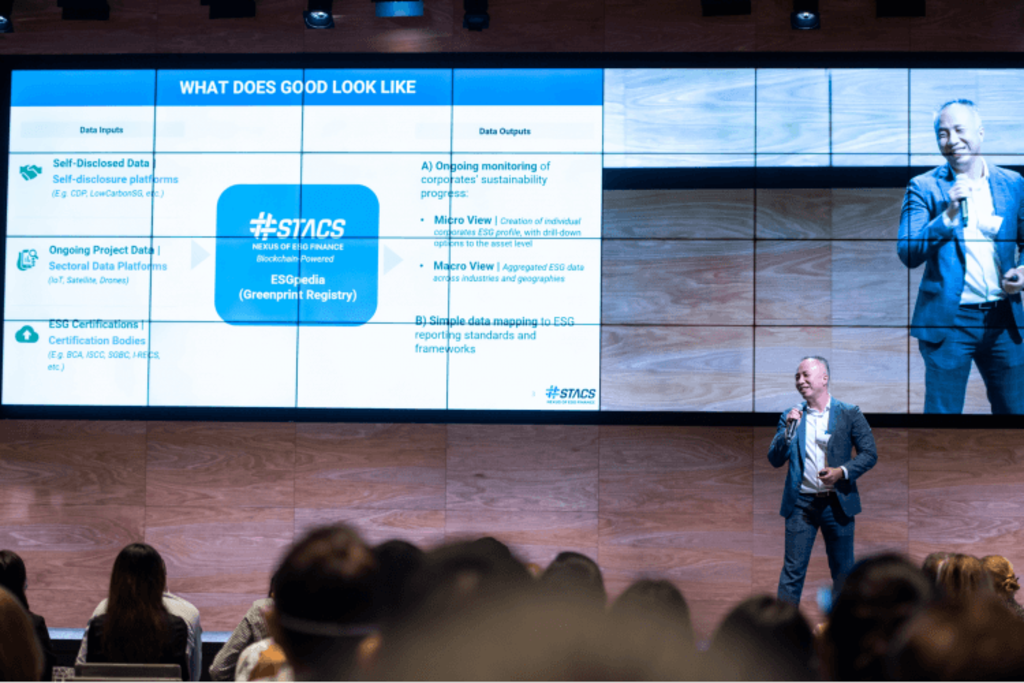
Soh at the launch of ESGpedia, which powers the ESG Registry of the Monetary Authority of Singapore’s Project Greenprint / Photo credit: Stacs
IMDA OIP connects firms that offer innovative tech solutions with businesses that can best benefit from their products and services.
The platform helps corporations diagnose their business challenges, refine them into problem statements, and crowdsource for solutions and evaluate proposals. It also facilitates discussions between the parties involved and creates a level playing field for smaller firms helping them seize opportunities and gain new customers.
Through the platform, Stacs was able to help two fund managers, Fidelity Investments and CSOP Asset Management, respond to some of their pain points.
“When we saw the problem statements from the OIP, we felt they were directly relevant to what we do at Stacs. We knew that we could solve those problems and definitely wanted to participate,” says Soh.
Fidelity Investments, for one, had issues tracking and monitoring the sustainability data of its portfolio companies, which was important as sustainable finance gained steam with consumers. With ESG certification and data often scattered throughout different databases, it was difficult for Fidelity to keep tabs on all the information.
CSOP, meanwhile, wanted to streamline the processes of over-the-counter (OTC) trades, which were still being reconciled with brokers via email and increasing the risk of costly errors.
Stacs’ solutions helped to address these gaps. Fidelity was able to gather data from ESGpedia and gain a bird’s-eye view of how the companies it invests in are faring on the ESG front. Stacs also built an interface for the fund manager to access this data, integrating it into the firm’s existing processes.
For CSOP, it was able to tap into Stacs’ existing trade processing solutions to automate its OTC trades.
According to Soh, OIP guided Stacs at every step of the process, helping it manage project timelines and offering resources to further elevate the startup’s capabilities. This included a complimentary, digital storytelling consultancy from Pixel, IMDA’s corporate innovation space, to improve the way the company pitched its solutions to clients as well as a UI/UX consultant to ensure its products were optimized for end users.
“All that the OIP team offered proved extremely useful for us and allowing us to continue to build and evolve the product and scale it up to other users,” says Soh.
Having Fidelity and CSOP as clients has also added credibility to the Stacs name and has created opportunities for it to bring more customers on board and strike up global partnerships with banks, asset managers, exchanges, corporations, and SMEs.
The firm has also partnered with the Monetary Authority of Singapore (MAS) on Project Greenprint, a collection of initiatives that aims to harness technology and data to enable a more transparent and efficient ESG ecosystem in the finance sector.
Being a “Bloomberg” for ESG
While Stacs has come far since it first started out, Soh has much bigger ambitions for the company.
In the short term, Stacs looks forward to acquiring and showcasing more successful use cases of its solutions across both the financial and non-financial sectors.
For example, the firm has already begun working with businesses in various sectors, such as hospitality and logistics, to help them effectively manage their sustainability goals and receive the relevant sustainability-related financial services from financial institutions.
In the longer term, the firm aims to scale up its regional expansion to bring its ESG services to other markets in Asia.
Ultimately, Soh’s goal for Stacs is for the company to become top-of-mind for those on the lookout for ESG solutions.
“Just like how you look to Bloomberg for stocks, we want people to look to us for ESG data,” he says. “We want to be the go-to platform, the nexus for ESG finance use cases.”
The IMDA Open Innovation Platform (OIP) matches businesses with tech startups, providing structured, high-touch end-to-end consultancy support. This includes diagnosing business challenges, refining problem statements, crowdsourcing for solutions, evaluating proposals, and setting common key performance indicators.
The OIP has a pool of 12,000 solutions providers, from startups to global technology companies, and has facilitated more than 300 problem statements worth over US$6.2 million in prize money since 2018.
If you’re a startup looking to win key reference customers for your product, sign up to receive the latest updates from the OIP’s quarterly innovation calls here.
This content was produced by Tech in Asia Studios, which connects brands with Asia’s tech community. Learn more about partnering with Tech in Asia Studios.
Stay updated on the go with our mobile app.
Get latest insights with smoother, more personalized experience through TIA mobile app.
Recommended reads
 ASEAN gets a tailored risk tracking tool
 This system is tackling Indonesia’s $422m payment fraud
 Why defense tech isn’t a typical startup game
 Why Index Ventures warns against mid-sized M&A deals
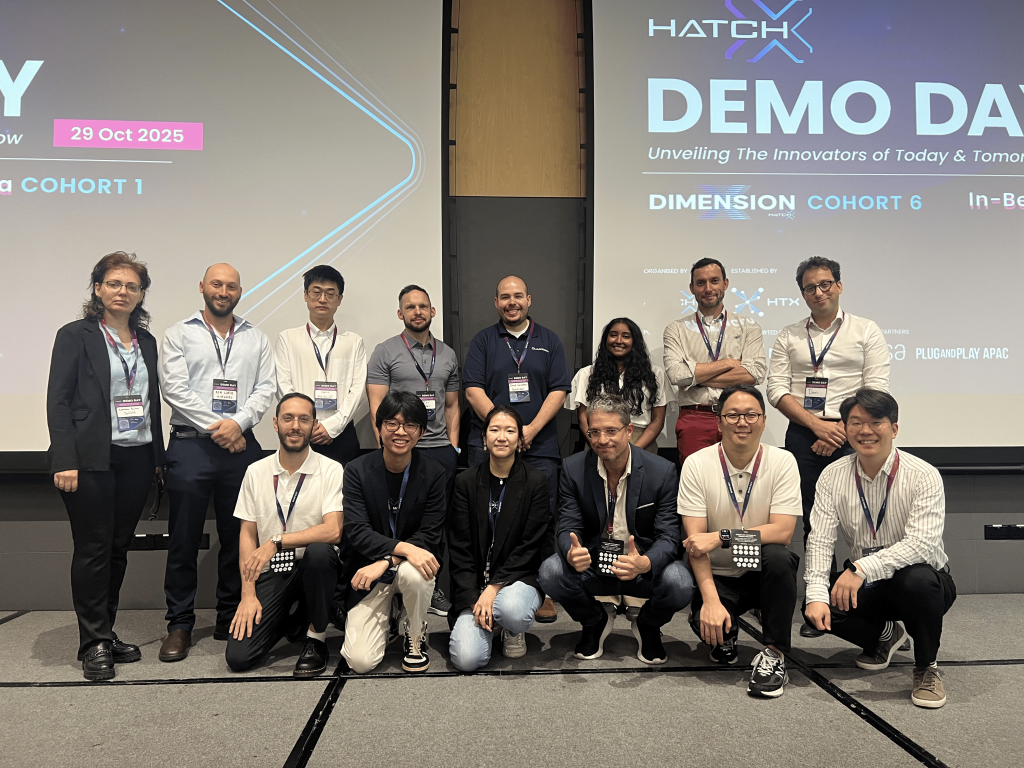 Hatch’s new playbook for rapid innovation with cutting-edge tech
 The 99% AI traffic threat (and how business survives)
 AI meets its newest constraint: war
 Banks crash wealthtech’s investing party
 Why we need tech for public safety now more than ever
 Batam’s data center boom is just getting started, with caveats




Editing by Stefanie Yeo, Winston Zhang, and Jaclyn Tiu
(And yes, we’re serious about ethics and transparency. More information here.)




