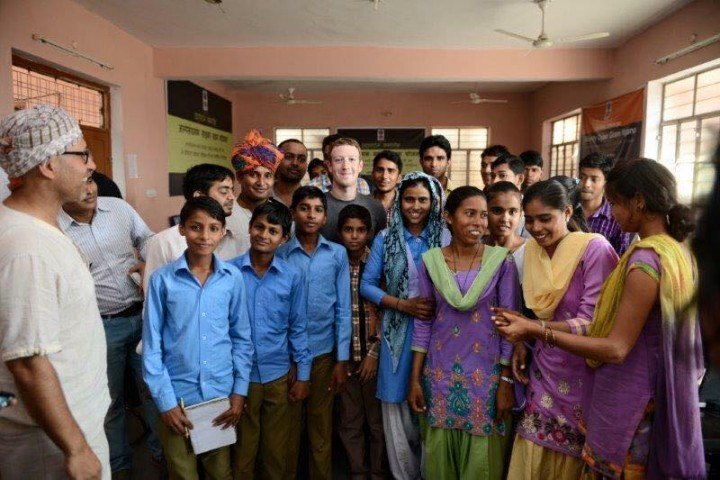
Mark Zuckerberg during the launch of Internet.org, the precursor to Free Basics, in India. Photo credit: Facebook.
The Telecom Regulatory Authority of India (TRAI) today ruled in favor of net neutrality, explaining that no service provider should have the right to charge different prices for data services based on content.
While the latest release isn’t only directed at Facebook, Mark Zuckerberg’s aggressive attempt at providing what he calls “free internet” to India has definitely gotten the TRAI to work a little faster.
The TRAI will charge US$735 for each day that a service provider goes against the ruling. This fine will be implemented after six months, and the newly passed regulation will be reviewed after two years.
A long and winding road
Earlier this year, the TRAI launched a templated consultation paper in order to figure out whether people supported the scheme or not. In response, Facebook released – rather tone deaf, in my opinion – full page ads promoting Free Basics, reportedly spending over US$50 million on the campaign. While the TRAI slammed its heavy handed efforts at winning votes, Facebook’s efforts seemed to have paid off at the time, with an overwhelming 80 percent of responses supporting the dissolution of net neutrality. However, critics observed that the majority of responses came from two domains: @supportfreebasics.in and @facebookmail.
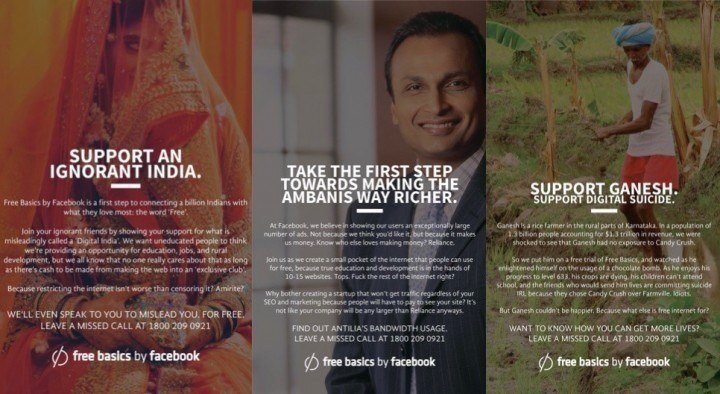
Reddit makes fun of Facebook’s Free Basics ad campaign. Photo credit: Reddit
Others have also chimed in to criticize the campaign, with some of the country’s top academics creating a joint statement to voice their opinions.
See: Disconnect: Mark Zuckerberg is trying to hoodwink India
Net neutrality is not new news
Although it has only recently caught the public eye, the net neutrality debate has been around in India for a while. Before Free Basics existed, “Internet.org,” Zuckerberg’s original campaign to get India online (er, on Facebook) was introduced as an altruistic act. In late 2014, he announced the launch of a US$1 million fund for apps to work with the Internet.org initiative. Soon enough, dissenting voices appeared, pinning Internet.org as a “poor internet for poor people.” The “Save the Internet” campaign got tons of responses, with some sources claiming that it was the most that any petition in India had ever received.
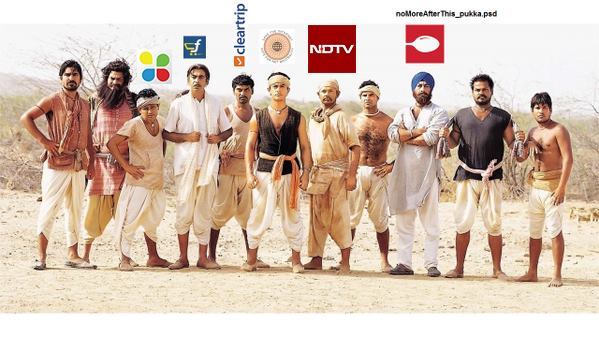
A poster made by net neutrality campaigners in India.
Even before that, Indian telco Airtel came out with a plan to charge users differently (read: more) for data when they made calls over the internet using certain apps.
Perhaps if Zuckerberg hadn’t been so aggressive with his campaign, the fight would not have been this messy and there would still be wiggle room for companies to figure out a way to make more money off data usage.





Stay updated on the go with our mobile app.
Get latest insights with smoother, more personalized experience through TIA mobile app.