 Terence Lee · · 7 min read
How Dailyhunt became one of the top news apps in the world
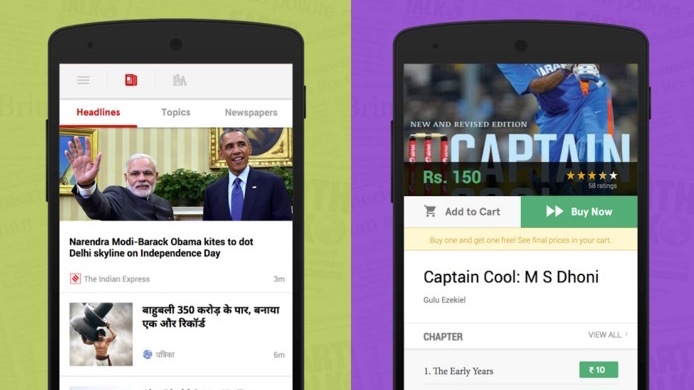
Virendra Gupta, the founder and CEO of Verse Innovation, doesn’t get much sleep. “There’s not a single boring day,” he says as we meet in his office in Bangalore.
But when he does get some shut-eye, he’s probably smiling. Dailyhunt, a Flipboard-like news aggregation app targeted at Indians, is firing on all cylinders. Its growth, ever since it was acquired by Virendra’s company, has been astounding:
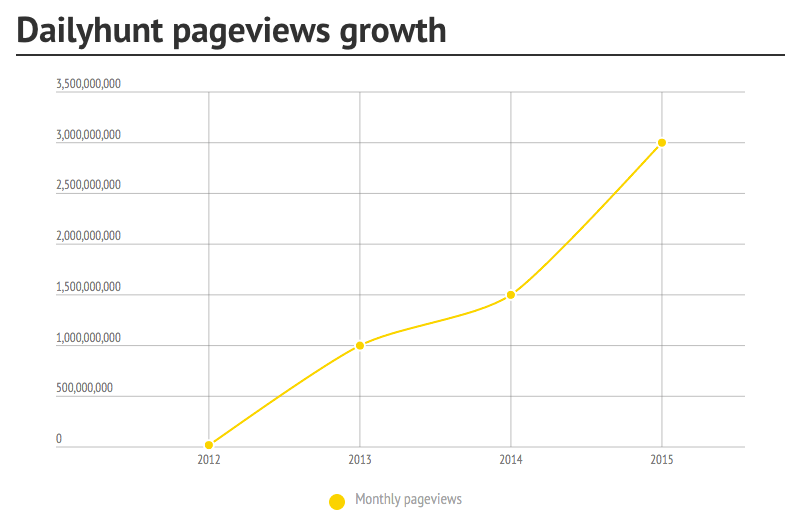
Made with Infogr.am.
Three billion monthly pageviews. And that excludes the home screen. It’s no wonder the Bangalore-based startup raised a US$40.5 million round from illustrious investors like Sequoia Capital and Matrix Partners.
Dailyhunt’s numbers compare favorably with leading news aggregation app Flipboard, which had 2.5 billion monthly pageviews in 2014 but over 80 million monthly active users compared to Dailyhunt’s 22 million.
Dailyhunt has scored well not just among smartphone users in India. At the time of writing, it’s the number one news app in 19 countries, and top ten in five more, according to mobile analytics firm App Annie. These countries range from Asia to the Middle East, South America, and Eastern Europe.
A fortuitous marriage
Formerly called Newshunt, Dailyhunt was created by ex-Nokia employees Umesh Kulkarni and Chandrashekhar Sohoni in 2009. It arose at the right time in the right place, quietly gaining prominence in India as an app on Symbian (the operating system for Nokia phones). It gained 18 million monthly pageviews in two years.

Virendra of Dailyhunt
Around the same time, entrepreneur Virendra Gupta was window shopping. He started Verse in 2007 as a value-added service (VAS) company, an old term referring to mobile services beyond voice calls and fax. Before that, he was an executive in the telco industry for 13 years.
According to Virendra, his experience helped him see where the mobile industry was going. iPhones and Android devices were gaining popularity. Smartphones were getting cheaper, and the app store was taking off, which meant telcos were losing control of the pipe.
Verse would fall off a cliff if it didn’t act. So, Virendra transited his company from business-to-business to business-to-consumer. This means that instead of dealing with telcos, he surmised app stores would become a gold mine, and the best way forward was to directly make money from consumers.
Riding the Android wave
Made for Indians
Its true competitor is… Facebook?





Stay updated on the go with our mobile app.
Get latest insights with smoother, more personalized experience through TIA mobile app.











📅 Upcoming Events
22 October 2026
Payoneer x CSPN Summit 2026