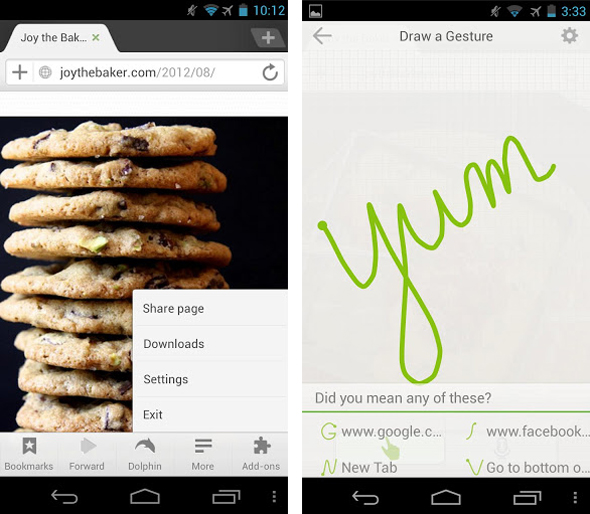
Dolphin Browser, a popular mobile browser with over 50M downloads and more than 10M installs on Android, is looking to Southeast Asia as its next big market. The company is hiring a point person to head the startup’s expansion into the region.
Yongzhi Yang, the founder of Dolphin’s parent company Mobotap and head of marketing Edith Yeung (LinkedIn) have been in Singapore to understand Southeast Asia.
While the browser’s top three countries by installs are the United States, China, and Japan, Dolphin views Southeast Asia as a region of growth due to its combined population of over 500M people who are awakening to the possibilities of the mobile internet.
Founded in 2010, Dolphin is a relatively new player in the internet browser field. Despite its youth, it has distinguished itself with a mobile-oriented interface that partially eliminates the need for typing, as well as an ecosystem of add-ons.
It also succeeded because it bet on Android early, back when developers were skeptical about building for Android. There were only 30,000 offerings on the operating system’s app store then.
But as the company started looking outside the US, localized products that take into account each country’s user behaviors has been a crucial plank of its strategy.
“Understanding user intent is key to what Dolphin does,” says Edith. Dolphin has four customized versions of its browser catering to its top three markets plus South Korea, along with support for 16 languages.
While Americans often know exactly what they are looking for when opening a browser, users in China do not. They see the browser more as a time-killer between transits and a content discovery tool.
As such, the interface of the Chinese version of Dolphin resembles a client-side version of Yahoo! — filled with links to different categories of content.
“It’s useful because people can’t remember URLs as well since English is not their native language,” said Yongzhi.
Meanwhile in Japan, games feature large on Dolphin’s content strategy. It has partnered with several game developers to port feature phone titles over to HTML5, which can be accessed through the browser.
Besides the level of sophistication in knowing what content is available online, user behavior could also be dictated by their mode of transport.
Americans, Edith points out, drive to work, which could partially explain why they prefer Dolphin’s Siri-like Sonar feature, more so than people in Hong Kong, who tend to commute by train and may not rely as much on a hands-free interface.





Stay updated on the go with our mobile app.
Get latest insights with smoother, more personalized experience through TIA mobile app.