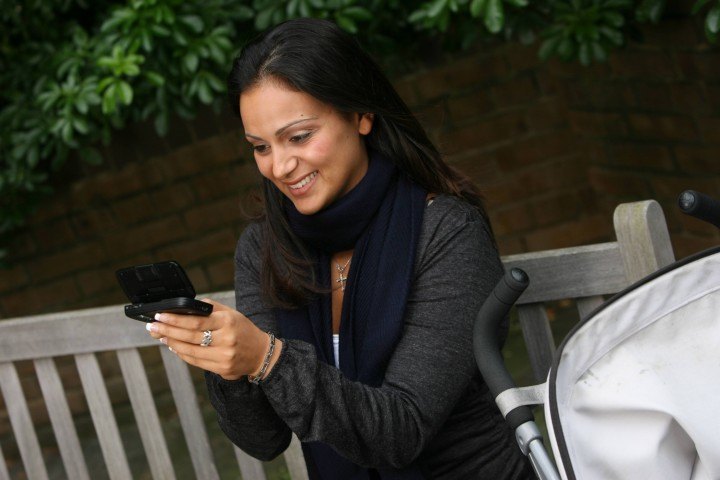
Image source: Flickr
How would you describe your relationship with your mobile? What role does it play in your life?
People posed with this question gave replies like “it is attached to my hip”, “an affordable butler”, “literally my lifeline.” Smartphones, these days, are like little genies.
Have a look at how millennials are using their phones:

Now why is that? Because this little device that we keep by our sides all the time is transforming our lives. We may not notice this transformation actively, but it is happening.
Consider a busy mom. She must find the nearest coffee shop to grab her breakfast on her way to office. She uses her smartphone app to place orders and goes to the store to pick them up, thus saving time.
During lunch hour, she recalls that her son’s school is starting tomorrow and that she needs to locate a store that stocks her son’s shoe size for Nike’s new sneaker range. The busy mom looks for local businesses on Google and quickly gets a pair.
While playing with her son in the evening at the park, she wishes to click a wide-angle picture with her new camera. However, there is no time or desire to go through the voluminous camera manual. So, she quickly searches for a video tutorial on YouTube, follows the steps, and gets the job done.
Introducing micro-moments
Imagine what would have happened if the busy mom in the above example didn’t have a smartphone which could do all those tasks for her. We know the answer – These tasks would have taken the better part of her day.
In all these instants where she used her mobile phone, there were three governing motivations – urgency, intent, and engagement.
Google calls such instants, micro-moments. In the company’s own words,
“Micro-moments are critical touch points within today’s consumer
journey, which when added together, ultimately determine how that
journey ends.”

As per the trends report by Kleiner Perkins, Caufield & Byers, we check our phones 150 times a day. Couple this with another survey’s results from Flurry Analytics showing that we spend 177 minutes each day on our phones, we get that an average mobile session is one minute and 10 seconds long. And this happens dozens of time in one day!

82 percent of smartphone users say they consult their phones on purchases they’re about to make in a store, while 91 percent of them turn to their phones for ideas while in the middle of a task.
What has micro-moments got to do with retail?
Everything!
In the past year alone, websites in the US have seen a 20 percent increase in mobile’s share of online sessions and an 18 percent decrease in time spent per visit.
You might conclude that mobile is unable to help customers locate what they are looking for, when in reality, mobile conversions have jumped by 29 percent in the last year.
So what does that mean? It means that we are not wasting long hours on desktops to make a purchase decision. We are actively and passively researching for our desired product on the go and making informed decisions faster than ever.
A similar phenomenon is taking place at brick and mortar retail stores too. Footfall has decreased, and yet people are spending more. Why? Because when they arrive at the store, they have fully researched their object of desire and arrive to just pick it up.
Needless to say, these micro-moments are the new battleground for brands.
Earning customer’s consideration and action in the era of micro-moments
Relevance and timing of message, as we know, are critical to attracting any customer’s attention.
Let’s take example of Red Roof Inn, a hotel chain. It found a window of opportunity and jumped into that.
The company’s marketing team noticed that more than 90,000 passengers are left stranded every day due to flight cancellations. So, it devised a technique to track flight delays and cancellations in real time and then triggered targeted search ads for all Red Roof Inns near airports. Its message:
“Stranded at the airport? Come stay with us!”
Attacking the “I need a hotel ASAP” moment with the relevant and timely content, they witnessed a 60 percent elevation in bookings.
Three strategies helped the hotel company pull this experience off efficiently:
- Anticipation of need of presence (Be there)
- Relevance of the presence (Be useful)
- Timing of the action (Be quick)
All you have to do is seize the moment.
1. Be there
Why does being there matter? Because most consumers aren’t brand loyal.
Now you may wonder how can consumers not being loyal to any brand help you. The answer is that even though 90 percent aren’t looking for a specific brand, they are looking for a specific product, which you might also happen to have.
This gives you a shot at attracting your competitor’s customers.
- Every third smartphone user has bought from a brand different from the one they intended to because the other company provided necessary information in the moment he needed it.
- 51 percent of smartphone users discover a new brand or product through mobile search.
This means that simply showing up doesn’t only gets you seen. It also gets you chosen. So can we say that a brand in need is a brand indeed?
2. Be useful
Why does being useful matter?
There is one thing that we all know – just being there for the consumer won’t make the cut. We are told that consumers purchased from brands other than those they initially intended to only because the ‘other brand’ gave useful information.
73 percent of people surveyed confessed that receiving useful information from a brand is an integral attribute when shortlisting a brand to purchase from.
Also, it shouldn’t surprise you that being there but not being useful can make your brand face dire consequences.
- 40 percent will not return to your site or app.
- 28 percent will not purchase from you in future.
- 29 percent will immediately jump to another brand.
Don’t just be with the user when he is ready to buy. Be there at all stages of his purchase journey, and this includes four key micro-moments:
- I want to know (the research phase): Provide him with information he can use in a snackable format.
- I want to go (the consideration phase): Show your presence at a physical store near him.
- I want to do (the trial phase): Present him with accurate and comprehensive how-to content.
- I want to buy (the conversion phase): Help him with ideas and information to make his purchase decision more informed and confident, be it on mobile, in store, via a call or across device.
So far, we have discussed how to respond to a consumer when he says, “I want it”, but now we will discuss the next aspect of this statement: “I want it NOW!”
3. Be quick
Being quick matters. You don’t just need to hit the right spot with the right force, you’ve to hit when the iron is red-hot.
Today’s consumers are making decisions faster than ever and for that they need to access to what they need immediately. Let’s face it: This is an era of immediate gratification.
And just like how not being useful leads to undesirable hop-offs, a delay in delivering the required content or creating unnecessary steps to receive it can result in customers switching to other sources.
How to be quick at every micro-moment
Step 1: Remove unnecessary steps
- employ one-click functionality
- keep form fields minimal (up to three)
- use browser autofill settings
- swap type fields to dropdowns
- use progressive profiling
- give multiple payment options
Step 2: Anticipate needs
- keep primary call-to-action in a prominent spot
- hide lesser-used functions under menus
- use smartphones’ GPS functionality to locate the user
- recommend products/ messages based on his past behaviour
Step 3: Increase your loading speed
- just load like lightning
Designing your micro-moment strategy

So you see that mobile is driving activities to other channels too. The journey of the user is no longer limited to one screen or one channel. They are moving seamlessly everywhere and just acknowledging the device or channel where the ‘buy’ button was clicked discredits the roles of all other devices and channels.
Hence, you need to overhaul your marketing strategy and rethink customer touchpoints.
So this is what you should do:
- Take all sales into consideration, and not just mobile sales.
- Monitor activities happening on all channels and screens as part of one big picture.
- When it comes to mobile app, don’t pat your back with just the number of installs. Consider engagement, functionality, and retention too.
Bring all your teams together. Sales, marketing, advertising, UI/UX designing, optimization, customer relationship management, and analytics teams are all now form part of a bigger team: the conversion team.
Segregating them into categories will leave them paralyzed and might even cost you valuable customers.
The right way to nurture your customer in the current times is to be with him at the moment of his need with the relevant content he can make use of. And in all this jiggle, do not forget to put on your supersonic speed shoes.
This article was first published in TargetingMantra
Stay updated on the go with our mobile app.
Get latest insights with smoother, more personalized experience through TIA mobile app.
Recommended reads
 The 2026 Prediction Bingo update: half right, fully accountable
 Turning dramas into carts: Inside Vidio’s ecommerce playbook
 The viral playbook behind my 1m-user AI apps
 Latest AI app swaps influencers for avatars – and brands want in
 Indonesian startup makes TikTok-ready content from a single prompt
 The spark of innovation behind Huawei’s newest consumer products
 Why Google is forcing travel sites to pivot or die
 The Starbucks vs. Luckin debate misses the real winner
 The recipe for viral AI apps
 This 22-year-old turns Notion templates into a thriving business