 Winston Zhang · · 5 min read
How this company is enabling the digital economy’s long-term future

For all the credit that Covid-19 receives for kickstarting the overall move to digital, there were already signs of significant growth in digitalization before then. For example, the e-Conomy SEA 2019 report by Google, Temasek, and Bain & Company forecasted that Southeast Asia’s internet economy would grow to US$300 billion by 2025.
The cloud space grew in 2019 as enterprises changed how they consume technology, leading new and existing applications to move to the cloud, according to Mark Smith, managing director for Asia Pacific at Digital Realty. The company supports the data center needs of organizations.
With Covid-19, that trend has continued and strengthened.
“Everybody started working from home, and we saw a real acceleration in the digital economy. There was a 35% increase in internet bandwidth internationally,” he shares. “The amazing thing is, despite this spike in demand and usage, the digital systems that have been supporting this mass migration didn’t break.”
Driving the digital economy
Smith observes that higher internet usage highlights the essential role of data centers and other infrastructure that support our digital lives, particularly as data is the fuel for the digital economy. These building blocks are an aspect of the digital transformation process that organizations can’t afford to neglect.
“There has been an explosion in the amount of data that’s being created. The challenge for enterprises now lies in how to manage all of this data and therefore how to gain insights and value from this data,” he explains. “They need to rethink how they architect their digital infrastructure, taking into account that data is now the central pillar around which they must build.”

Mark Smith, managing director for Asia Pacific at Digital Realty / Photo credit: Digital Realty
This exponential rise creates an effect known as data gravity, which posits that as data accumulates, there is a higher likelihood that additional services and applications are drawn to it to speed up the process of gaining better insights. As the amount of data and applications using it increase, business processes get more complicated. Ultimately, this hinders an organization’s efforts to transform digitally.
To prevent this buildup in one “location” and the subsequent slowdown of processes, the traditional centralized infrastructure is giving way to a decentralized one, in which data is distributed across different locations, clouds, and networks. This, in turn, means that disparate data clusters need a way to communicate with each other.
“What PlatformDigital does is to connect enterprises to any of the multiple clouds or other facilities they use,” says Smith, referring to Digital Realty’s global data center platform solution. “The hybrid cloud really comes to life within our facilities. We can enable very fast and secure connections, and we can connect them to clouds that might not even be in our buildings. It’s the ecosystem approach.”
Fast connections are key in the digital economy, and they can have a tangible effect on a company’s bottom line. Take the simple example of page load times: 40% of users abandon a website that takes more than three seconds to load. That’s a lot of lost potential conversions.
Or what about autonomous vehicles? If there’s latency and delay in determining whether to stop or go at an intersection, the consequences can be dire.
“Our large global footprint – over 279 data centers around the world in 47 different metros with over 4,000 customers – helps to ensure that the customer experience is consistent around the world,” Smith says. “Additionally, we’ve had clients such as Facebook and Uber who have grown with us, from needing just a few racks to several floors of racks across the world. So we have the experience of growing alongside our clients and working with both small and large enterprises.”
Growing sustainably
Digital Realty sees tremendous growth potential in Asia Pacific, so it continues to invest in the region by establishing a third data center in Singapore – its largest in the city-state.
Known as Digital Loyang II (Sin12), the new center offers end-to-end next-generation colocation services – from a few racks to multi-megawatt deployments – and access to PlatformDigital, a global data centre platform which keeps data secure and allows for scaling on demand. Clients include a major Singaporean multinational banking and financial services corporation, a leading consumer internet company in Southeast Asia, and a global cloud services provider, among others.
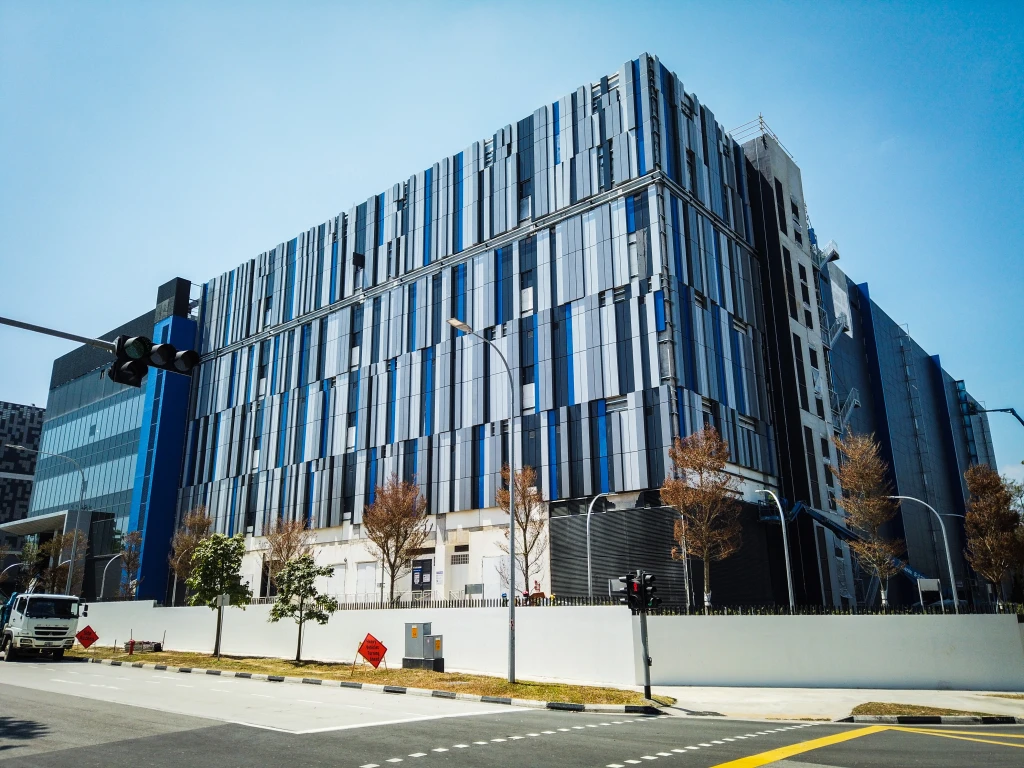
The Sin12 data center / Photo credit: Digital Realty
Besides the business considerations, however, Digital Realty’s latest data center was built with sustainability in mind.
Smith points out that such facilities “obviously consume a tremendous amount of power and electricity, and that creates a challenge with regards to sustainability and minimizing the carbon impact that we and our customers create.”
With that in mind, Sin12 was built to operate at high energy efficiency but with limited water usage and environmental impact. It has already achieved platinum certification under the Singapore Building and Construction Authority’s Green Mark assessment system, which evaluates the overall environmental performance of buildings to promote sustainable design.
This sustainable design approach is important because Asia Pacific still relies predominantly on fossil fuels. In fact, coal, oil, and natural gas accounted for 86% of total primary energy supply in the region in 2016, according to a 2019 report by the Asia-Pacific Economic Cooperation. It’s a large-scale problem that requires the intervention of governments and big corporations.
“Nobody’s going to be able to stop the data usage. So it’s going to come down to providers like us, the whole ecosystem and governments to come together and work out how we can build all of this sustainably in Asia,” Smith says. “We want to help clients further their business interests but not at the expense of the environment. That’s a responsibility we take very seriously, and we’re incredibly well-placed as a large company providing foundational services to make a positive impact in this area.”
Find out more about how Digital Realty is taking steps to provide sustainable data center solutions by attending the online launch of Sin12, which includes a virtual tour of the facility as well as keynote speeches from the Minister for National Development and a representative of the US Embassy. You can register for the event on the Digital Realty event website.
This content was produced by Tech in Asia Studios, which connects brands with Asia’s tech community. Learn more about partnering with Tech in Asia Studios.
Stay updated on the go with our mobile app.
Get latest insights with smoother, more personalized experience through TIA mobile app.
Recommended reads
 Life’s a game, and AI agents are Animoca’s new play
 Indonesian AI startup goes global
 Forrest Li on scaling Sea, building smarter bots, and founder grit
 An AI assistant that joins sales calls and scores team skills
 Beyond the check: Why VCs need more than capital
 SGX’s CEO says it doesn’t need a unicorn to win
 SMEs want AI too, but not the kind Big Tech is selling
 Oatside’s alt-milk rise hits a profitable gear
 Alibaba’s financial health in 12 charts
 Asia’s telcos bundle AI into mobile plans. Will it pay off?





Editing by Stefanie Yeo, Nathaniel Fetalvero, and Eileen C. Ang
(And yes, we’re serious about ethics and transparency. More information here.)






