 Zachary Tan · · 5 min read
How technology can help solve Asia’s unsustainable energy issues

Asia has an energy problem.
Home to two major economies – China and India – the region is expected to lead the way in global power demand, accounting for 67% of growth over the next two decades, according to energy research and consultancy group Wood Mackenzie.
Unfortunately, fossil fuels are still the overwhelming answer to this demand, raising concerns about environmentally sustainable methods of energy production in the region. An Asia-Pacific Economic Cooperation report in 2019 revealed that coal, oil, and natural gas accounted for 86% of the cooperative’s total primary energy supply in the region in 2016. Specifically in Southeast Asia, the use of coal rose by 39% between 2013 and 2016.
To combat this, a United Nations report recommends “accelerated action” to foster sustainable resource usage, improve waste management, increase natural disaster resilience, and enact policies to adapt to climate change impacts. These changes are required if the region is to meet its Sustainable Development Goals.
Why the region isn’t using more renewable energy
Thanks to rapid economic development, Asia’s energy demand will continue to outstrip that of every other region, says Phyo Ko Ko, chief innovation officer at energy AI startup EverComm Singapore.
Since demand is expected to only rise, the key to sustainable economic and environmental health lies in using alternative energy sources, increasing usage efficiency, and effectively managing energy waste.
One of the reasons for the prevalence of fossil fuels in Southeast Asia is due to a lack of funding. Indeed, while investments in coal and gas power between 2014 and 2018 reached a total of US$67.5 billion, similar investments in hydropower, geothermal energy, solar photovoltaics, and wind power combined to less than half, peaking at US$26.8 billion.
“Even though there are government incentives and foreign aid for solar panels and wind turbines, they only meet a small percentage for energy demands,” says Phyo.

Phyo Ko Ko, chief innovation officer at EverComm / Photo credit: EverComm
The CIO adds that transitioning to clean energy is also complicated, as most coal plants in the region are relatively new, having only been in operation for around 15 years on average. This makes decommissioning and phasing them out – similar to what Europe has been doing – a costly and, ultimately, impossible option for the majority of countries in the region.
And outside of outliers like Singapore, ASEAN nations aren’t as well off, which restricts access to energy services companies and the implementation of costly technology-based tools.
“Consultations with domain experts to diagnose issues are an expensive affair and not viable [for many clients] in the long term,” says Phyo.
But even at the societal level, it’s difficult to change the mindset of the general populace since going sustainable has no discernible, immediate, or quantifiable impact on individuals.
“There are no statistics that show that what you’re doing on the individual level is going to affect the planet by any tangible amount – so things are largely invisible,” Phyo explains. As a result, transformative education is paramount in helping to change behavioral habits.
Enabling sustainability through technology
The situation isn’t much better at the enterprise level. The United Nations report cited earlier also indicates that no significant energy usage data of the region exists, Phyo says. This is where EverComm comes in.
“We help with getting that data quickly and simply, with wireless IoT solutions providing real-time information on energy usage levels of, for example, cooling systems of buildings,” Phyo shares.
Essentially, the company’s platform lets organizations see, at a glance, how efficiently its machines are performing and how much power they are using. And by using AI technology, which is trained with the input of domain experts, the platform is able to identify where energy is potentially wasted and provide real-time recommendations to make energy consumption more efficient.
For example, systems for areas in malls that don’t need much cooling due to lower footfall can divert the cooling load to more populated areas.
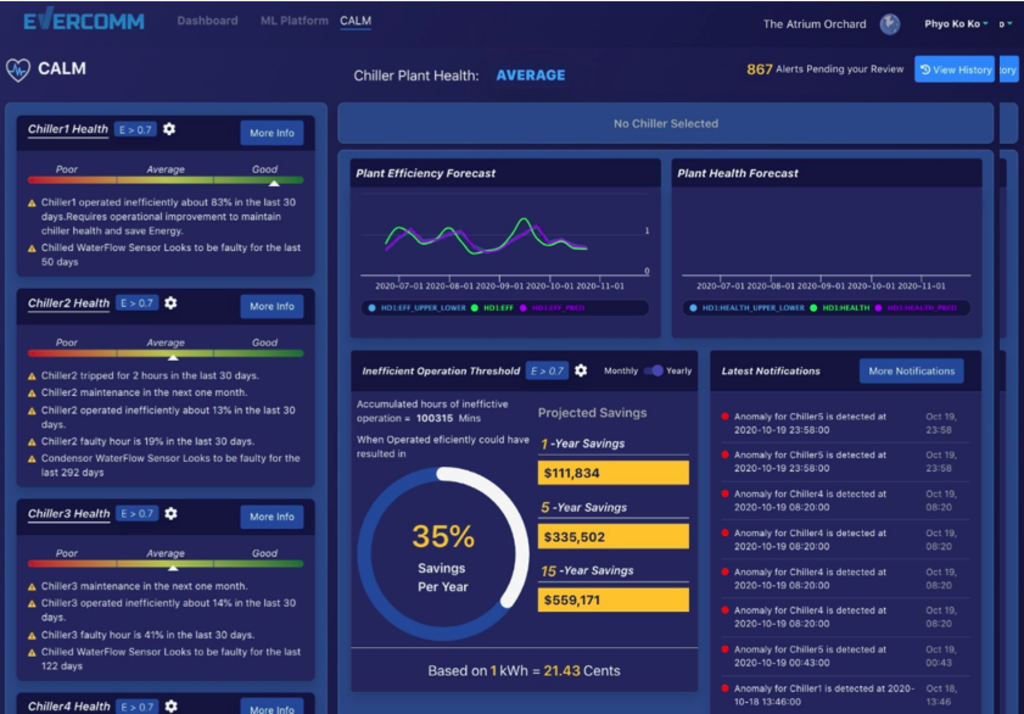
The dashboard of EverComm’s platform / Photo credit: EverComm
With the platform’s use of AI, domain experts don’t have to constantly be on standby too. “The main idea is to be able to cut down on manpower and improve productivity, while making equipment know-how easy for everyone,” says Phyo.
A centralized monitoring system also allows users to manage multiple sites from a single platform, minimizing the resources and effort needed to optimize overall energy efficiency through AI-enabled operational insights.
In addition, EverComm helps with asset lifecycle management by performing predictive maintenance on equipment. This allows building management to purchase spare parts just before they are required, instead of buying them way in advance or too late.
The company’s solutions have been applied to multiple energy-intensive industries such as hospitality, food and beverage, and manufacturing, and the team also works with government agencies to help align them with the United Nations’ Sustainable Development Goals agenda.
In Singapore, EverComm’s collaboration with the Infocomm Media Development Authority (IMDA) has helped the startup quickly commercialize its AI and machine learning functions.
In September last year, the AI firm was selected to be one of the project leads for IMDA’s Advanced Digital Solutions program, an initiative aimed at assisting Singapore’s small and medium-sized enterprises achieve sector-wide digitalization goals such as increasing resilience and productivity.
Looking to the future
Despite the blip in energy consumption due to the Covid-19 pandemic, electricity demand in Southeast Asia is expected to rise 27% between 2018 and 2025. For the most part, this is due to the accelerated digitalization that is expected to occur due to the pandemic, along with a continued shift of manufacturing activity away from China and into the region, as a result of the tensions between China and the US.
As such, adopting energy efficiency practices should be encouraged. As EverComm’s CIO, Phyo will undoubtedly have lofty goals to achieve.
“Ultimately, we plan to provide governments with effective tools to monitor the macro view of their respective energy consumption rates across various industries,” he says. “Then, they can come up with energy-saving policies and solutions that make sense for each industry.”
In this way, EverComm seeks to enable expert-level analytics and insights on energy consumption across wide geographical areas – making energy know-how readily available with minimal cost and effort.
EverComm is part of the Infocomm Media Development Authority’s Accreditation@SG:D program. Reach out to the startup at sales@evercomm.com.sg to learn more about its services.
This content was produced by Tech in Asia Studios, which connects brands with Asia’s tech community. Learn more about partnering with Tech in Asia Studios.
Stay updated on the go with our mobile app.
Get latest insights with smoother, more personalized experience through TIA mobile app.
Recommended reads
 You can’t spell India without AI
 ‘Not how humans act’: how agentic AI is changing cyberattacks
 The hardware secret that gave OpenAI the edge on Anthropic
 Why ‘vibe PMing’ is the future of product management
 Southeast Asia’s data center boom has a water problem
 ‘Good morning, Dave’: The new world of physical AI in daily life
 QuickBytes: How GovTech Singapore is fighting fire with fire in cybersecurity
 Southeast Asia pulls ahead of global average on AI adoption
 OCBC takes a first-mover role in bringing quantum tech to banking
 How AI agents will be the new software buyers





Editing by Winston Zhang, Nathaniel Fetalvero, and Jaclyn Teng
(And yes, we’re serious about ethics and transparency. More information here.)




📅 Upcoming Events
22 October 2026
Payoneer x CSPN Summit 2026