David Corbin · · 4 min read
Crowdsource everything, from dating to web design to fortune telling, with this Japanese startup

Crowdsourcing has caught fire for the way it reduces business costs. In Japan, companies like Crowdworks and Lancers lead the pack, connecting large and small firms with an army of freelancers ready to take care of tasks like accounting, web design, or copywriting. Niche firms have also sprung up to target specialized work like translation (Gengo) or video production (Viibar).
For Coconala, crowdsourcing does not need to be limited to the workplace. Some of the usual freelance work is listed, but there is also treasure trove of other offered services, often for things like personal consulting. You can get advice on topics as various as fashion choices, restaurant picks, fun hobbies, and child rearing.
Psychological and love counseling are two other categories as well. Love, predictably, is complex and has numerous subcategories like “looking hot,” “non-heterosexual,” “getting married,” “problems in marriage.” Users wanting to get married but also wanting to avoid the problems of married life might want to purchase some time with one of the fortune tellers listed on the site.
Coconala’s decision to be more than strictly business means non-traditional freelancers can register and earn cash. This result is not accidental. Coconala, with a motto of “Your skill can help someone,” is trying to expand the definition of freelancer.
The definition might be expanding but revenue has been a bit more stubborn. Users on Lancers and Crowdworks have managed to make US$200 million and US$110 million, respectively, from their offered services, but Coconala founder and CEO Akiyuki Minami tells Tech in Asia that the startup’s freelancers have commissioned a little over US$1 million.
The lower number is partly due to the firm’s freemium model. Basic tasks can be bought for a price of JPY 500 (about US$5) but higher-end fare comes at a steeper price. Established, trusted freelancers can charge more but customers tend to err on the side of being cost conscious. Coconala attracted early users by pushing everything at JPY 500, but Minami says that the company will start to take a more measured approach. Properly touting its finer products will lead to rapidly increasing revenue, he predicts.
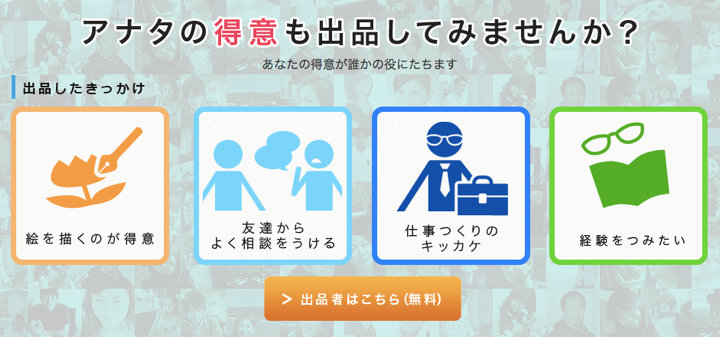
Part of the company’s home page, the images encourage visitors to consider what sorts of skills they could share
”I would be happy if I can be helpful for someone”
The company sprung up in January 2012. That is four years after Lancers and two months after Crowdworks made their debuts, but Minami feels that Coconala should not be measured by those two firms. “Coconala focuses on consumer-to-consumer consulting so we have little overlap with customers that go to pricier, business-focused production crowdsourcing firms like Crowdworks or Lancers,” he says. Rather, he cites New York City-based Fiverr as a more natural comparison point.
Fiverr, like Coconala, is C2C and also offers a full gamut of services. Founded in 2010, the US company has steadily gained steam, most recently posting a US$30 million series C round in August.
Coconala raised JPY 150 million (US$1.4 million) in September 2013. Though a modest amount, it is a testament to the work Minami and his team put in. “It was a team with no experience with internet business […] growth was very slow in the first year. It was a tough situation where, because weren’t able to hire an engineer we could not grow, and because we weren’t growing, we couldn’t hire an engineer,” he tells Tech in Asia.
The idea for Coconala came to Minami as he was preparing to launch a healthcare business. While he was doing preparatory research, he started getting feedback from nutritionists that they would like to share their knowledge outside of hospitals but were lacking the means to do so. After realizing that this sort of person-to-person knowledge sharing could be applied to any number of fields, Minami started to get excited about the possibilities.
For Minami, the most critical element of Coconala is that human connection. “Japan’s economy was stalled [… and] young employees were having a hard time finding a real sense of accomplishment or progress in their work and I thought that they were unable to satisfy the basic desire of ‘I would be happy if I can be helpful for someone,’” he explains.
His message has hit home. The average age of Coconala’s registered users is 30 years old.





Stay updated on the go with our mobile app.
Get latest insights with smoother, more personalized experience through TIA mobile app.