Sumit Chakraberty · · 8 min read
Pros and cons for Alibaba in battle with Amazon on neutral ground in India
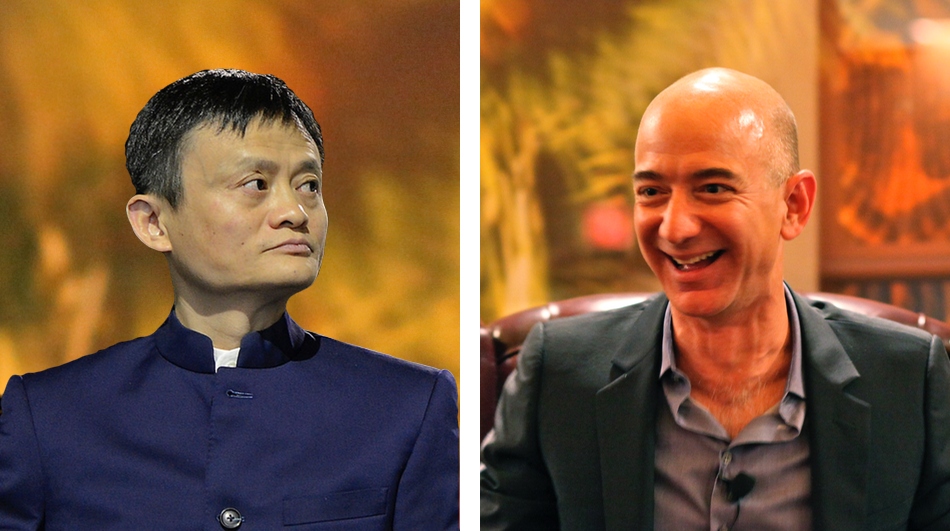
Photo montage by Tech in Asia. Photos by Steve Jurvetson and UN climate change.
Chinese companies seldom get credit for innovation and entrepreneurialism because they’re seen to be winning over global competitors in a protected market at home. But now, as China’s cash-rich tech giants move out into global markets, they have a chance to prove they can win on neutral ground, too.
Last month in Alibaba-owned UCWeb’s headquarters in Guangzhou, I got a glimpse into its keenness to take on the likes of Google and Facebook outside China’s walled garden. “Instead of competing with global companies in China, we’re competing with them in India, which is an open market,” Alibaba Mobile Business Group president Jack Huang told me in an interview. The UC Browser, which comes preloaded on Chinese smartphones flooding global markets, is the most actively used mobile browser in India, according to StatCounter.
See: Inside Alibaba-owned UCWeb’s plan to outwit Google and Facebook in Asia
Now, it appears we’re in for a much bigger showdown – the mother of all ecommerce battles between Alibaba and Amazon on the neutral and vast, open territory of India. Unconfirmed reports say Alibaba is pumping US$200 million into India’s mobile commerce and payments company Paytm, on top of the US$680 million it had invested along with its Ant Financial spin-off in 2015.
As China’s cash-rich tech giants move out into global markets, they have a chance to prove they can win on neutral ground, too.
What’s significant is that Alibaba’s fresh investment is being made in Paytm E-commerce. Paytm’s parent company One97 Communications recently split Paytm into two entities – Paytm E-commerce and Paytm Payments Bank. Paytm founder Vijay Shekhar Sharma sold 1 percent of his personal holding in One97 to invest US$48 million in Paytm Payments Bank and holds a 51 percent stake in it.
The payments bank is a special entity created in India to facilitate a push toward a digital economy and financial inclusion. It is limited to payments and cannot give loans directly like traditional banks. The Reserve Bank of India has issued licenses to 11 payments banks, including Paytm’s, which will encompass its digital wallet.
See: Paytm founder prepares for his next pivot, which could be the biggest yet
The payments bank is similar in concept to Alibaba’s MyBank in China, but banking regulations are different in India. That is partly the reason Paytm split into two and Vijay Shekhar Sharma took a majority stake in the payments bank, complying with RBI requirements.

Vijay Shekhar Sharma, founder and CEO of Paytm. Photo credit: Tech in Asia.
Now comes the other part of the story. Alibaba’s new investment would take its total stake in Paytm E-commerce to over 50 percent. This serves twin purposes – it keeps the Chinese company off the radar of skittish Indian banking regulators who’ve delayed the launch of Paytm’s payments bank, and it lets Alibaba take the lead in an Indian ecommerce business.
Alibaba probably finds it easier at the outset to start a new site instead of taking over a struggling business.
Consumer will decide the victor





Stay updated on the go with our mobile app.
Get latest insights with smoother, more personalized experience through TIA mobile app.