
It’s been a rough few years for the Hong Kong economy, including a 6.1% contraction in 2020 – its sharpest annual decline on record. This has been due to factors such as the trade war between China and the US and the onset of the Covid-19 pandemic.
That said, although the business hub suffered a sharp decline in gross domestic product like other economies, it has also bounced back with its fastest growth recorded in a decade – a fact that contributes to how it has managed to remain an attractive environment for startups.
According to Jayne Chan, head of InvestHK’s StartmeupHK, the number of startups in the city has grown from around 3,100 in 2019 to just over 3,300 in 2020, with the companies accounting for over 10,000 employees across 116 co-working spaces, incubators, and accelerators. StartmeupHK by InvestHK is the government department’s dedicated team that promotes Hong Kong as a startup destination.
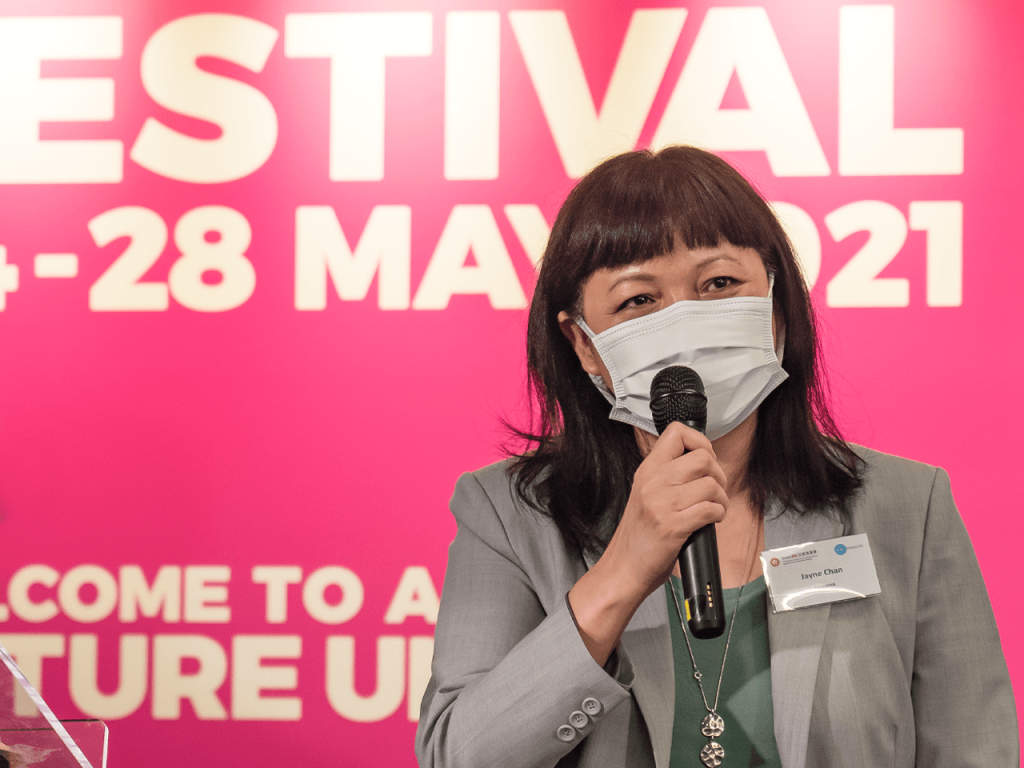
Jayne Chan, head of StartmeupHK / Photo credit: InvestHK
“This shows two things: One, that there’s a resilience to startups. If there’s a business opportunity or problem to solve, they’ll be there,” Chan says. “Second, it shows that the fundamentals of Hong Kong are very strong.”
Money talks
The market’s long-standing position as a global financial hub forms part of this foundation and contributes to its resilience. The ease with which companies can raise money in Hong Kong remains strong. A KPMG report examining Hong Kong startups’ response to recent socioeconomic concerns found that the total capital invested in them – including government venture capital, grants, and incubation funding, and private venture capital – reached approximately US$2.45 billion for financial year 2019/2020. This compares favorably with neighboring Southeast Asia, whose 10 countries’ tech startups collectively raised US$7.7 billion in 2019 and US$8.2 billion in 2020.
This strong performance appears to be due to – and not in spite of – the pandemic. The KPMG report found that 34% of entrepreneurs have seen increased demand for their products and services, compared to 19% of corporates. Startups have also been quick and agile enough to adapt to constraints, and displayed a willingness to work with other organizations to produce solutions.
Additionally, Tech in Asia data shows that over the same period, the industries receiving the lion’s share of investment were the fintech, logistics, and artificial intelligence industries.
“The government has prioritized certain areas that we want to nurture and grow,” Chan concurs. “AI and robotics, fintech – which you’d expect – and there’s also smart city technology.” These are in line with the government’s plans to digitally transform the Hong Kong economy – plans that take on a greater sense of urgency in the current pandemic climate and where startups are especially important.
“They are very good at developing new commercial applications of technology, and they scale very fast – which means the impact they make on areas such as employment and opening up new markets can be significant,” Chan adds.
However, “it’s not like other industries are neglected. Our economy as well as the startup sector are incredibly diverse.” She points to how the Hong Kong Stock Exchange’s listing requirements for pre-revenue biotech companies were relaxed a few years ago as an example of the government’s constant re-examination of its policies, regardless of industry, to provide a company-friendly business environment.
“We recognized that biotech firms take a lot longer before they can actually go to market – the amount of money that’s required to get a product to market is incredibly high,” she explains.
As for funding from the private sector, Chan says that there are many accelerator and incubator programs that cater to startups that are still in relative infancy, such as those in the seed round. As they progress to the series A, B, or C rounds, venture capitalist firms then come in to provide that next level of support.
Holistic support
The assistance goes beyond creating a strong base for funding.
The science parks of Hong Kong Science and Technology Park and Cyberport have a variety of overseas networks that the startups they work with can tap into, in addition to providing a range of services such as developing the tech talent pool and putting in place infrastructure such as labs, manufacturing hubs, and workspaces.

Photo credit: 123RF
There is also the Hong Kong Productivity Council (HKPC), which can provide specialized assistance and expertise in the manufacturing field. For example, a healthtech company that makes medical devices can approach HKPC to find and get connected with a partner that is able to provide the exact type of production capabilities it needs. “There’s a whole bunch of different types of prototyping and other advanced facilities, and the Council can advise startups on which company might be good to work with to manufacture small batches of a given device, for example,” explains Chan.
As for StartmeupHK, it aims to make sure that overseas startups establishing themselves in Hong Kong are able to easily reach three fundamental needs: access to capital, access to talent, and access to market. These also help them identify potentially mutually beneficial partnerships and connect with the right parties.
Chan brings up the example of how StartmeupHK helped to connect BuyHive, a company that helps overseas corporations source personal protective equipment (PPE), with Dun & Bradstreet, which provides data analysis solutions, among others. As a result of its successful operations stemming from close studies of how the Chinese market worked to produce enough PPEs, BuyHive has put together a concentration of data that’s full of insights, such as indications of how bad a corporate situation is in one country versus another or how efficient the supply chains are. The collaboration allows Dun & Bradstreet to go to market and provide that information as part of a bigger offering to its clients, while BuyHive receives access to data analytics tools for its platform, helping to ensure the authenticity of its PPE sources.
The government agency also organizes the annual StartmeupHK Festival, a week-long series of events focused on industries that Hong Kong has competitive strengths in or that presents attractive opportunities for companies to take advantage of.
“We’ve seen a lot of traction. At my first event, we had 5,000 people,” Chan says. “Fast forward to last year – we went completely virtual due to the pandemic – and we had 180,000 people come on.”
In addition to keynotes and discussions on a variety of topics such as healthtech, proptech, and environmental, social, and governance investing, this year’s edition features startup showcases and hackathons, among other activities, all organized by a variety of partners. These include Finnovasia, WHub, and Brinc, among others.
Chan says that these different aspects of the event’s agenda present not just educational opportunities but also practical ones for business matching and networking at breadth.
“We want to connect startups with investors, we want to give them opportunities to pitch, we want to showcase how strong the ecosystem is here in Hong Kong,” she affirms.
“Fundamentally, we want to provide value to startups. A strong and vibrant startup ecosystem means having more people working in high-value positions, improved living conditions, and hopefully a better social and environmental impact for Hong Kong at large.”
The annual StartmeupHK Festival supports, showcases, and connects Hong Kong’s startup ecosystem to the world. Its week-long format covers industries and themes of interest to tech founders, featuring talks by renowned speakers, demos, workshops, job fairs, startup pitches, and investor and business matching, among others.
This year’s edition is from May 24 to 28. Find out more about the agenda and sign up to attend on the StartmeupHK website.
This content was produced by Tech in Asia Studios, which connects brands with Asia’s tech community. Learn more about partnering with Tech in Asia Studios.
Stay updated on the go with our mobile app.
Get latest insights with smoother, more personalized experience through TIA mobile app.
Recommended reads
 Animoca backs $70m round of 🇹🇼 VC firm’s maiden Web3 fund
 Navigating Malaysia’s drone tech landscape – The Executive Brief
 East Ventures backs $2.7m round of Indonesian climate tech startup
 Learning from the mistakes of the West’s ‘unicorn factory’
 The Nadiem effect on investors, talent, and Indonesia
 Wavemaker, UNDP 🤝 to drive greentech startups in SEA
 Xend founder launches Philippine proptech venture builder
 Vertex Ventures Japan launches $64m fund
 For PM Wong, sustaining SG’s position as top tech hub calls for tough choices
 Vietnam, Philippines attract VCs deterred by pricey Indonesian market





Editing by Nathaniel Fetalvero and September Grace Mahino
(And yes, we’re serious about ethics and transparency. More information here.)






📅 Upcoming Events
22 October 2026
Payoneer x CSPN Summit 2026