 Michael Tegos · · 8 min read
New startup brings P2P loans to Singapore’s small businesses

Meeting Capital Match co-founders Pawel Kuznicki and Kevin Lim, it feels like they are well on their way to bridge the gap between a technology company and big finance. Dressed in button-up shirts and dark trousers, I get the feeling they’re going to advise me about loans rather than discuss setting up a tech startup. It’s a good thing, then, that they are here to do both.
Singapore-based Capital Match uses its website and technology to enable peer-to-peer (P2P) lending via crowdfunding for small and medium-sized businesses. It’s already a popular practice in markets like the US, the UK, and China, but it’s yet to catch up in Southeast Asia. Kuznicki, an economics graduate from the University of St Andrews in the UK and a former managing consultant at Rocket Internet, recognized that gap and moved to fill it. Lim, an ex-FIG investment banker who has worked with JP Morgan, Macquarie Capital, and Standard Chartered, joined soon after.
“At Rocket, I learned how to build and run a technology company, and I realized that no one is doing [P2P lending] here,” he tells Tech in Asia. “It’s a huge opportunity and a great disruption to the sector. So in the last few months when I was at Rocket, I was preparing all the basic legal and business model documentation and then at some point in mid-2014 I decided to quit Rocket and start this company.”
Making soup out of loan sharks
For small- to medium-sized enterprises (SMEs) looking to secure a loan, the process with Capital Match isn’t that much different than going to a bank, with two exceptions: one, it involves a lot more logging in to websites and uploading documents, and two, it is much more likely to succeed. According to Capital Match, 80 to 90 percent of small business bank loan applications are rejected by large financial institutions in Singapore. So the prospective borrower can either risk turning to ah long (loan sharks – never a good idea), or they can give that new-fangled P2P lending a try.
On Capital Match, the borrower can make a request for a loan and then forward all the necessary documentation to the company. Capital Match employs its own credit officer, Low Yen Chew, specializing in SME credit review and audit and with previous experience at Singapura Finance and KPMG. She is responsible for reviewing the borrower’s credit rating and borrowing power, just like a bank would.
After approval, the loan request goes up on Capital Match’s online platform, where potential investors can review it via their own investor accounts and decide whether to contribute to the loan. An investor may contribute as little as S$1,000 (US$745) or go large and cover the entire loan. The loan amounts are currently in the ballpark of S$50,000 (US$37,240) to S$200,000 (US$149,000) with a tenure of three to 12 months and interest rates of 1.5 to 2 percent per month. Once the loan has been covered, Capital Match syndicates the loan and draws up the legal documentation for all parties. Finally, the money is transferred to the borrower.
Lenders can expect a return on their investment to the tune of 20 to 25 percent per year, according to Kuznicki. And through the platform, which will allow them to select, manage, and monitor their loan portfolio, the lenders can start multiple investments. “Once we can actually prove to people that this is a fairly safe investment, or that you can diversify your investment, this becomes a very attractive fixed income product,” he says.
The law of the land
Capital Match is favored by a legal framework in Singapore that allows individuals to become lenders and investors on such a platform. Money lending in the country is regulated by the Monetary Authority of Singapore and the Ministry of Law, as well as the Moneylenders Act, preventing unlicensed individuals from exploiting borrowers in need. Kuznicki says the company has worked with both authorities in order to ensure its activities don’t fall under their purview.
“As long as we are lending only to companies, we are an excluded moneylender [under the Moneylenders Act] and we don’t need a license,” Kuznicki says. “If someone starts P2P lending for individuals, that could be tough because it’s a really grey area in Singapore from a legal point of view.”
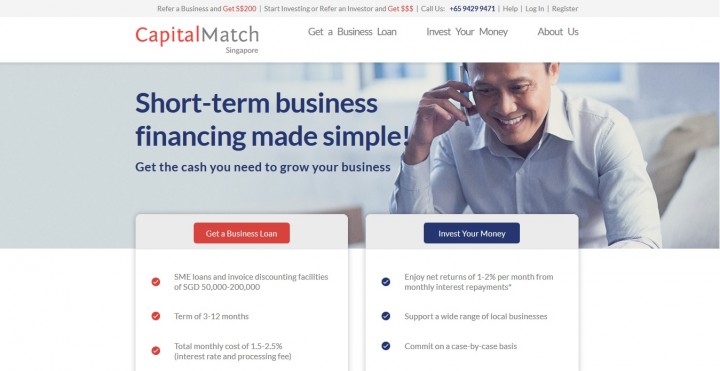
Borrowers and investors can use Capital Match’s
online platform to manage their loans.





Stay updated on the go with our mobile app.
Get latest insights with smoother, more personalized experience through TIA mobile app.











📅 Upcoming Events
22 October 2026
Payoneer x CSPN Summit 2026