Malavika Velayanikal · · 3 min read
What are the hottest sectors for venture capital in India this year? (INFOGRAPHIC)
Infographic by Kathrinna Rakhmavika of Tech in Asia
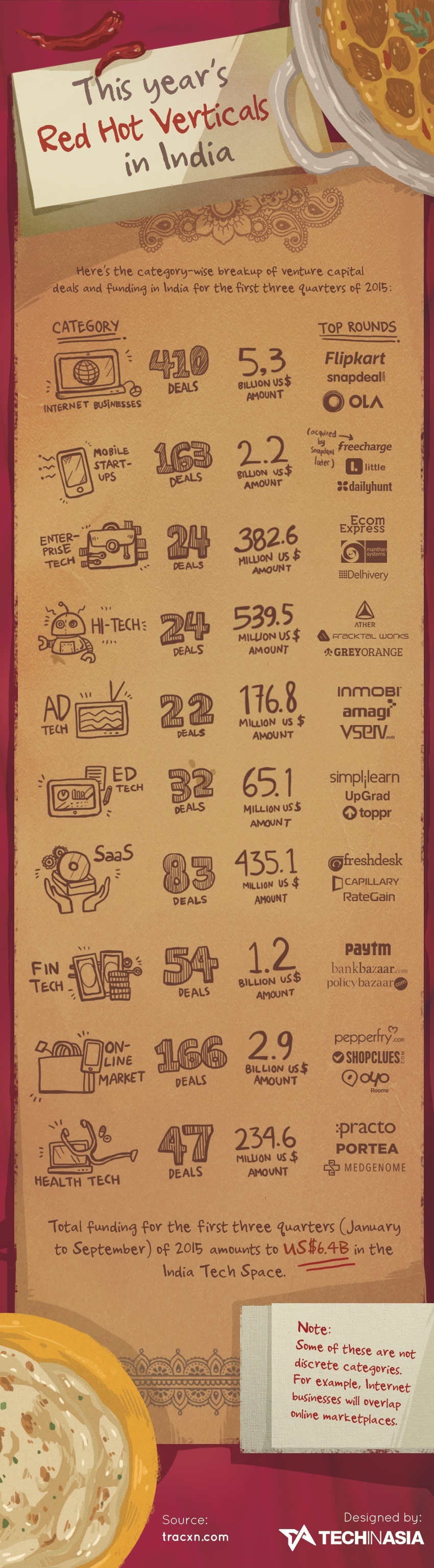
Not surprisingly, the lion’s share of the US$6.4 billion of total funding for startups in India in the first three quarters of the year has again gone to the B2C (business-to-consumer) segment of ecommerce marketplaces, with US$500M+ funding rounds for Flipkart, Snapdeal, and Paytm.
Online marketplaces cornered nearly US$3 billion of investments in 166 deals over the first nine months of 2015, according to data from venture capital analytics firm Tracxn. This is a continuation of the trend we saw last year, when Flipkart had a billion dollar funding round to scale up and fight off local rivals, even as global giant Amazon pumped US$2 billion into India.
What’s new
What’s new this year is the emergence of B2B (business-to-business) as a hot area for funding. This augurs well for Indian startups targeting global markets with software products. SaaS (software-as-a-service) startups had 83 deals worth US$435 million in the first nine months of the year, shows the Tracxn data. Customer support software maker Freshdesk raised a US$50 million funding round; customer analytics firm Capillary Technologies grabbed a US$45 million round. Along with RateGain, whose software helps hotels and travel companies streamline operations, they were leaders of the SaaS pack. The south Indian city of Chennai has emerged as a SaaS hub.
Logistics and analytics
Ecommerce enablers, especially in logistics and analytics, also gave a push to the B2B segment. Ecom Express, Delhivery, and a host of other logistics tech startups scaled up rapidly during the year. Analytics firms like Manthan providing retail intelligence also gained from the boom in ecommerce. Enterprise tech as a whole got US$383 million in funding.
See: Seed funding sextuples in India. Here’s why that’s exciting (INFOGRAPHIC)
Money matters
Fintech emerged as another hot area, handling payments for a range of internet businesses. Paytm (which is now a more diversified player in mobile commerce) dominated this segment thanks to a big infusion of funds from Alibaba. Loans for small businesses as well as individual consumers also got a fillip from fintech, with the growth of financial marketplaces like BankBazaar and PolicyBazaar.
With India on track to become the world’s second largest smartphone market by 2017, mobile startups were naturally in the spotlight. FreeCharge – a unique Indian service that rewards users with coupons for using it to top up mobile phones – got funded and was acquired soon after by Snapdeal. It then launched a mobile wallet to provide an alternative to Paytm.
Going hyperlocal
A number of hyperlocal mobile startups, such as deals app Little and ecommerce messaging app Lookup, got significant funding, as did niche ecommerce players like furniture marketplace Pepperfry.
Aggregators continued to grow with the spread of the internet and rise in smartphone usage, such as Ola for cabs and OyoRooms for budget hotels.
Adtech startups like InMobi and Vserv similarly rode on the back of ecommerce and other internet and mobile businesses to gain traction.
Robotics and clean energy
Among emerging verticals, health and education tech finally made a move up this year: US$120 million for Practo in two funding rounds was among the largest investments for a healthcare startup anywhere in the world.
Noteworthy too is the half a billion dollars in funding for hi-tech startups such as Grey Orange for robotics, Fractal Works for 3D printing, and Ather Energy for cleantech. So even if ecommerce still hogs the headlines, the startup scene in India is taking on the many-splendored hues of a healthy, diversified ecosystem.





Stay updated on the go with our mobile app.
Get latest insights with smoother, more personalized experience through TIA mobile app.