- Premium Content It takes our newsroom weeks - if not months - to investigate and produce stories for our premium content. You can’t find them anywhere else.
 Tay Tian Wen · · 6 min read
Inside China’s crusade against the education sector’s excesses
China Watch is a regular segment that looks at the country’s tech sector through a local lens. This edition explores the impact of the country’s education crackdown, based on the reporting of Chinese tech media site Sina Technology.
For nearly 700,000 Chinese education and training institutions and their millions of online teachers, Beijing’s Double Reduction education reform has confirmed their worst fears.

Image credit: Timmy Loen
Signs of an impending regulatory storm were already on the horizon since March. Foreign investors, mostly oblivious to political risk, saw their holdings plunge to all-time lows. China’s online education behemoths were sent scouring for alternative opportunities, and some have already made hard pivots.
Parents and students, the supposed beneficiaries of this sweeping measure, wring their hands as their die-hard attitudes toward education persist. Others question whether Double Reduction will spawn a fast-growing underground economy for illegal tutoring services.
Beijing wants capital out of education, and those caught on the sidelines are left to fend for themselves. But as those affected navigate new uncertainties, some find a silver lining in the opportunities to come.
The remedy for a “stubborn disease”
Officially named “Opinions on further reducing the burden of homework and off-campus training for students in compulsory education,” the Double Reduction policy is part of the Chinese government’s bid to improve school education by implementing changes to the country’s tutoring industry.
Under the Double Reduction policy, academic tutoring businesses providing classes to students in compulsory education – the first nine years of school in China – are prohibited from certain activities, including raising funds through stock listings. Foreign capital is also banned from investing in these businesses.
More recommendations include a ban on classes offered on weekends, holidays, and summer and winter breaks, as well as prohibiting “photo search for questions” tools that companies like Zuoyebang and a TAL Education Group subsidiary offer. The education measures have also spawned calls for academic tutoring businesses to be restructured as nonprofits.
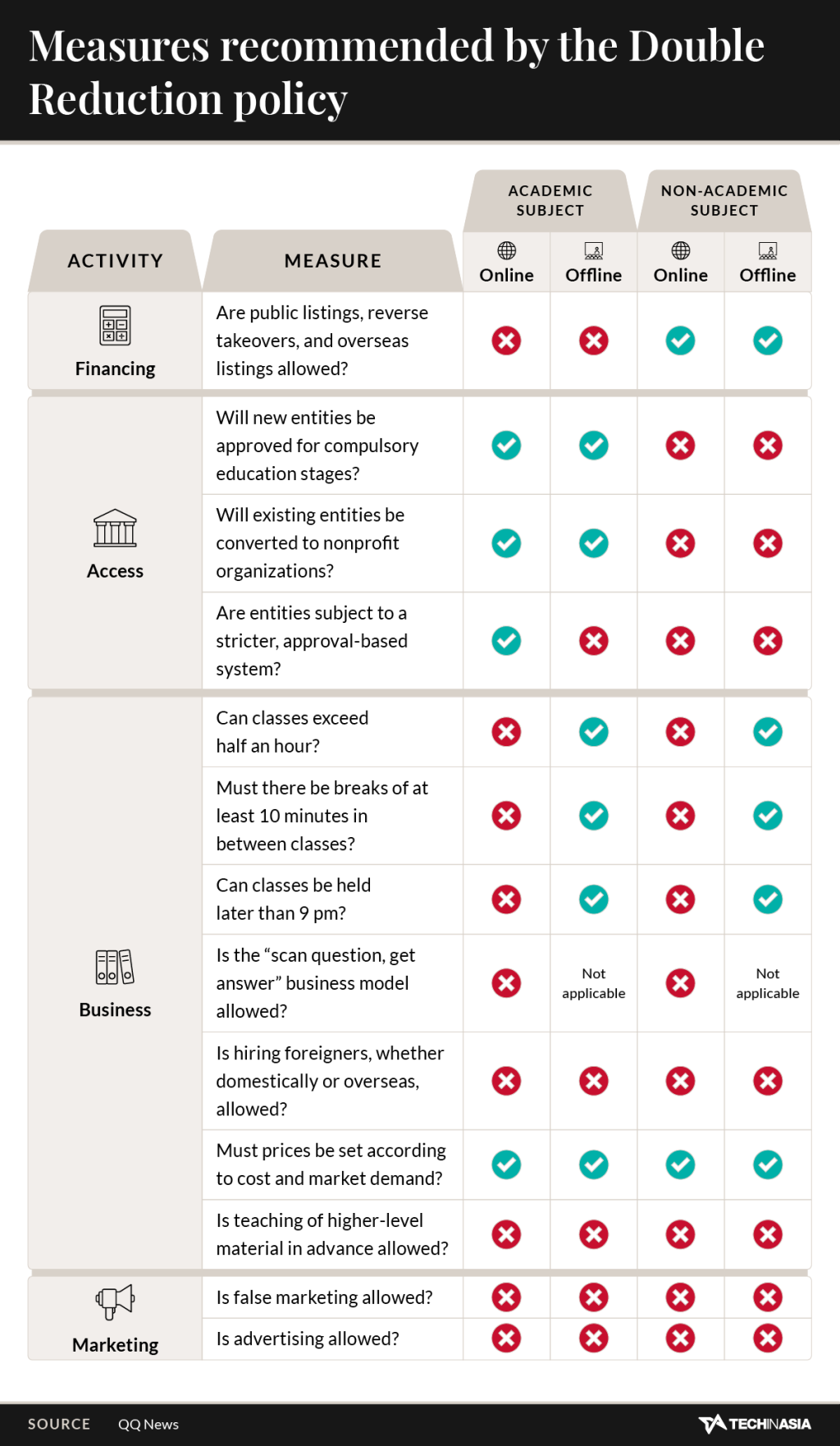
Image credit: Timmy Loen
The new measures come on the heels of government accusations against online education companies for worsening inequality and a host of other social ills. Previously criticized for literally worsening students’ eyesight, China’s tutoring industry was also singled out by President Xi Jinping as a “stubborn disease that is difficult to manage.”
Not only is educational excess difficult to stamp out, it’s also perceived to be responsible for many ills. The country’s once-burgeoning tutoring market, which was estimated to be worth US$120 billion in 2019, has been chided for increasing child obesity rates and using deceptive and manipulative tactics to sell services to parents. The industry has also been accused of exacerbating negative social trends among Chinese youth, like the “involution” and “lying flat” phenomena.
No prospects left?
Investors in Chinese education firms certainly have nothing to cheer about. As the market closed on July 23, the shares of Chinese edtech company Gaotu Techedu plunged more than 63% overnight, while TAL Education Group shares shed 70.8% of its value. Fellow big players New Oriental Education and Youdao Inc. saw their values fall 54% and 43%, respectively. Many barely held on to 10% of their peak value over the past year.
Treating the symptoms and not the cause?
What’s next for China’s education giants?
Stay ahead in Asia’s tech landscape
This is premium content. Subscribe to read the full story.
“Double Reduction” had China’s education titans in its crosshairs, but investors, parents, and teachers have become collateral damage.
We know this is not ideal. ⌛ Sign up in 20 seconds. Cancel anytime.
Our subscriber community includes professionals from these companies:





Stay updated on the go with our mobile app.
Get latest insights with smoother, more personalized experience through TIA mobile app.