 C. Custer · · 4 min read
China will have the world’s first driverless-cars-only city: Baidu CEO
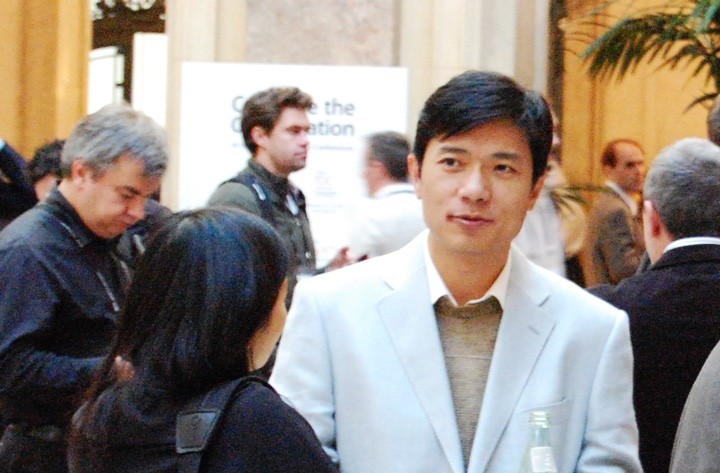
At China’s recent Big Data Industry Summit, not everybody was interested in talking about big data. Baidu’s Robin Li, who gave a speech at the summit, is more interested in the role big data can play in the development of artificial intelligence. So he used big data as a springboard from which he made some interesting comments about artificial intelligence, and the future of one particular application: driverless cars
Here’s a full translation of Robin Li’s speech:
Hello everyone, today I’d like to talk about a topic that’s related to big data but not exactly the same thing: artificial intelligence (AI). The term “artificial intelligence” first popped up around 60 years ago, and for the next 50 or so years it remained pretty obscure, nobody really paid attention to it. When I was studying in America [in the early 1990s], I really enjoyed the AI classes, but when I finished my studies I found that nobody in the outside world approved of it, because there were no real commercial applications for AI.
In recent years, why has AI gotten so hot? The main reason is big data, which is why I say that the two are closely related. Every day there is more and more data being produced, and we’re using it to get computers to do things that previously only humans could do. And in addition to the fact that data is getting more plentiful, computing power is getting more plentiful too. To put it another way: computers are getting more and more powerful even as their costs drop. Because we’ve got good, cheap computing power and big data, now we can realize a lot of technological ideas like voice recognition, image recognition, natural language processing, autonomous driving, etc. Although obviously autonomous driving is still being researched.
Just now the Premier mentioned big data several times, a lot of it relating to the government’s perspective. That is to say, the government has all of this data, and what they want to do is release and share it.
I’m looking forward to China becoming the world’s leading AI tech country
So I’m thinking: how should companies make use of their data? An important key here is insight. This term was also mentioned by one of the guests at the Premier’s conference yesterday. So what is insight? Everyone knows that Copernicus came up with the theory of heliocentricity, which was very advanced at the time. He used all kinds of logical reasoning to support this theory, but he didn’t have the support of big data. 100 years later an astronomer from Denmark painstakingly gathered all kinds of astronomical data, including the movements of the planets, over the course of 20 years. But he didn’t have any insight into the data, so he still wasn’t able to convince people the earth rotated around the sun. But his assistant Kepler used all of that data in combination with his own insight. Looking at the movements every day, it looked random, but with all of that data, if you looked at the same day from each year, the pattern became fairly clear. That was Kepler’s insight, so later he discovered the oval orbits of the planets, successfully explaining what previously couldn’t be explained. It was only because of his work that heliocentricity became widely accepted.
In terms of companies, we’re grateful to the government for making all kinds of data public, and we should try very hard to find the insights, and make the data produce the value it ought to produce. AI is a field that makes use of big data, and its influence will probably be no less than big data’s. AI will change every trade and every industry. More and more things that we used to think only people could accomplish will be done by machines. If industrialization liberated people from physical labor, AI may well liberate us from mental labor.
Right now this is probably most felt in the area of driverless cars. Just a few days ago we did a press conference with the Anhui city of Wuhu. Wuhu is setting up a special zone where driverless cars can be tested, and cars with drivers won’t be allowed. I’m really excited; I truly believe that the world’s first city with only driverless cars will be in China. We’ve also been discussing testing opportunities with the city of Guiyang.
Driverless cars is one classic example of an AI application. It uses a computer and wheels to replicate what a human driver can do; it can see, hear, understand, and process data. One driverless car in one day can process tens of terabytes of data. That’s huge. And these cars probably won’t need the internet, or at least won’t need to rely on it, since there are always some places with poor signal and you can’t just have the car shut off.
So, the example of driverless cars tells us that AI can really do a lot. Perhaps our next technological revolution won’t just be built on the foundation of big data, but more on the foundation of artificial intelligence. Baidu has invested a lot in AI over the past ten years, and in the future we hope to further develop and push forward Chinese AI with all of our industry colleagues here. I’m looking forward to China becoming the world’s leading AI tech country, and seeing the first city that only allows driverless cars appear in China. Thank you!





Stay updated on the go with our mobile app.
Get latest insights with smoother, more personalized experience through TIA mobile app.










📅 Upcoming Events
22 October 2026
Payoneer x CSPN Summit 2026