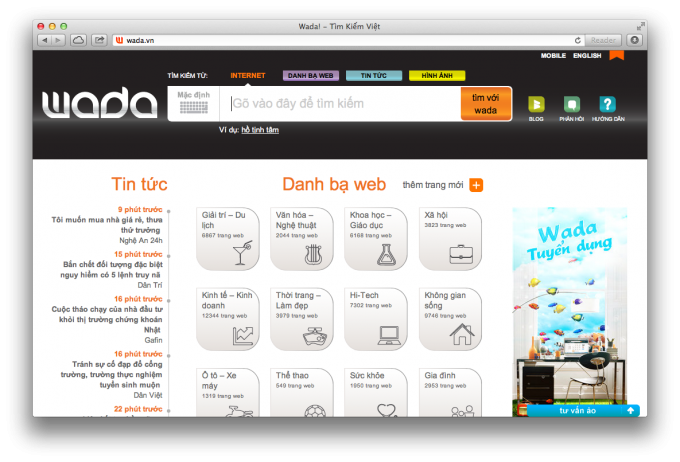
We’ve been hearing a lot from Vietnamese search engine CocCoc lately, especially with our recent meetup and interesting news about its planned $100 million strategy in the next decade. So I wanted to take a look at Wada, CocCoc’s other big competitor in this space. Not to be outdone by CocCoc, Wada has already spent $10 million in the past year in building its search product and acquiring people. Not only that, they’re also backed by Russian investors like CocCoc. Thus, it’s an interesting battlefield we’re seeing in Vietnam’s search landscape. CocCoc and Wada, the Russian-backed Vietnamese search engines, all seeking to topple Google’s statue. Oh wait a minute, isn’t Sergey Brin’s family from Russia as well?
Wada, unlike CocCoc, is going for a mobile strategy. After all, CEO Pham Tien Thinh, whose background is in telecoms, and Vo Dinh Bao Quoc, Wada’s CMO, both have a background in mobile. This interestingly puts them in a space that they hope CocCoc and Google are both not competing in. But the differences don’t stop there. Let’s look at some numbers and Wada’s history first.
Wada’s been in development for a year now and officially launched seven months ago. The team currently consists of 45 full-time and 70 part-timers. In February it launched a mobile search function in beta, with a full scale release set for next month. That’s when they’ll also be releasing Android and iOS apps along with a mobile browser. They also have a cool app called Wada Wifi Map. Aside from these mobile beginnings, Wada also produces a toolbar that works on Internet Explorer, Chrome, and Firefox browsers that curates content for users.
Wada’s search into location
As Thinh says “We seek to co-exist with Google, and don’t compete with Google.” What this means in terms of strategy is that Wada is attacking ad markets and content streams where Google is not. An example that Thinh loves to cite is pawn shops. If you’ve lived in Vietnam, you’ll know that pawn shops are pretty commonplace and people need to find them to exchange their goods for money and vice versa. This is a category that Google doesn’t cover. The same is true for finding an ATM. Wada buys all this location data from a local third-party provider and then crawls it themselves. Thinh believes this provides for a more local and up to date data set. It also allows them to be stronger in the countryside where Google and CocCoc may still be weak as their data would be centered in the cities.
In fact, much of Wada’s data is curated by humans instead of algorithms. According to Thinh:
Currently, the data in Vietnam is quite weak and Google isn’t local enough to know what Vietnamese people want. For example, I need to know where to wash my motorbike, not my car. So what we do is we meet users and find out what they want. From there, we have a database of about 50,000 websites that we think are the most popular sites in Vietnam. We push the most relevant ones to users. In the future, maybe by next year, we’ll start employing more technical solutions like algorithms but we need to organize enough data first before then and Vietnam’s content is still weak.

Within this curated content strategy is Wada’s Toolbar.
The Wada toolbar
Wada’s browser toolbar (currently only available on Windows), which was released in April, already gets 1.3 million users per month, has been downloaded 600,000 times and has generated 3.9 million page-views via the bar. That’s some pretty fast growth for a toolbar. The key with the toolbar has been identifying what Vietnamese users want most and pushing the best websites for that on the toolbar. For example, if you want to find a restaurant, the Wada bar will direct you to sites like Foody.vn or PartyinSaigon.com. These are sites that Wada has identified as best for users.
|
|
The Wada Wifi Map app
At the heart of Wada: news and mobile ads
Spending and investment
2013’s battle between CocCoc, Google, and Wada





Stay updated on the go with our mobile app.
Get latest insights with smoother, more personalized experience through TIA mobile app.