Iris Deng · · 4 min read
Chinese researchers hail Google’s quantum computing feat, seek more funds to catch up
Chinese scientists have applauded Google’s claim of a breakthrough in quantum computing despite doubts from its American rivals, calling for continuous investment so they do not fall further behind the US in a field that promises to render supercomputers obsolete.
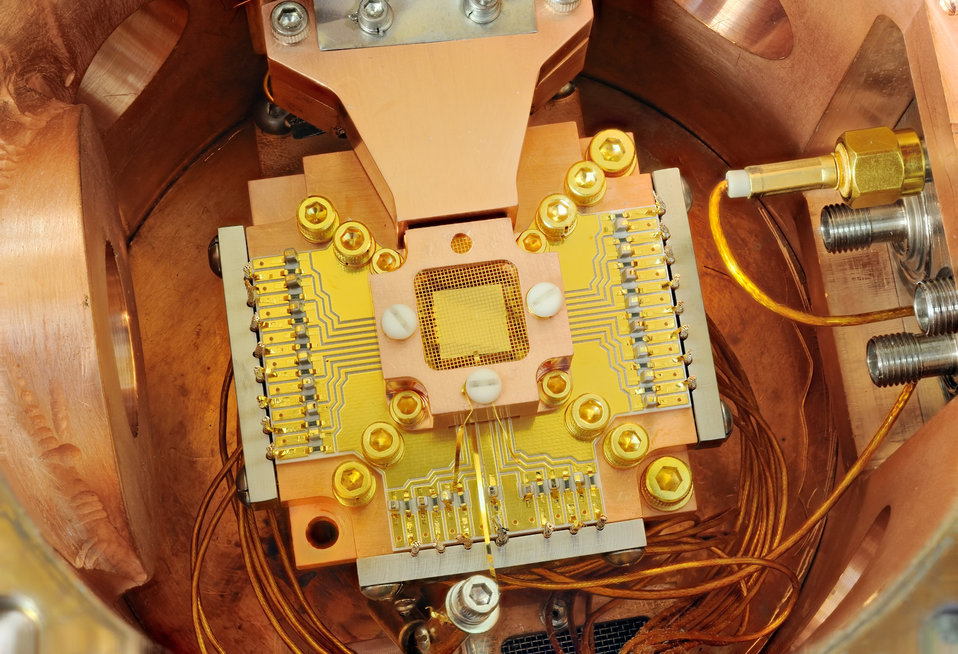
Photo credit: National Institute of Standards and Technology
Sycamore, Google’s 53-bit quantum computer, performed a calculation in 200 seconds that would take the world’s fastest supercomputer, the IBM Summit, 10,000 years to perform, according to a blog post by Google that was also published in Nature magazine last Wednesday. With Sycamore, Google claims to have reached quantum supremacy, the point where a quantum computer can perform calculations that surpass anything the most advanced supercomputers today can do.
Guoping Guo, a professor at the University of Science and Technology of China and founder and chief scientist of Chinese startup Origin Quantum, said the achievement was of “epoch-making significance.”
“Quantum supremacy is the turning point that has proven the superiority of quantum computers over classical computers,” said Guo. “If we fall behind in the next stage of general-purpose quantum computing, it would mean the difference between cold weapons and firearms.”
Quantum computers, which take a new approach to processing information, are theoretically capable of making calculations that are orders of magnitude faster than what the world’s most powerful supercomputers can do.
“With this breakthrough, we’re now one step closer to applying quantum computing to, for example, design more efficient batteries, create fertilizer using less energy, and figure out what molecules might make effective medicines,” Google chief executive Sundar Pichai wrote in a separate post on Wednesday.
While Google celebrated its breakthrough, rivals including IBM and Intel cast doubt over the claims. IBM said Google did not tap the full power of its Summit supercomputer, which could have processed Google’s calculation in two and a half days or faster with ideal simulation.
In a statement, Intel said quantum practicality is much further down the road.
Regardless of the different spins each company put on the achievement, Guo said the huge gap between 200 seconds and two and a half days was sufficient for Google to claim quantum supremacy.
Other Chinese researchers in the field pointed to the significance of the new technologies Google used in the experiment rather than the claim of quantum supremacy itself, such as the adjustable coupler used to connect qubits.
“At this stage, the problems that quantum supremacy can solve have no practical value, but [Google] has demonstrated its ability to perform a computation on such a scale of 53 qubits,” said Huang Heliang, a researcher in superconducting quantum computing at the University of Science and Technology of China. “It is foreseeable that it could lead to breakthroughs and applications in fields such as machine learning in the near future.”
A qubit, or quantum bit, is the basic unit of quantum information, similar to the binary bit in classical computing.
Google is among a group of US technology companies as well as Chinese universities and companies racing to develop quantum computers amid intensifying technology competition between the world’s two biggest economies.





Stay updated on the go with our mobile app.
Get latest insights with smoother, more personalized experience through TIA mobile app.