Photo by Kārlis Dambrāns
Chinese smartphone manufacturer Huawei filed for 3,898 patents in 2015, making it the world’s most patent-happy company for the second year in a row. Qualcomm, the US-based semiconductor company whose chips can be found in everything from the latest Xiaomi phone to Samsung’s flagships, took second place. Chinese Huawei competitor ZTE rounded out the top three, with 2,155 filings of its own.
In short, tech in China made a big showing in global patent filings last year, leaping 16 percent from its 2014 total. What exactly does that mean?
Do patents = innovation?
This patent data comes from the World Intellectual Property Organization (WIPO), a UN-affiliated organization that tracks global patent filings. More specifically, it tracks those under the Patent Cooperation Treaty, a global treaty that wants to make it possible for companies to file a single patent that is applicable across 148 member states.
This graph shows that Huawei didn’t just file the most patents – it exceeded Qualcomm’s #2 slot by more than 60 percent.
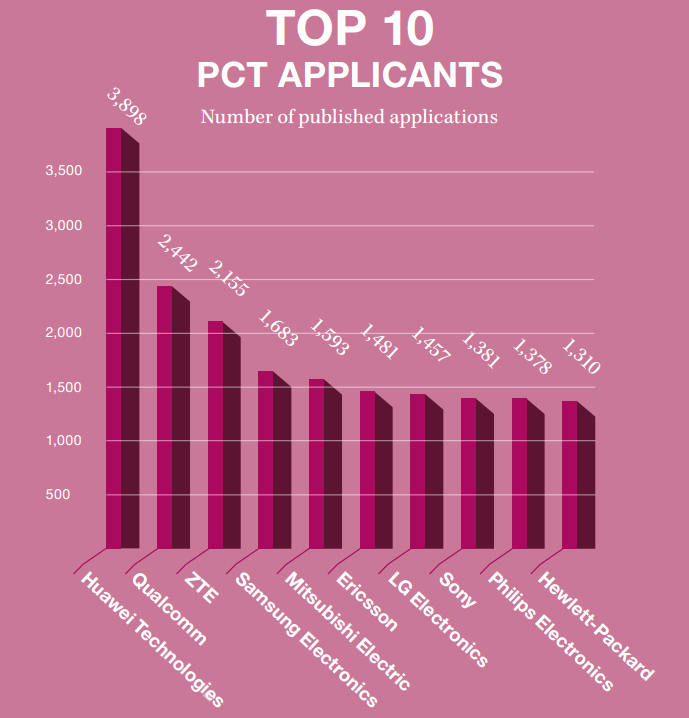
Top worldwide patent applicants in 2015. Chart by WIPO.
And China as a whole applied for a hell of a lot of patents last year: 29,846, to be exact. While still short of Japan and the US (#2 and #1, respectively) the People’s Republic filed for twice as many patents as its next Asian rival, South Korea.
So the numbers are big. But does that mean the innovation is big as well? Sort of.
The People’s Republic filed for twice as many patents as its next Asian rival, South Korea.
Patents can certainly show that a company is coming up with new ideas, but they don’t necessarily mean that those ideas will be realized.
Take Apple, for instance. There is an entire cottage industry of websites devoted to poring over Apple’s patent filings, looking for hints about future devices. It would be wrong to call most of its patent filings meaningless, but they can be misleading.
In 2014, for example, Apple filed a patent for a waterproof phone – something that A) still doesn’t exist two years later and B) has been created by other companies like Sony and Samsung.
Huawei and ZTE’s specific patent filings haven’t been made public, but it’s probably a fair guess to say that many of them are for ideas that the companies may be interested in, but which might not translate to staggering, never-before-seen products anytime too soon. Also, Huawei is more than a simple phone company – many of its patents may be for telecoms infrastructure.
Taking international patents seriously





Stay updated on the go with our mobile app.
Get latest insights with smoother, more personalized experience through TIA mobile app.