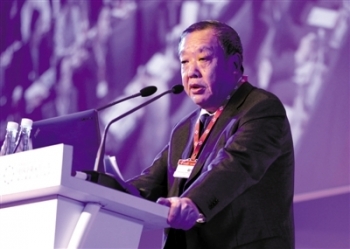
Shao Ning, CFP via Sina Tech
Shao Ning, deputy director of the State-owned Assets Supervision and Administration Commission of the State Council (SASAC), said at a meeting in Beijing on Saturday that the committee would be adjusting the way Chinese state-owned enterprises (SOEs) are run based on new classifications that separate all state-owned enterprises as either “competitive” or “public interest” companies.
It’s unclear what changes, if any, will actually occur in the companies’ day-to-day operations, but the classifications separate SOEs into those whose aim is to make money (“competitive”) and those who may take substantial losses intentionally in order to provide necessary services to the public (“public interest”).
In his explanation of public interest companies, Shao specifically said that category will include “communication services” and companies that have significant monopolies in their industries, both of which indicate that China’s major telecom providers — which are state-owned — will be considered public interest companies.
That could be good news or bad news for consumers, as it likely means lower, government-mandated pricing, but it also eliminates much of the impetus for companies to develop new services and technologies to get ahead of the competition. Economic scholar Hua Sheng responded to the report in a Beijing News article, saying “Doesn’t that mean we’re on the road back to the early days of the reforms [i.e., the 1980s] and all those years of economic reform were for nothing?”
It remains to be seen what effect this will actually have on the operation of telecom provides and other public interest SOEs. It’s also not immediately clear whether Shao was speaking just from the perspective of the SASAC, or whether his view is representative of the central government’s feelings on SOE reform.
In related news, more SOEs are set to pay the government dividends on their profits via the SASAC. Which companies were chosen has not yet been announced, but according to the People’s Daily the list will be published on December 31.
[Beijing News via Sina Tech]





Stay updated on the go with our mobile app.
Get latest insights with smoother, more personalized experience through TIA mobile app.











📅 Upcoming Events
22 October 2026
Payoneer x CSPN Summit 2026