Steven Millward · · 2 min read
Buykee Makes Pinterest Look Cheap, Launches a Luxury Brand Social Commerce Site

China’s already lively online shopping industry has a new challenger this week in the form of the luxury brand-oriented social commerce site Buykee. Newly launched out of a beta testing period, the site is actually a social network more than anything, adding a layer on top of various existing e-commerce platforms.
The Buykee.com experience, then, is a lot more like Pinterest than a conventional e-tailer, with couture clothing products generally aggregated from Tmall, and its high-end gadgets from 360Buy. As such, Buykee is in direct competition with the already numerous shopping-oriented social pinboard sites such as Mogujie, Wantu, or Renren Plaza. We recently looked deeper into Mogujie and saw how it was directing millions of e-commerce clicks each day, with its users making 60,000 purchases as a result. It’s going to be tough for Buykee to match that kind of social commerce firepower.
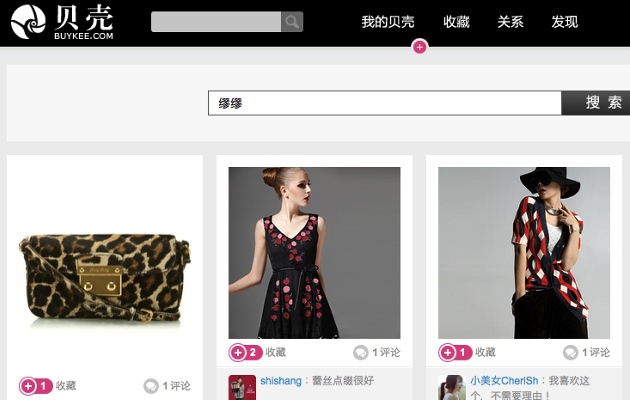
Searching for Miu Miu items on the Buykee site.
If the Buykee name sounds familiar to Chinese readers it’s because the same team, under that same moniker, were active on the web in the first wave of startup social sites in 2005 onwards. But Buykee’s previous iteration as an IT community failed in 2007, and this new launch is the perhaps surprising rebirth of a new social experiment some five years later. “We are coming back,” enthuses a post on the official Buykee blog, saying that the “online shopping portal platform will be the next big thing.” Mogujie – and, indeed, Pinboard – has already proved that to be largely true, so now it’s just a case of building up a solid user-base and then successfully evolving the service. As with its rivals in this space, the initial revenue model is focused on returns from clicks to Alibaba’s Tmall and other e-commerce sites.
The only trouble I see with the concept – especially for a site aimed at luxury brands – is that the element of user-generated content can make product categorization – and the site’s search mechanism – really messy (pictured above). Also, as a shopper I wouldn’t feel very reassured that I’m getting the latest season’s fashions, and would be put off by the idea that I’d be better served on a more conventional luxury e-commerce site such as The Outnet CN, IhaveU, or 360Top. But I’m not a 28-year old Chinese woman with a middle-income pay packet, so I’m not a target user.
The Buykee blog also teases a possible overseas expansion in the future, since it already feels it has a solid English branding and URL.





Stay updated on the go with our mobile app.
Get latest insights with smoother, more personalized experience through TIA mobile app.