
During the pandemic, Brian Kim’s parents discovered the joys of online shopping – but also the perils of the internet.
“They were searching for a product on one platform, and then, five minutes later, the exact same thing popped up in an ad on another platform,” says Kim, who is the director of strategy and operations at data and identity management firm Affinidi. “It felt kind of scary. That’s what happens when people become more aware of how their data is being used – it feels like an invasion of privacy.”

Brian Kim, director of strategy and operations at Affindi / Photo credit: Affinidi
The experience of Kim’s parents speaks to the challenge facing businesses today, where customer expectations for personalized digital experiences are colliding with growing concerns about data privacy and security.
As headlines fill with news of cyber breaches – organizations in Asia Pacific experienced an average of 1,963 attacks per week in 2023 – Kim says customers are getting increasingly wary about how their personal information is being collected and used.
For brands, this results in a sticky situation, one where they’re juggling greater security demands with the need to collect data for more personalized user experiences.
“People are actively sharing their data so their services are more convenient, but it’s just as important that it’s all done in a secure, privacy-preserving way,” Kim adds.
Quality over quantity
Bringing that sense of security to customers has never been more crucial, but it’s important for brands to keep in mind the need to practice data collection in a way that doesn’t overburden the user.
Let’s say a customer wants to try out an investment platform. Odds are, they’re going to have to undergo a rigorous know-your-customer check in addition to the usual identity verification processes. The platform might ask them to upload photos of sensitive personal documents like a driver’s license, which may contain more information than is needed.
While customers understand that these security measures are there to protect them, it’s nevertheless exasperating to have to “repeatedly give their data to different services” just to use a new product, says Kim.

Photo credit: oatawa / Shutterstock
Likewise, from a business perspective, having more data is not necessarily a good thing – businesses should focus on collecting only the most relevant information to reduce the cost of storing data and security risks.
“As a company, you don’t want to end up storing too much information that can be misused or stolen and then having to invest in more security and infrastructure,” he adds .
All this is taking place amid the growing momentum for privacy regulations in Asia Pacific, which is placing additional pressures on companies to innovate their data infrastructures to remain compliant. Businesses now need to think about how to communicate to customers what is being collected and how it is used, especially when partners or third parties are involved in a much more transparent way.
If businesses leave these aspects unaddressed, they risk creating friction in the user experience and uncertainty in customers about the security of their data, which in turn leads to a loss of trust from customers.
“All of this ultimately goes toward how you’re building trust. If you think about it, the reputational damage of a data breach is so much bigger these days than before,” Kim notes. “Customers have so many different alternatives now. They’re going to choose the service they trust over others.”
A holistic take on identity
To tackle these challenges, Affinidi is leveraging holistic identity management, which “flips the script” on how data is collected and managed.
“What we’re trying to do is give data ownership back to customers, rather than these few, big companies owning all of it,” Kim explains. “Customers have more visibility and control over what data they share, how they share it, and how it should be used.”
This user-centric approach inherently builds trust as it relies on customers actively agreeing to share their data while also empowering them to decide what information they are willing to provide.

Photo credit: Chay_Tee / Shutterstock
Let’s say a customer is looking to buy liquor online – they would have to provide proof of age. With the Affinidi Vault, users can store different types of data, such as digital copies of ID cards that certify their legal age. What the liquor retailer gets is the confirmation that the user is able to buy its products without actually having to share the entire ID.
“These are what we call privacy-preserving data sharing solutions,” says Kim. “What we’re building with the Affinidi Trust Network (ATN) is the capability for individuals to collect their data footprint, build a holistic identity, and share that in any shape or form they like, and the capability for businesses to interact with customers to access this holistic identity.”
The concept of a holistic identity also enables users to express their digital selves in a way that reflects who they are in the real world. What Affinidi wants to do is enable users to seamlessly switch between those different digital identities and control what data people can obtain.
“I can be very selective about how I build my profile and minimize the data-sharing – that’s what holistic identity will be able to do,” Kim adds.
The Affinidi Trust Network
Affinidi Vault is just one of the tools in the ATN, which Kim says is the world’s first digital trust infrastructure built on open standards. Complementing it is Affinidi Login, a passwordless authentication product that allows users to easily and quickly sign up with one click and be onboarded, without having to repeatedly provide and share personal sensitive information.
“Login interacts with the Vault to get login credentials, and that data interaction is facilitated by the Affinidi Iota Framework,” he explains, citing the firm’s consent-based data sharing framework built on open standards, which is one of the first of its kind.
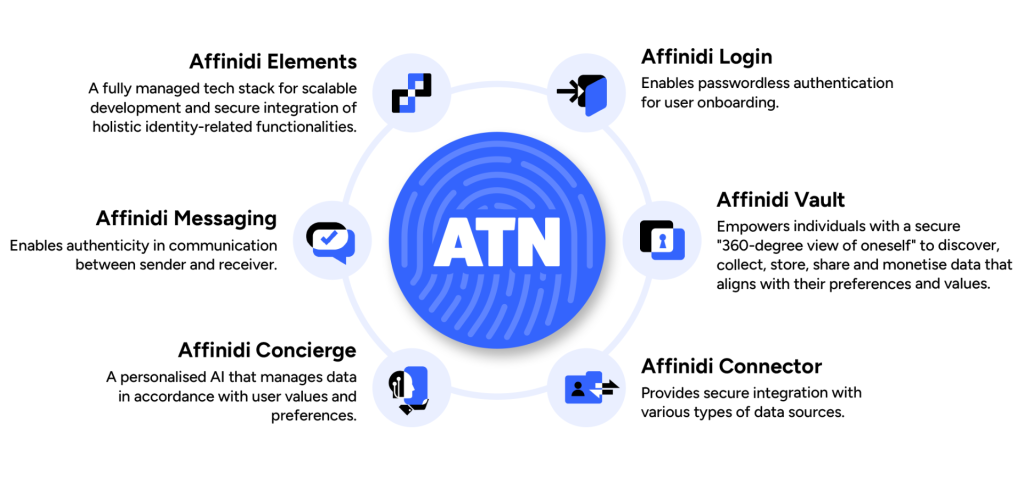
Photo credit: Affinidi
With ATN, businesses can attain the relevant information they need while minimizing collection – ensuring users’ privacy and security – thanks to the Affinidi Iota Framework.
“From a company perspective, I can build a very transparent governance framework that reflects the trusted relationship I have with my customers,” says Kim.
Businesses are doubly protected because they own none of the data, as it’s all stored in a wallet on users’ devices. That helps keep them compliant with evolving global regulatory trends, thus reducing their data risks and costs.
Additionally, Affinidi’s entire system is built on open-source technology, reducing the risks of technical debt and leaving the door open for further innovation.
“We’re providing a different way to share data so businesses have the ability to better understand their customers, allowing them to focus on delivering their core services and build trust,” Kim explains. “You don’t want to get stuck spending on security or data storage when you could be investing into innovating and creating customer value.”
A bridge between worlds
As concerns about data privacy continue to mount, Affinidi sees a big opportunity for holistic identity to become the norm, addressing the major challenges faced by brands today.
“I think ATN fits nicely in that verification gap,” Kim says. “We’re going to help businesses build that seamless user experience in a way that enhances privacy and security.”
Ultimately, the company is looking to bridge the physical and digital worlds, where Kim sees an “imbalance” in terms of how trust is defined.
“As a company, we want to build a technology that doesn’t create silos, whether it’s between platforms or technologies or systems,” he explains. “What Affinidi is looking to enable is trust in the digital space.”
Affinidi is a technology company dedicated to changing data ownership for good. By placing control back into the hands of users, its solutions strengthen trust to foster strong communities.
Find out more about Affinidi on its website.
This content was produced by Tech in Asia Studios, which connects brands with Asia’s tech community. Learn more about partnering with Tech in Asia Studios.
Stay updated on the go with our mobile app.
Get latest insights with smoother, more personalized experience through TIA mobile app.
Recommended reads
 Who pays for AI in your language?
 MoneySmart grows revenue by 26% in 2025, but AI threatens margins
 The truth about AI language models: No one wants to pay for them
 Tracking AI hiring in Singapore: OpenAI, Anthropic, and more
 Korea’s physical AI ambitions meet the factory’s bottom line
 SEA financials tracker: Moladin’s revenue rises 6% in 2025
 On‑demand services lift Line Man Wongnai’s 2025 revenue to $544m
 Flipkart’s costly late push into quick commerce and food delivery
 Inside Singapore’s government team that kills its own products
 Once an IPO hopeful, SCI Ecommerce nears collapse





Editing by Stefanie Yeo, Winston Zhang, and Lorenzo Kyle Subido
(And yes, we’re serious about ethics and transparency. More information here.)





