 Leighton Cosseboom · · 6 min read
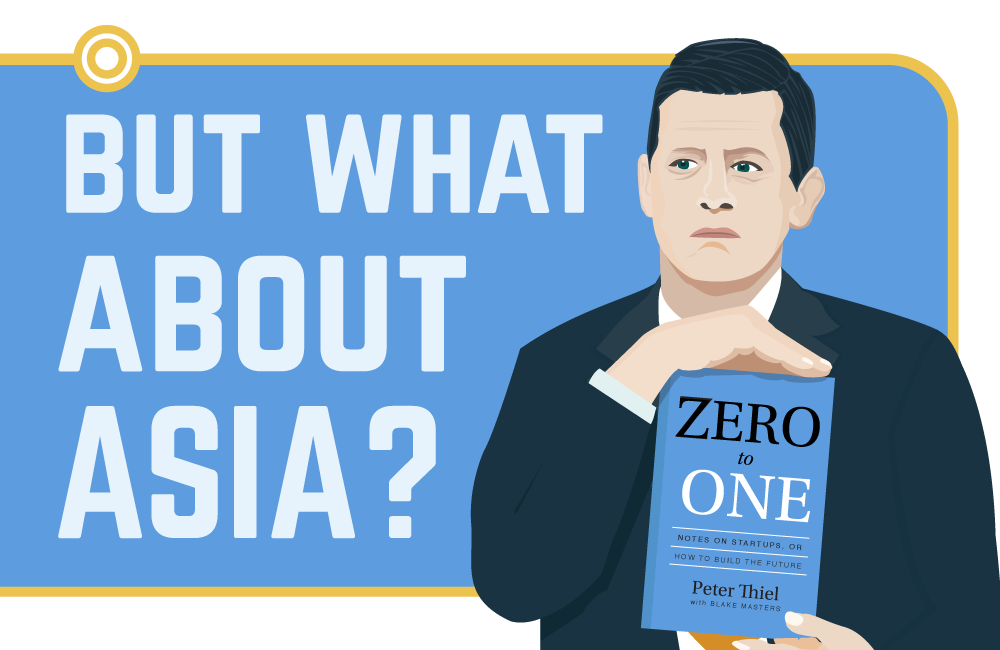
Zero to One is a great book. But is Peter Thiel oversimplifying Asia?
I hesitate to disagree with Peter Thiel. Zero to One: Notes on Startups, or How to Build the Future has received nothing less than stellar reviews since its September release. The book is still the number one bestseller in Amazon’s entrepreneurship category, and Forbes calls it “a spectacular book on economics.” Derek Thompson of The Atlantic goes so far as to say it might be the best business book he’s ever read.
Tech in Asia is inclined to agree. Zero to One is a much needed breath of fresh air for anyone who reads entrepreneur books, studies the global economy, or loves to wax intellectual on business philosophies and startups. As Thiel’s work is extremely dense, with a variety of interesting topics that could each occupy their own feature article, I worry about trying to stuff a whale into a tuna can by covering the entire book here.
True, it’s a great read, but I’d like to focus on two specific things from Zero to One that bothered me: Thiel’s optimist-pessimist spectrum – particularly where Asia can be placed on it – and whether or not it’s fair to say that financial conservatism in Asia is a result of fear.
Definite optimism, definite pessimism, and everything in between
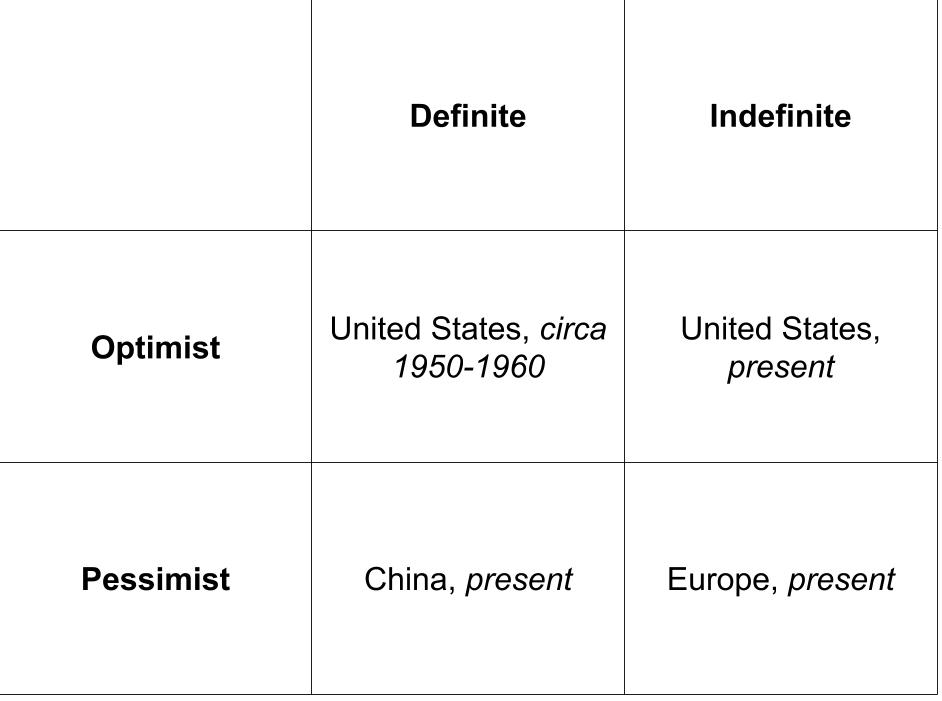
In chapter six, Thiel presents a simple quadrant chart (see below) that rationalizes the confidence levels of societies based on two key perceptions about the future: optimism and certainty. Thiel argues that the reason China is scrambling to create copycat tech products is that, as a society, the country has a “definite pessimistic” view of the future. He writes:
China is probably the most pessimistic place in the world today. When Americans see the Chinese economy growing ferociously fast (10 percent per year since 2000), we imagine a confident country mastering its own future. But that’s because Americans are still optimists, and we project our optimism onto China. From China’s viewpoint, economic growth cannot come fast enough. Every other country is afraid that China is going to take over the world; China is the only country afraid that it won’t.
Thiel also asserts that savings are at an all time high and investments are at an all time low when societies fall into the indefinite pessimistic quadrant. Conversely, investments are at a peak when societies exhibit traits of definite optimism, like the way the US was in the 1950’s and 60’s. Thiel puts China into the quadrant where investments and savings are high simultaneously. How can this be? As the Chinese are so-called “definite pessimists,” this can only mean that while they save a shitload of money, they’re also investing somewhat conservatively in super safe startups with proven business models (ie: cloning products that have already been successful in the US). This may hold true to a degree, but is it correct across the board? And what about the rest of Asia?
Asia seems optimistic because it is optimistic
To wit, I believe Thiel hasn’t hit the nail on the head in a couple of areas. First of all, China – and the rest of Asia for that matter – doesn’t seem all that pessimistic from the perspective of someone on the ground. Quite the opposite, actually. Internet entrepreneurship in China first gained momentum just over a decade ago, but lessons have already been absorbed and passed down to a second generation of entrepreneurs, according to author Rebecca Fannin. “The first generation of Chinese entrepreneurs is unlikely to retire to a beach or the golf course, in part because they earned their money while still very young,” says Fannin. “Many are already using their wealth in other ways. Some say [Jack Ma]’s involvement in philanthropy and environmental causes is just one further sign of China’s evolution. The more typical course however has been to try their luck again at another startup or to help others get going.”
Regarding the rest of Asia, a recent Nielsen study says Indonesia is the most confident market globally in terms of economic outlook, followed by the Philippines. Southeast Asian economies also dominate the top 10 rankings of the world’s biggest savers. Vishal Bali, managing director of Nielsen’s consumer insights business in Southeast Asia, North Asia, and Pacific says, “With more disposable income than ever before, consumers across Southeast Asia have the opportunity to consider investing their money and bolstering their savings accounts […] These latest findings indicate Southeast Asian consumers are thinking about and planning for the future.”





Stay updated on the go with our mobile app.
Get latest insights with smoother, more personalized experience through TIA mobile app.








📅 Upcoming Events
22 October 2026
Payoneer x CSPN Summit 2026