 Eli Schwartz · · 6 min read
Google is the solution, not the problem, in the war against medical misinformation.
Disclosure: Eli Schwartz is the Director of Marketing APAC at SurveyMonkey.
Photo credit: Truehealth Programs
We are privileged to live in an age overflowing with information. With access to the entire world’s knowledge literally in our pockets, there is never an excuse to have dinner debates about whether Friendster was the world’s first social network or the source of a Singlish phrase. Even more than the random useless trivia that we draw from the internet, we pretend the internet can substitute as as our parents, our legal advisors and even our clergy.
One major area of online search is health. We find a rash on our arm, we ask Siri to Google it. We even ask Google to diagnose multiple symptoms (bad idea: the results usually, falsely, point to a deathly disease). To anyone who read the recent news about a person dying as a result of a Baidu search, this comes as no surprise, and we all do it. While Baidu might have quality issues when it comes to ranking results, the same wrong information is still available on Google.
Search as the means
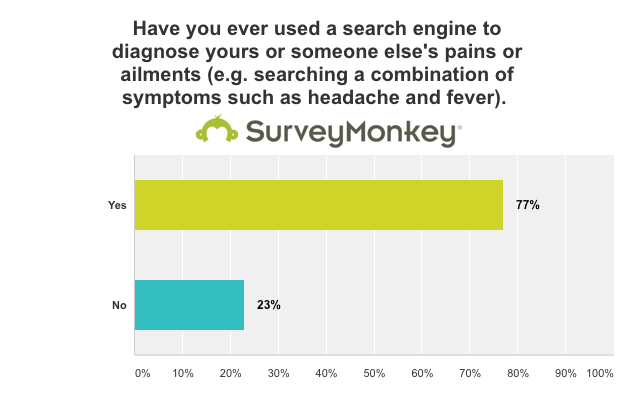
According to a survey I conducted in the US on SurveyMonkey Audience with 395 random Americans, 77 percent of respondents admitted to going online to diagnose medical symptoms. (Please take the survey here so we can see how readers align with the existing sample.)
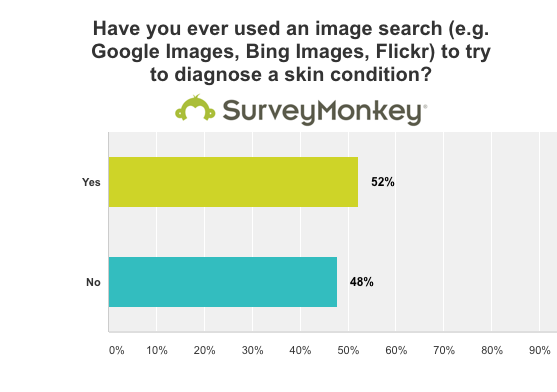
52 percent of Americans even used an image search engine like Google Images or Pinterest to diagnose a skin condition. (Googling for anything bed bug related is the most common.)
While many medical professionals are opposed to this practice, there are others who think it’s a great idea. According to these medical professionals, searching online for answers to health issues leads to a more engaged patient and even allows people to figure out if a “nasty rash” is a mosquito bite or a creeping parasitic infection that requires a trip to the emergency room. Self-diagnosis might even be a good method to reduce the load on the health care system by empowering patients to triage themselves.
The source of all of this health info
However, there is one major issue with this hypothesis: Much of the medical resources on the web is horrifically inaccurate (just like everything else on the web). The authors of the vast trove of health information on the Internet are not trained medical professionals. Rather, they are “content marketers” hired to produce articles to rank high on Google searches. That means that much of Google’s highest ranked medical advice is written by a person whose job is to simply bring people to a website.
Lacking the medical background to write original medical information, content marketers source their writing from other websites. For the discerning content marketer trained to ignore user generated content, they instead source content written by other content marketers thus contributing to the ever growing cycle of manufactured, and often false, medical advice.
“There are ample examples of how doctors who have taken an oath to ‘do no harm’ respond to financial and other incentives in ways that do harm patients,” says Josh Steimle, CEO of digital marketing agency MWI, citing a 2015 Los Angeles Times article that explores variances in the rates of c-section births in Los Angeles area hospitals.
Example
Google as the savior
Health search in the new norm





Stay updated on the go with our mobile app.
Get latest insights with smoother, more personalized experience through TIA mobile app.











📅 Upcoming Events
22 October 2026
Payoneer x CSPN Summit 2026