- Premium Content It takes our newsroom weeks - if not months - to investigate and produce stories for our premium content. You can’t find them anywhere else.
 Emmanuel Samarathisa · · 5 min read
3 things about Malaysia’s new ‘startup’ government
Malaysia’s new government has gone to work. Prime Minister Anwar Ibrahim announced his Cabinet last Saturday and has appointed 28 ministers. Deputy ministers and other roles will be revealed later, but the most important part was settled.
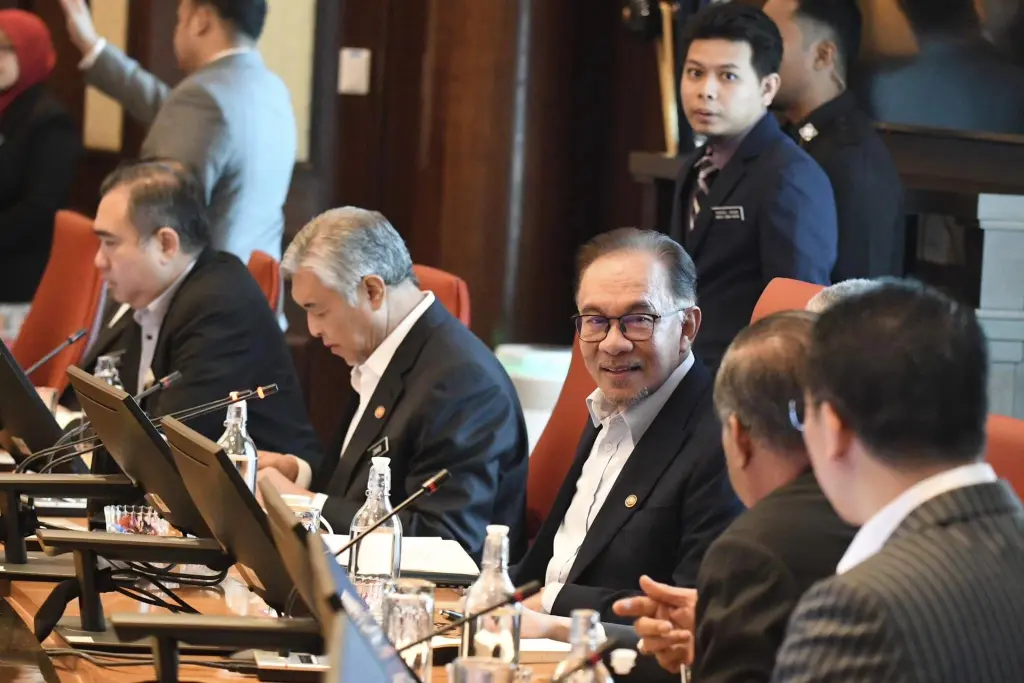
Prime Minister Anwar Ibrahim (in glasses) chairing his second Cabinet meeting on Wednesday / Photo credit: Anwar Ibrahim’s Facebook page
I’m hoping that by next week, we can take a break from this heavy political coverage cycle. But since this is an ongoing and important development, we’ll have to stomach this for a while because politics will have an impact on startups and the tech space in general – to a certain degree.
“Extraordinary circumstances”
For starters, Anwar has gone back to the old days of consolidating the prime minister and finance minister roles. This bestows him with near-absolute power. Malaysia’s federal constitution already makes the PM a powerful person, but coupled with the finance portfolio, he can single-handedly dictate where the government should invest without check and balance.
You could argue that Anwar’s Cabinet members would scrutinize deals and provide input. Ditto lawmakers in parliament, but dissent is rare. That’s how the 1MDB scandal exploded – it was because then-PM Najib Razak was also finance minister and he had the backing of his coalition.
After winning the 14th general election in 2018, Pakatan Harapan (PH) – Anwar’s coalition, which was then under the leadership of Mahathir Mohamad – separated the portfolios. PH was ousted by a coup in 2020 and the two successive governments since then have maintained that separation.
This time, Anwar merged it ostensibly due to “extraordinary circumstances”. He also believes that he is the best person to draw in foreign investors.
While another 1MDB scandal is possible, Anwar has assured none of these things will occur under his leadership. He doesn’t have the privilege of leading a strong, single coalition, unlike his predecessors.
This time, the new government is more of a consensus between Anwar’s and two other coalitions. So the PM can’t do as he pleases as he might risk losing support, which could trigger a change in government or another election.
Raising the bar
As for tech reforms, I’m betting that it will fall on Anwar’s colleague, Rafizi Ramli, who’s also the economic affairs minister. Rafizi runs an AI startup called Invoke Solutions, so he’s very much attuned to the startup and tech scene.
Rafizi isn’t Nadiem Makarim, who took on the education minister role after growing super app Gojek into a unicorn. Invoke is not even near soonicorn status as the startup is currently valued at 105 million ringgit (US$23 million), according to Rafizi. But this is Malaysia where the bar is low, so we’ll have to start somewhere.
The good news is that Rafizi is different from earlier officeholders who were career politicians – he has dabbled in both startups and politics.
He has also hinted that Malaysia will move away from being commodities-driven, which has been the case since forever. So that gives a glimmer of hope that we’ll see a more lively space that will have a greater emphasis on tech and digital policies as well as funding.
The difference between the finance and economics affairs ministries is that the former crafts policies, especially on revenue generation while the latter focuses more on development and long-term goals.
Tackling monopolies
Stay ahead in Asia’s tech landscape
This is premium content. Subscribe to read the full story.
The country is open for business, but reforms may be slow.
We know this is not ideal. ⌛ Sign up in 20 seconds. Cancel anytime.
Our subscriber community includes professionals from these companies:





Stay updated on the go with our mobile app.
Get latest insights with smoother, more personalized experience through TIA mobile app.