Terence Lee · · 3 min read
Apple has been trying to trademark ‘startup’ since 2011 in Singapore, China, US, Australia
 Digital News Asia reported today that Apple has filed a trademark for the word ‘startup’ in Malaysia, which will cover retail store services, hardware maintenance, education services, as well as hardware and software design.
Apple has also registered the same trademark for the second time in Australia on August 27, according to TM Watch. The first application, made in 2011, is stuck in limbo.
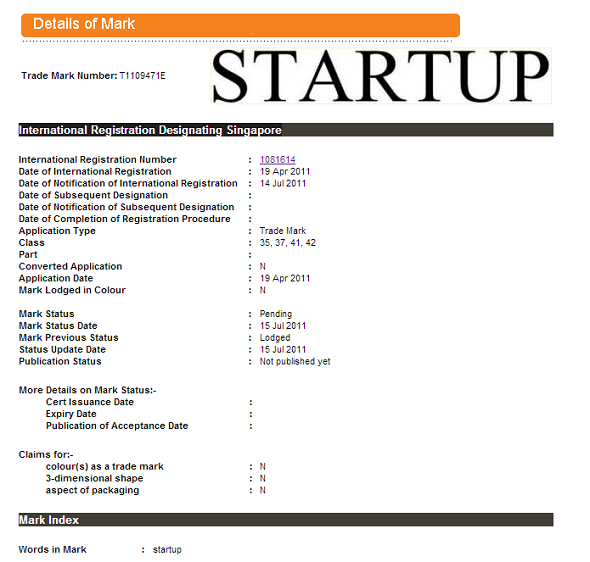
It turns out that the same filing has also been made in Singapore, China, and the US since 2011, covering the same type of services. In Singapore, the mark is still pending approval despite being registered more than two years ago, which suggests that the registration has faced complications.
It is unclear if the Intellectual Property Office of Singapore received any objections, since any party can oppose the trademark two months after it was filed.
In the United States, Apple’s trademark has faced resistance, according to Wired. The computing giant has until September 20 this year to respond to the objections.
The company’s trademark application in Singapore was filed through the Madrid Protocol, an international registration system for marks of which Singapore is a member country. The US, China, and Australia registrations have also been filed through the same system.
While trademarking English words may sound preposterous, it is in fact legally possible to trademark them as long as the mark is distinctive and capable of distinguishing the applicant’s goods or services from other traders, intellectual property lawyer Foong Cheng Leong told Digital News Asia.
If successfully registered in a country, Apple would have exclusive rights to use the word in the category of services it has specified, and even variations like ‘STARTUP’, ‘Startup’, or ‘StartUp’ are covered.
As an example, Foong points out that startup boot camps, accelerator programmes and government-initiated programs with the term in their names may be liable to trademark infringement should Apple be successful.
But if the trademark distinctiveness test is any indication however, Apple’s applications may face an uphill climb. Trademark registrations are judged based on how unique they are.
This means that fanciful and arbitrary marks like Exxon for petroleum products and Apple for computers are more likely to be accepted since they bear no relation to the product.
On the other hand, generic terms are more likely to be rejected. A term like ‘startup’ is already commonly used: Startup a computer, Windows Startup, and startup companies are just some examples.
That said, different jurisdictions may have different ideas about how generic a term is.
Apple has yet to respond to press inquiries on the matter. Its reasons for trademarking the word is unclear.





Stay updated on the go with our mobile app.
Get latest insights with smoother, more personalized experience through TIA mobile app.