Rita Liao · · 6 min read
Tencent-Bytedance legal spat highlights China’s escalating short-video war

Slogan of Tencent‘s short-video app Weishi: to discover the more interesting / Image credit: Weishi
Tencent and Bytedance are in fight mode. While recent weeks have seen the two firms get embroiled in a legal dispute, their larger battle for China’s short-video app market has also heated up.
Tencent has ramped up efforts to challenge Bytedance’s fast ascent in this market, which is now one-third the size of the country’s 1.1 billion mobile internet population. It is estimated to hit US$5.54 billion consumer spend in 2020.
Bytedance currently owns three out of the five most popular short-video apps in China: Douyin, Xigua, and Huoshan, according to data research firm Analysys.
Not to be outdone, Tencent in April revived Weishi – its first app in this category – after “abandoning” it more than three years ago, as reported by local media. In May, it introduced a second short-video app called Xiafan.
Prior to these, WeChat’s operator only owned a stake in Kuaishou – China’s number one short-video app – through a US$350 million funding round it led last March.
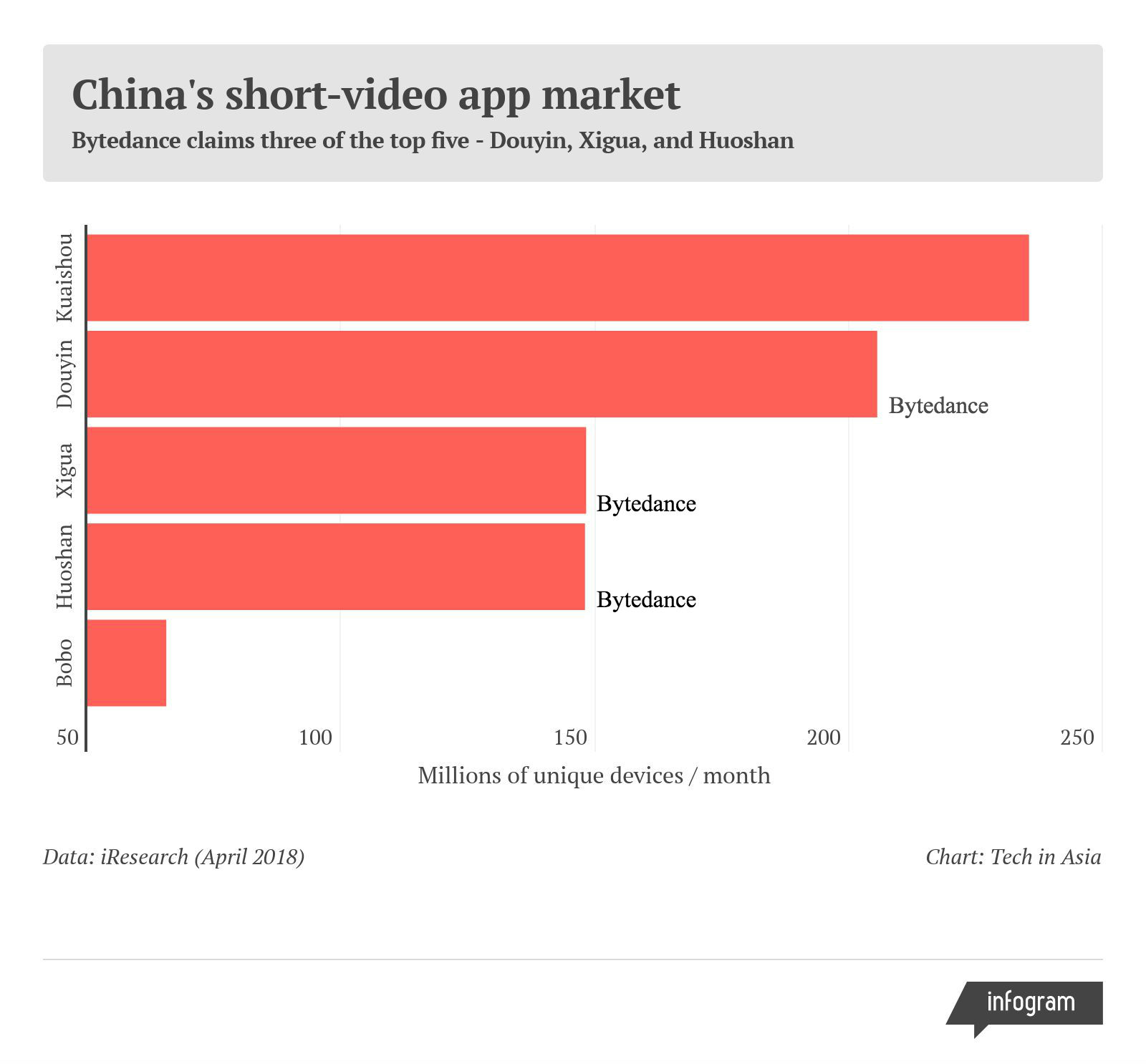
Though Bytedance seems to have the upper hand, analysts believe Tencent isn’t too late to the game as the market is still expanding. Moreover, Tencent’s dominance in online content and social media means that it has a shot at reshaping the micro-video sector. But it won’t be an easy fight.
A big threat
Tencent sees the huge opportunity in shorter media formats. As its president Martin Lau explained during the firm’s Q1 2018 earnings call, growth in text and photos has stalled, and the future lies in micro-sized, digestible videos.
Weishi, which means “micro videos” in Chinese, lets users create 15-second clips with various effects and then share them. The app has become Tencent’s newest weapon in its quest for more eyeball time.
Chen Weiyu, co-founder of new media data analytics firm New Rank, echoes Lau’s view. Chen thinks the media formats that will prevail are those that can carry denser information. The popularity of short videos “is a manifestation of this rule,” he told Tech in Asia at the GMIC Beijing event in April.
Tencent has been making forays into different verticals by funding or acquiring companies, and its Kuaishou investment is one example. But short video is so close to Tencent’s core that it probably prefers to pursue it on its own, Ma Shicong, an analyst at Analysys, explains to Tech in Asia.
“There’s a strong social aspect to short-video apps,” says Ma, citing how they present a new medium for online expression and interaction.
Playing catch-up
Fight on different fronts





Stay updated on the go with our mobile app.
Get latest insights with smoother, more personalized experience through TIA mobile app.