- Insights This article was written by a TIA community member. Insights pieces undergo the same rigorous editorial process that newsroom-produced articles have.
 Stephen Turban · · 6 min read
Why blockchain founders brag about their community size

Photo credit: hobbitfoot / 123RF Stock Photo
Stephen is a TIA Star Contributor and publishes high-value content that serves the Asian tech community. Read more from TIA Star Contributors here.
In every blockchain conference, a startup founder will inevitably go on-stage and brag about their “community size.” “Our Telegram group has 15,000 members,” one might boast. “Our subreddit has 5,000 subscribers,” another will say. ”We’ve got a combined community of over 200,000 people,” a third might offer.
Whenever I hear someone brag about their cryptocurrency community, I get suspicious. If I were a traditional business, I’d brag about my revenue or profit. If I were a product company, I’d brag about the number of users. But, if I’m in crypto, I brag about the number of people who follow a subreddit about me?
To understand why, I began investigating the structure of blockchain communities. I wanted to answer the question: do communities matter more for blockchain projects than traditional companies?
How communities for blockchain projects are different
To understand blockchain communities, let’s look at the stakeholders of a more traditional company. I’d argue that there are three, relatively separate groups: users, investors, and contributors. Let’s use a brick-and-mortar company like Walmart to anchor the example.
- Investors: Investors are the people who own the company and provide capital. In the case of Walmart, this is a combination of the Walton family, public investors via stocks, and private investors.
- Contributors: Contributors are the people who help run the company. For Walmart, this would range from c-suite executives to cashiers in the stores.
- Users: Users are the people who buy or otherwise use the service you provide. In the case of Walmart, this would be your customers in the store.
To be sure, there is some overlap between these groups—some investors are also shoppers at Walmart and some shoppers are also employees. But this overlap is incidental.
Blockchain communities break down this paradigm
For blockchain projects, there is a complete overlap between these three groups. Blockchain community members serve as investors, contributors, and users.
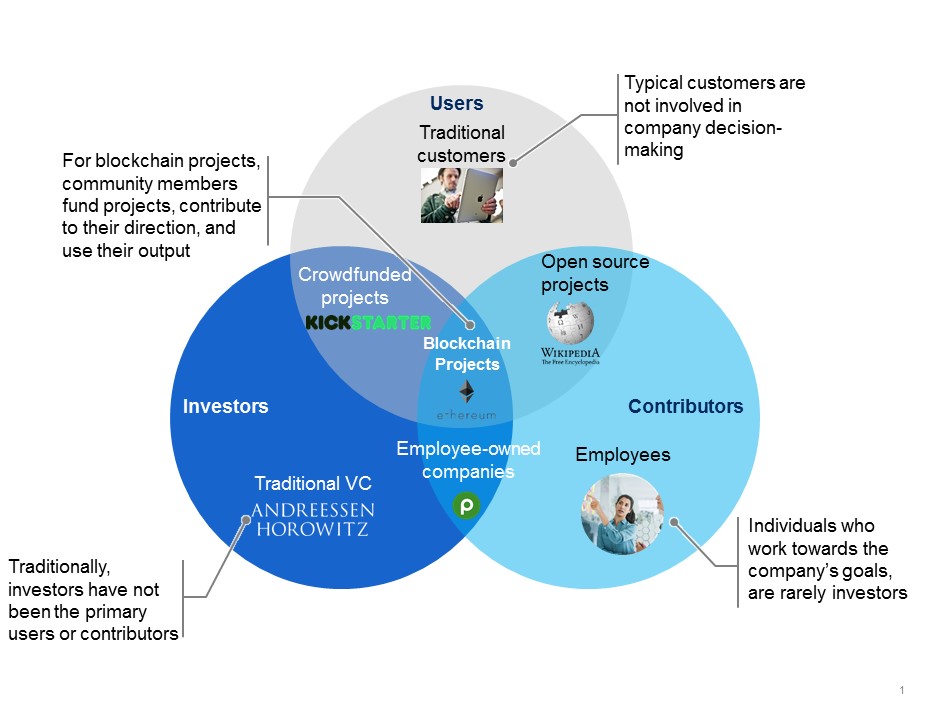
Let’s take Ethereum as an example. Ethereum’s success lies intimately with its community because the community serves a number of important roles. First, the community drives the direction of the project. If a blockchain is public, that means that changes to its code base are made via consensus. To make a change, a majority of Ethereum miners need to accept the code changes and direct their mining power toward the new chain (this is called a “fork” in crypto lingo).
Similarly, because all public chains are open source, community members can use the code base to create their own projects. Ethereum, for example, allows groups to create dApps (distributed applications) which can create specific projects on top of its blockchain. In this way, people in the community are both contributors and users of the Ethereum blockchain.
Finally, funding for Ethereum comes from people who hold the ETH cryptocurrency. The more people who use Ethereum, the higher the value of the coin. This, in turn, increases the capital that ETH holders have to spend on developing more projects for Ethereum.
Why size matters for communities
What communities can’t do





Stay updated on the go with our mobile app.
Get latest insights with smoother, more personalized experience through TIA mobile app.