Michael Tegos · · 5 min read
Hitching a ride on Jeff Bezos’ rocket to bring broadband to rural Thailand
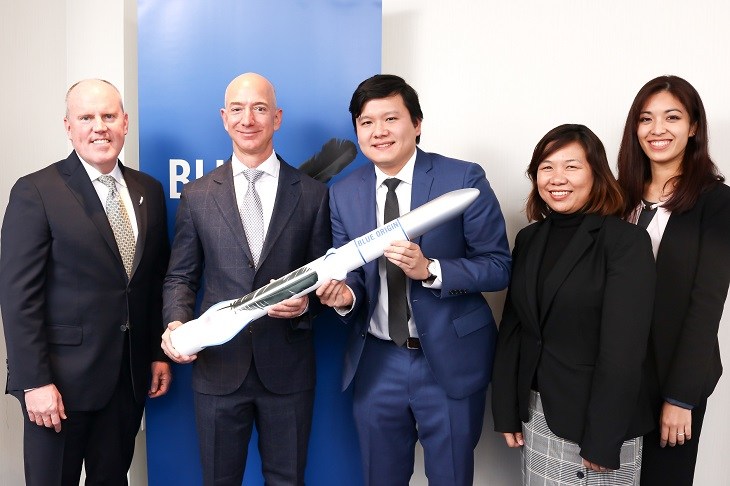
Mu Space CEO James Yenbamroong and Jeff Bezos hold up a model of the New Glenn launcher / Photo credit: Tony Powell, Blue Origin
Spacetech startups are blossoming. Cheap and quick to manufacture, satellites have become an easy entry point for small companies that are rushing their own Sputniks into orbit with Space Age fervor. This means that spacetech startups are appearing in countries that lack a space tradition. Take Mu Space, for instance. It was founded in Thailand in 2017 by James Yenbamroong, a Thai-born, US-educated engineer who previously worked for American aerospace and defense company Northrop Grumman.
He came back to Thailand to start the company because he wanted to solve local problems through technology. “Satellite applications are beneficial to people, particularly in remote areas,” Yenbamroong, who is the CEO of Mu Space, tells Tech in Asia. “Satellites, for example, can be used to deliver distance learning to students in rural schools or e-health services in remote community clinics.”
Connecting rural areas
Yenbamroong grew up in Thailand and New Zealand before studying aerospace and mechanical engineering at the University of California. After graduating, he led unmanned vehicle projects at Northrop Grumman where he learned what satellites can do beyond telecommunications. He wanted to explore applications like environmental monitoring and search and rescue operations.
Yet telecommunications is Mu Space’s square one, targeting Thailand’s rural population with no access to broadband. According to the kingdom’s National Broadcast and Telecommunications Commission (NBTC), only about 8.3 million people out of Thailand’s population of 69 million have broadband access – that’s about 12 percent.
As part of the Thailand 4.0 initiative, the government last year pledged to bring broadband connectivity to Thailand’s 70,000 villages by end of 2018. These areas are underserved because it’s impractical and costly for providers to lay down the necessary infrastructure to reach them.
To start with, Mu Space is renting capacity from a fleet of satellites belonging to global satellite and telecommunications firm SES Networks to provide connectivity to such areas.
Eventually, the startup wants to deploy its own satellite, and it’s negotiating with manufacturing partners to do so. It was recently allowed to operate a satellite service in Thailand by NBTC, the first local spacetech startup to clinch such a license.
Through the SES partnership and by engaging telcos in Thailand, Mu Space expects to start generating income within the year. However, Yenbamroong declined to share revenue estimates.
Mu Space is renting capacity from a fleet of satellites belonging to global satellite and telecommunications firm SES Networks.
Mu Space plans to launch its first satellite in 2020 and is hitching a ride on New Glenn, the massive rocket built by Jeff Bezos’ Blue Origin. The Thai startup went with the SpaceX rival, preferring its version of reusable rocket technology. While SpaceX’s rockets have the same feature, Mu Space thought Blue Origin was more suited to their budget. The startup didn’t reveal the cost.
“There were lots of emails back and forth, meetings, and negotiations,” Yenbamroong recounts. “Definitely, we had to demonstrate to Blue Origin our seriousness and capability to launch our satellite aboard their vehicle before we closed the deal.”
In-person meetings between the companies involved the standard hashing out of terms and contract clauses, including detailed costs of using the rocket for a launch, confidentiality terms, and so on. Mu Space still meets Blue Origin every three months on average to go over strategy and show their progress and plans. The team feels this helped build trust between them and Blue Origin.
In the lead-up to the launch, it’s keeping the lights on by providing broadband connectivity through their satellite partner to Thailand’s Digital Park innovation hub in Chonburi.
Lofty ambitions
Looking skyward





Stay updated on the go with our mobile app.
Get latest insights with smoother, more personalized experience through TIA mobile app.