Paul Bischoff · · 3 min read
India’s Premji and China’s Tencent back Cyanogen’s $80M funding
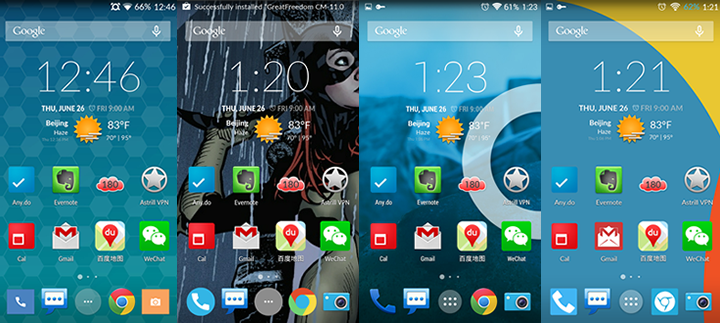
Cyanogen OS themes
Cyanogen, the US-based maker of an alternative Android-based mobile operating system called Cyanogen OS, announced today it completed a US$80 million series C round of funding. India’s Premji Invest led the round, followed by Twitter Ventures, Qualcomm, Telefonica Ventures, Smartfren Telecom, Index Ventures, Access Industries, Rupert Murdoch, Vivi Nevo and other undisclosed investors. Previous investors Benchmark, Andreesen Horowitz, Redpoint Ventures, and Tencent Holdings also participated, according to an announcement on the company’s website.
"We invested in Cyanogen because we’re big proponents of what they’re doing in opening up Android and supporting global and local ecosystem players," said Sandesh Patnam, technology sector lead of India’s Premji Invest. "Cyanogen is well positioned to become the 3rd leading mobile OS, and we’re excited to back them in growing their business on a global scale."
Cyanogen has navigated Asia well, first in China and then in India. Big developing markets like China and India are ripe with opportunity for Cyanogen, where many users are buying smartphones for the first time and aren’t yet tethered to the Google ecosystem (or are blocked from doing so, in China’s case).
Cyaongen OS comes pre-installed on the OnePlus One smartphone and some Oppo models from China, a market where local phone makers are prohibited from using Google’s version of Android. Chinese brands must cut out services like Google Search, Google Play, and Gmail, either by making their own Android skin (called a ROM) or co-opting an alternative like Cyanogen.
Tencent is currently testing its own Android fork called Tencent OS. This is the Chinese social giant’s second consecutive investment in Cyanogen.
India’s grass is greener
Cyanogen recently turned its attention to India. The company ended up spurning OnePlus when it agreed to an exclusive partnership with local phone maker Micromax. OnePlus had just entered India and was rattled by Cyanogen’s betrayal. OnePlus is now working on its own Android ROM to replace Cyanogen.
With Cyanogen at its side, homegrown Indian brand Micromax wants to beat back Xiaomi and take the top selling spot from Samsung in the burgeoning market. Micromax recently launched a new budget brand of high-spec smartphones, largely modeled on Xiaomi. The “Yu” line of phones sports Cyanogen out of the box. In an interview with FoundingFuel, Cyanogen founder Kirt McMaster said, "Yu plus Cyanogen will be the Xiaomi of India. There’s no question about that."
Micromax launched the first Cyanogen-powered Yu phone for just US$140 in December, but Micromax isn’t putting all of its eggs in one basket just yet. Google’s favor isn’t lightly abandoned; Micromax offers the Canvas A1 under Google’s Android One budget phone program.
Cyanogen is no stranger to brashness. Its founder, Kirt McMaster, has publicly challenged Google, the creator of Android, and aspires to beat the search giant at its own game. McMaster wants to ween Android off of the Google services that ultimately drive Google’s revenue, creating a distinctive and independent mobile operating system. In an interview with Forbes, McMaster boasted, "We’re putting a bullet through Google’s head."
Cyanogen has raised a total of US$110 million in funding to date.
Editing by Josh Horwitz
(And yes, we’re serious about ethics and transparency. More information here.)





Stay updated on the go with our mobile app.
Get latest insights with smoother, more personalized experience through TIA mobile app.