Willis Wee · · 3 min read
Alibaba: E-commerce Changes Lives in China, Talks About Social, Data, and the Future
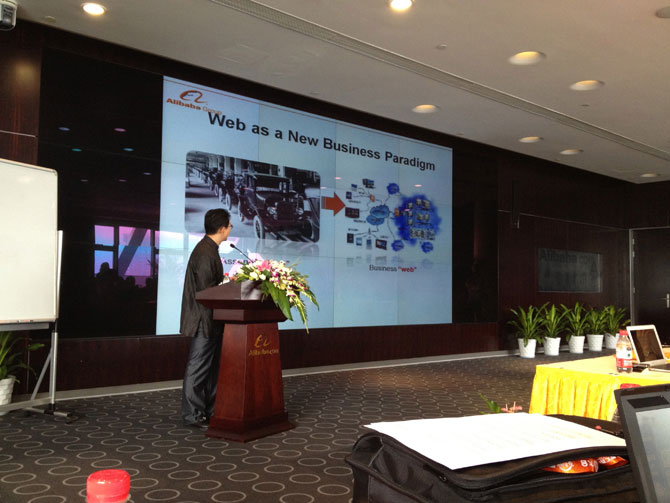
Prof Zeng Ming, Alibaba’s chief strategy officer, shared some of his thoughts on how e-commerce has changed lives in China and also business in China. E-commerce has grown so quickly in China, about 100 percent annually according to Zeng.
Thinking of the challenges, Zeng claims that logistics are the “bottleneck of e-commerce” in China. While e-commerce in China grows at 100 percent each year, the national logistics industry only grows at 40 percent annually. Zeng noted that out of 60 million parcels sent in China, 10 million are generated from e-commerce. He also talked about the role of e-commerce in China:
E-commerce is not just online sales, but transforming business in every aspect, step by step. E-commerce in China is revolutionary.
He went on to explain that third- and fourth-tier cities can’t get a good selection of products from brick-and-mortar stores at good prices. But now e-commerce allows folks in those far-flung cities to have an avenue to buy the same products as the people living in Beijing or Shanghai as long as they have at least a mobile phone to access the web.
Moving forward, Zeng believes that the future of e-commerce will be more customer driven, focused more on “built to order” and “mass customization.” He remarked that there will be a shift — from B2C (business-to-consumer) to C2B (consumer-to-business), which I believe is similar to the JIT) (just-in-time) manufacturing process.
In the traditional supply chain model, the lead manufacturer controls the chain. But Zeng believes that the supply chain management in the future will be integrated into the web. It will no longer be totally controlled by the lead manufacturer and information will be reflected real-time across the supply chain – which would require the company to be more flexible to demands both up and down the chain.

Zeng also noted that data is an important asset for Alibaba in the future. He said, quoting a famous management quote that, “If we can’t measure things by numbers, we can’t manage it.” Curious to know about that data it holds, I asked what’s the role of eTao, its product search engine, in Alibaba’s future. The topic is quite widely talked about in the country since Alibaba, as an e-commerce company at heart, tracks the prices of other e-commerce sites (many of which are their competitors) in China on eTaos.
Zeng says that what people search and find online in terms of products is important data for Alibaba but didn’t elaborate how Alibaba will use it. He did, however, note that data gets more valuable as more people get access to it – and so Alibaba is willing to share data with other e-commerce sites in China, including 360buy which is its closest B2c online mall rival.

Taobao's stats: 500 million users, 600 million product listings, 80 million daily unique vistors





Stay updated on the go with our mobile app.
Get latest insights with smoother, more personalized experience through TIA mobile app.