Pranav Balakrishnan · · 9 min read
AGI is moving faster than we are
Welcome to The Prompt, your Monday dive into the world of AI that puts Asia front and center. From Big Tech’s power players to the region’s scrappy disruptors, we cover it all. Want full access to all our AI reporting? Subscribe to us here.
Hello reader,
Google DeepMind CEO Demis Hassabis believes that artificial general intelligence (AGI) is coming sooner than most people think.
For years, Hassabis has spoken extensively about AGI. His latest comments are broadly aligned with his earlier 2030 prediction, though he now describes AGI as being just “a few short years away.”
In the note, Hassabis called for an independent standards body, led by the US, to regulate frontier AI, warning that the consequences of failing to do so would extend beyond cybersecurity to include nuclear and biological risks.
Still, there is no clear consensus about what AGI actually is, even if humans need to prepare for it.
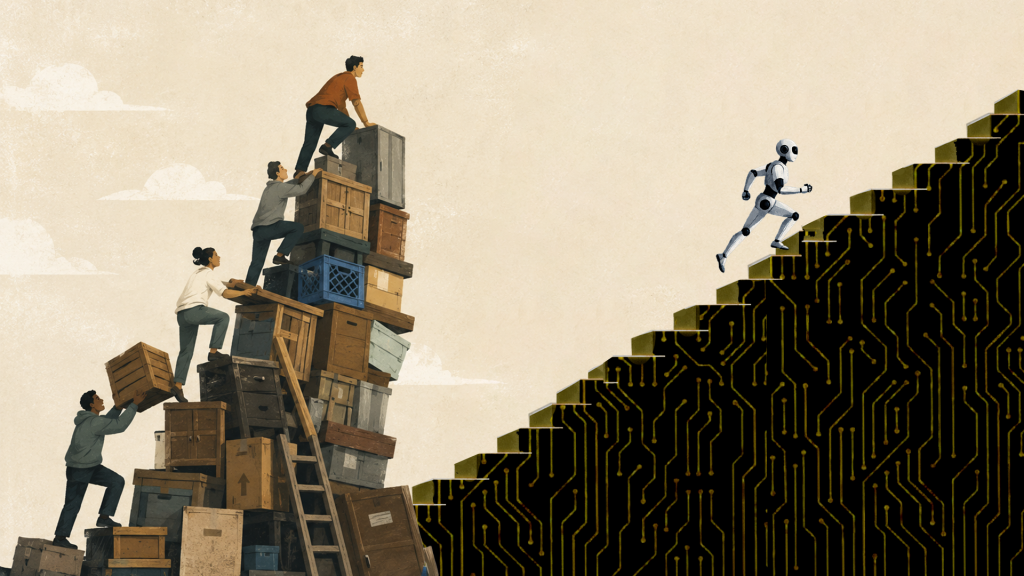
Image credit: Ulla
One of the biggest challenges is bringing AI to the physical world, such as through intelligent robots. Our latest reporting shows that we’re still some way off from robots doing chores at home.
LLMs were trained on the vast amount of text data available on the internet, but robots need to learn from the physical world. Hence, a new hustle is booming across India and Southeast Asia, where workers strap cameras on their heads to record manual tasks. But this data gold rush might not last long.
Meanwhile, the public markets have shown that companies worldwide are under a great deal of pressure to defend their AI strategies. IBM suffered its worst trading day on record, with shares plunging 25% on July 14.
In India, IT firms are assuring investors that their AI plans are paying off. One example is HCLTech, the third largest IT company in the country. It is investing US$366 million to build AI centers as part of its efforts to become a full-stack company. HCLTech also recently led the US$234 million round of Sarvam AI, India’s leading frontier lab.
Elsewhere in this issue, you’ll see our conversation with Dahua Lin, co-founder and chief scientist of Chinese AI company SenseTime. He talks about his vision for AGI, the firm’s latest image generation model, and why design and content creation are going to be the next avenue for AI to disrupt after coding.
Pranav Balakrishnan, AI reporter
TOP AI READS FROM OUR DESK
1️⃣ Why the robot data gold rush is on borrowed time
WHAT WE THINK
FOUNDER FOCUS





Stay updated on the go with our mobile app.
Get latest insights with smoother, more personalized experience through TIA mobile app.