Paul Bischoff · · 3 min read
China’s car services startups get a funding boost that will drive them off a cliff

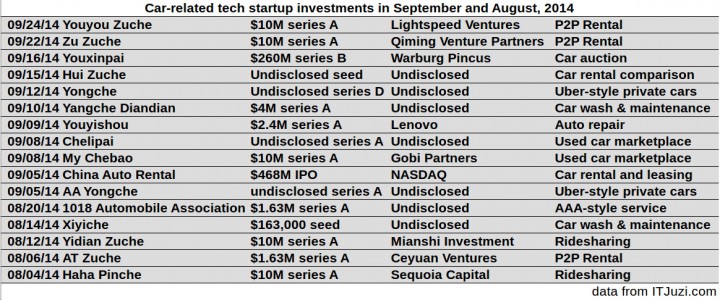
If you run a startup that has anything to do with cars in China, then there’s a pretty good chance you got funded recently. 16 companies that range from sharing, renting, maintaining, washing, to selling cars secured investment in the last two months, according to Chinese tech startup tracking site ITJuzi. So why the sudden interest in the car transportation industry by China’s startup ecosystem?
The first reason is that the country’s venture capital scene is on fire right now. It’s so hot, in fact, that the co-founder of Matrix Partners China even sent an open letter to his portfolio companies warning of an imminent bubble burst. Valuations and investments are both high and frequent across several sectors.
Secondly, the online-to-offline aspect of automotive startups lures China’s investors like flies to a dog turd. O2O has become the day’s biggest buzzword, and startups that slap on the label have a better chance at catching investors’ interest.
Chinese investors prefer safe bets to risky gambles, and making similar investments to their peers is an easy (see: lazy) way to minimize risk. They see apps like Uber, Lyft, Kuadi Dache, and Didi Dache gaining steam, and want in on the action. Investors hope the success of those services will spill over into other consumer-driven automotive services.
Most at least know better than to compete with heavily-funded premium services like Kuaidi, Didi, Uber, and Yongche, the lattermost of which just received a growth stage round rumored to be worth over US$100 million. But other O2O services offer a back door into China’s booming O2O transportation sector. Although August and September saw the highest frequency of investments, the fad has been ongoing since the beginning of the year.
Follow that car!
But none of the reasons for investing are about the startups themselves being of good quality or actually solving problems. Nearly all of the recent investments were either series A or seed rounds. Very few were series C or above, so the idea that these are proven, profitable models in China is bunk. Many have never been proven to work at scale anywhere in the world, but investor FOMO (fear of missing out) is driving many of them to throw money at whatever they can get their hands on.
Even if ridesharing and P2P rental can work in China, are investors ready to foot the massive bills that Uber, Yongche, Kuaidi, and Didi had to pay to get to the top? While those services certainly have users, it will take several years before anybody sees a return on investment – not the quick turnaround that many mainland VCs and angels are looking for.
These types of startups are also extremely difficult to scale up. With so many new competitors entering the market at once, expanding beyond one or two cities will get even tougher, leading to fragmentation. These are winner-take-all models. Users – whether they be passengers, buyers, sellers, or mechanics – will default to whichever app the majority of their friends and colleagues use, so a quick influx of cash is needed to quickly take over the market. P2P rental and ridesharing still face major trust barriers in China as well.
These are bandwagon investments that portray the larger failings of China’s venture capital scene. Yes, there’s more than enough money to go around, but investors who should be taking risks are blowing it on ventures they perceive to be safe because that’s where their peers are investing – rather than in startups that innovate and solve real problems. If and when the bubble bursts, many of these early stage VCs will be left wondering why they invested so blindly.
See: Shotgun! China’s internet giants race to get cars online





Stay updated on the go with our mobile app.
Get latest insights with smoother, more personalized experience through TIA mobile app.