Sumit Chakraberty · · 6 min read
Inside Alibaba-owned UCWeb’s plan to outwit Google and Facebook in Asia
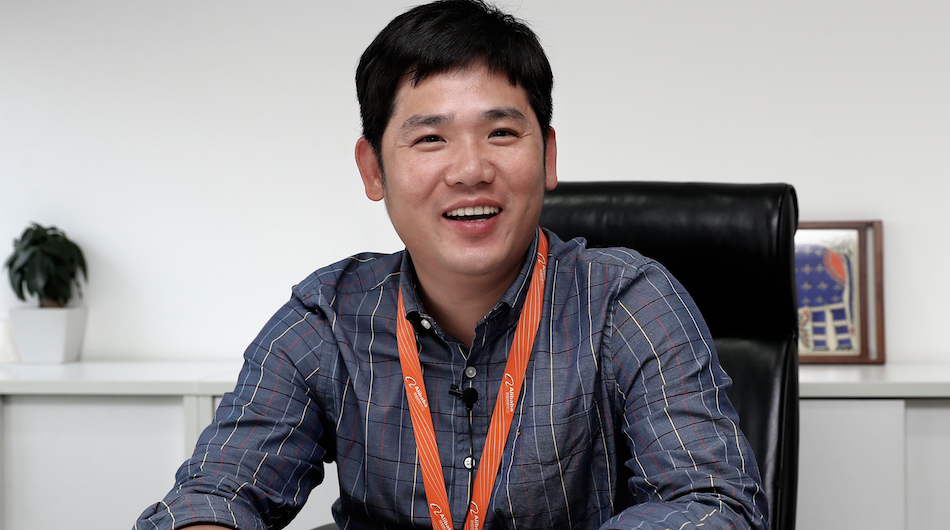
Jack Huang, president of overseas business, Alibaba Mobile Business Group. Photo credit: UCWeb
Last week, Alibaba-owned UCWeb announced a US$30-million investment to develop a content business around the UC Browser in India and Indonesia. This is just the start of a much bigger commitment to its two most important markets outside China in 2017, Jack Huang, president of the Alibaba Mobile Business Group, later explained.
The recommendation model is booming right now and will continue to do so in the near future.
What’s more interesting than the money invested is the UCWeb content strategy. The Alibaba-owned company believes it has both the user base and market savvy in Asia to beat Google and Facebook at their own game of building a content ecosystem that drives their ad businesses.
In an interview with Tech in Asia at the UCWeb headquarters in Guangzhou, Jack Huang spelled out the game plan in no uncertain terms.
“Our user volume is a key factor. We’re not far behind Google and Facebook (in Asia), and we’re growing really fast,” points out the stocky and energetic Huang, in a small, sparsely furnished room at one corner of the tenth floor of a building that houses thousands of UCWeb employees, including teams from India, Indonesia, and Russia.
The millions driving its bet
UCWeb claims to have 420 million monthly active users, out of which more than 100 million are in India. To put that into perspective, Facebook claims to have 155 million monthly active users in India.
The race is closer or even in UCWeb’s favor when it comes to mobile, which accounts for over two-thirds of internet traffic in India. The UC Browser is already the most popular mobile browser in India and neck-and-neck with Google Chrome in Indonesia, according to StatCounter. The use of compression technology to speed up browsing and minimize data usage, keeping in mind the poor connectivity and the frugality in India, has worked wonders for the browser.
Now the idea is to build a content ecosystem around it, which can then be monetized. That’s not unlike the personalized Facebook news feed or Google user data being used for targeted advertising. But the prerequisite is to have an ecosystem that hooks lots of users to spend time there.
“We should learn more from Google and Facebook how they do this,” Huang tells me candidly. But UCWeb has a few aces of its own, too.
A personalized engine to engage users
Last year, UCWeb launched UC News in India and Indonesia. Initially, it aggregated content from traditional media, and integrated it with the UC Browser. But this soon broadened into a self-publishing program called We-Media to have diverse user-generated content, including video. What’s more, self-publishers can get paid according to the traction they get for their articles, images, and videos.

Most user-generated content platforms with large distribution networks expect their users to be happy with the intangible benefits of getting visibility, building a reputation, and gaining a following. So UCWeb is taking a different line here to incentivize publishing with payment on top of providing access to its massive user base. The bet is this will help ramp up UC News faster in India and Indonesia, its two main markets outside China.
Indian requirements
Global fight on local turf





Stay updated on the go with our mobile app.
Get latest insights with smoother, more personalized experience through TIA mobile app.