 Grace Priscilla Teo · · 4 min read
Zhipu AI’s formula for surviving China’s tech market
This article summarizes an episode of Xiaojùn Podcast’s video series featuring Zhang Peng, CEO of Zhipu AI.
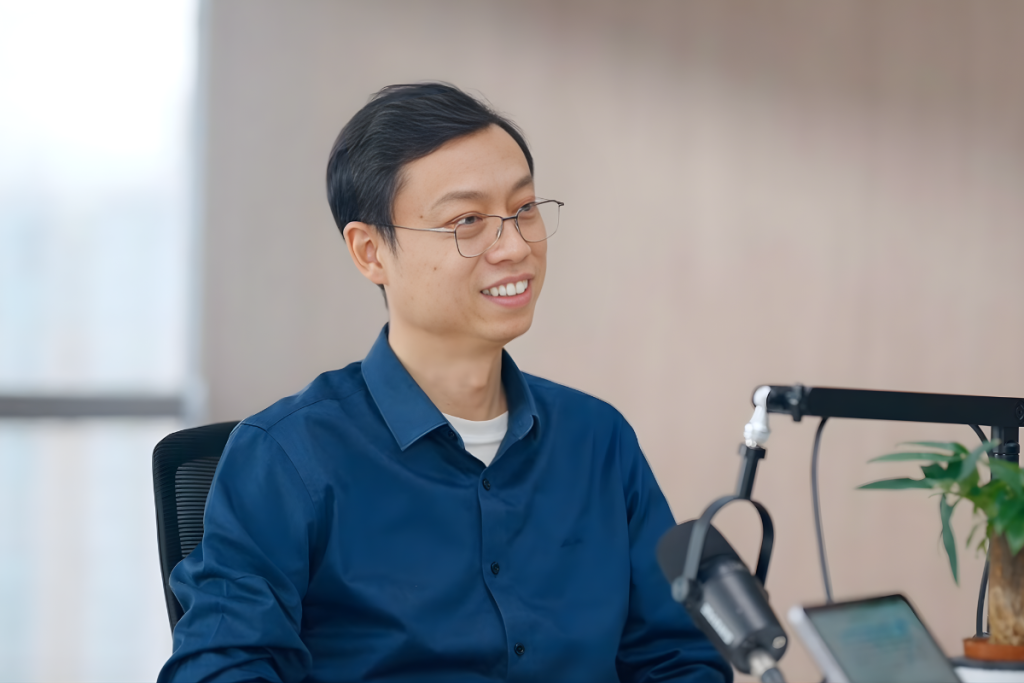
Zhang Peng, CEO of Zhipu AI / Photo credit: Xiaojùn Podcast
Zhang Peng, CEO of Zhipu AI, argues that the Western “subscription culture” is challenging to replicate in China. This economic reality forces Chinese AI firms into a high-stakes choice: pivot toward industrial strength or face obsolescence.
Zhipu AI, founded in 2019 by Tsinghua University researchers, recently launched on the Hong Kong stock exchange after raising US$558 million in its IPO. Backed by Alibaba, Tencent, and local government funds, the company reported 312.4 million yuan (US$44.6 million) in revenue in 2024.
Bridging lab and market
To survive, Zhipu uses the P2P (Paper-to-Product) Engineering System, an integrated pipeline designed to transform academic breakthroughs into commercial-grade infrastructure.
This approach moves knowledge through four critical stages to ensure research doesn’t just stay on the page, but becomes a tool for industry:
- Research: Conducting foundational studies to produce high-impact papers.
- Stabilization: Leading engineering teams to harden experimental models into reliable systems.
- Delivery: Deploying functional products to enterprise clients.
- Feedback: Using real-world client data to iterate and refine future research.
As Zhang notes, partners “don’t just want a paper or prototype code. He argues that AI is not pure science locked in a vacuum, but a symbiotic relationship between research and practical building.”
“Your research must convert to actual products,” Zhang says, “which in turn feeds back into our fundamental work.”
Avoiding the spending trap
Different payment cultures in the East and West have pushed companies away from B2C apps. While the US market sustains AI growth through monthly software fees, this model is largely absent in China.
In China, consumer models often devolve into “price wars”. Companies find themselves burning cash to acquire users who have no intention of paying. Zhipu rejected this trajectory to focus on business stability.
“The US has a strong subscription culture,” he explains. “In China, B2C often becomes a war of subsidies and freebies.”
Strategic capital must prioritize the core mission over side-projects
Zhang views funding merely as “travel provisions” for a long journey. He dismisses the idea of “saving the country through a curved path,” the strategy of chasing quick commercial wins in unrelated markets to fund AI research later. For him, the commercial path and the research path must be the same.
Correcting the open-source misconception
Zhipu’s enterprise focus faced an immediate hurdle: the rise of open-source rivals.
Defining intelligence beyond scale
The shift toward reinforcement learning





Stay updated on the go with our mobile app.
Get latest insights with smoother, more personalized experience through TIA mobile app.








📅 Upcoming Events
22 October 2026
Payoneer x CSPN Summit 2026