 Most of you reading this wouldn’t consider your family or yourself “poor”. Sure, you may be a struggling entrepreneur but your experiences are still probably very different from those of whom society terms as “low income families”. Envisage Social Education aims to bridge this knowledge gap.
Envisage was founded by a team of five in Singapore based on a Poverty Simulation Kit from the US. It is a comprehensive program where participants will role-play various characters, in which students have the opportunity to put themselves in the shoes of the less fortunate and in turn develop a greater application of their family, education and financial literacy.
Envisage was set up as an educational enterprise committed to youths’ holistic development by striving to promote empathy and compassion among youths to better prepare them for their ever-changing lives. Envisage aims to be the leading entity in working hand in hand with schools and various others partner organizations to sustainably empower youths.
Here, we are given a chance to talk more about it with Stanley Chia, Managing Director of Envisage.
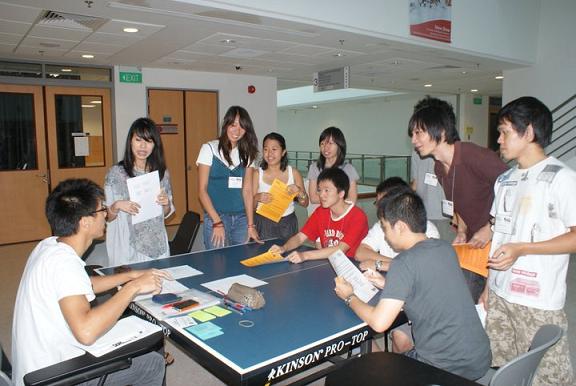
Discussion During The Programmes @ U-Trust-Us National Bank
What is your background?
I am an accounting student from NTU, however, having realized the service gap in our society of having program that help students realize the importance of empathy in the rise of service learning programs, I took a sabbatical to focus on building sustainable business model for Envisage so to develop Envisage into a sustainable Social Enterprise.
Through my active involvement in NTU-SIFE, SingYouth hub, Design for Change and other social initiatives, I utilized the experiences and networks formed to build the internal capacity of Envisage, as well as form strategic partnership with various partner organizations so to rapidly develop product offerings and market reach.
How did you come upon this idea?
I first came across the program through my participation in NTU-SIFE, under the program named Eye Empathy, aimed to educate high school students the importance of financial literacy through empathy for the poor.
It was then that I realized the potential of the program in its ability to engage students to realize the importance of financial literacy. As opposed to teaching them through dull presentation slides, the simulation program allowed students to learn through role-play. This experiential learning program was much more engaging and effective in communicating the learning points we hope to achieve.
Subsequently, we were introduced to Mr Lee Kah Howe, the CEO of ST Consultancy, who brought the program back from the United States of America, and partnered with NTU-SIFE which actively marketed the program to various schools.





Stay updated on the go with our mobile app.
Get latest insights with smoother, more personalized experience through TIA mobile app.