 Terence Lee · · 2 min read
Survey: Philippines world’s best in Business English; Malaysia and Singapore not far behind
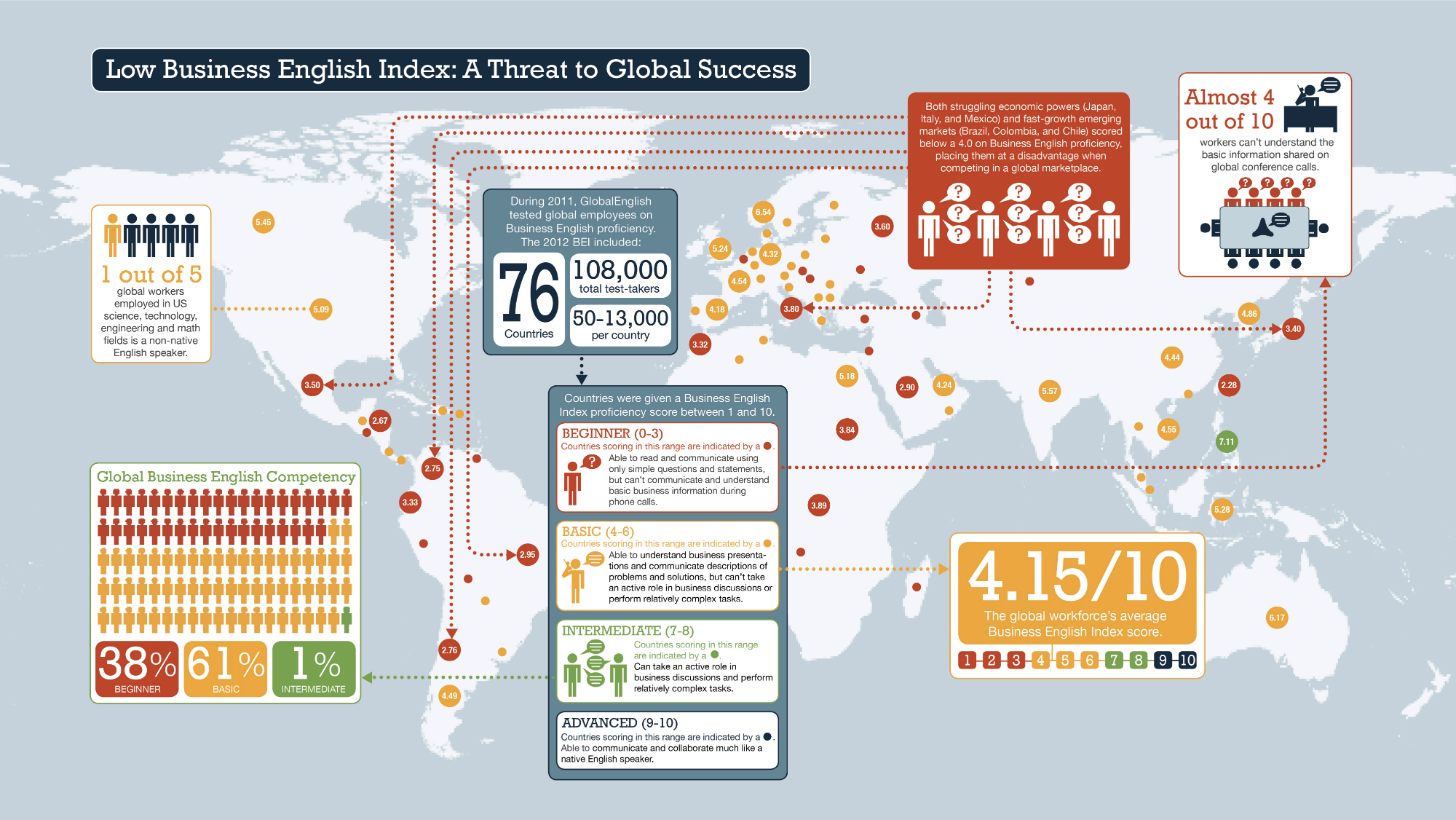
Click image for full size.
The Philippines is ranked number one in the world for Business English proficiency by the GlobalEnglish Corporation, a provider of cloud-based software to advance English literacy in global organizations.
Rounding up the top five are Norway, Serbia, Slovenia, and Australia. Surprisingly, English native-speaking countries like the United States and Great Britain are not even in the top ten, while Malaysia and Singapore occupy sixth and ninth place respectively.
The Business English Index (free download) is an annual survey that ranks global workers on their business English proficiency from a scale of one to 10. This year, over 76 countries were ranked and 108,000 workers were tested. The number or participants in each country could range from anywhere between 50 to 13,000.
The Index has also found out that average Business English standards have slipped year-on-year, falling by seven percent. However, this decline is “likely” to be attributed to external factors. The report explains:
More and more companies are being thrust into the global market at the early stages of their strategic efforts to push Enterprise Fluency throughout their company. This increases both the number of companies and the number of employees surveyed, which lowers the average score.
Another interesting tidbit from the survey: Four out of 10 workers can’t understand basic information shared on global conference calls. But it’s unclear if that is due to poor audio quality.
While the Index appears exhaustive, I have doubts about the survey’s usefulness as a comparative gauge of Business English competency.
Sampling bias, for instance, could skew the results. We don’t know if the survey measured all countries equally by ensuring an identical distribution across professions and industries. It’s unlikely though — since the infographic mentions that at least one country had a sample size of 50.
And while the GlobalEnglish Corporation likes to portray itself as the barometer of Business English proficiency, their determination of whether one is “proficient enough” is probably arbitrary. For instance, the report says that 99 percent of workers in the world “can’t take an active role in business discussions or perform relatively complex tasks”, a suggestion that sounds ludicrous.
Also suspicious is the fact that Singapore is ranked lower than Malaysia, which is perhaps another sign of how skewed the report is.
Nonetheless, countries like Philippines and Norway have been consistent top performers in the survey. While I don’t know if they should be ranked that high, it’s clear that, at least based on my experience in the Philippines, entrepreneurs there are definitely good English communicators.
That’s an important advantage for the country’s budding startup scene, which has just started to attract funding and receive more government help in recent years.





Stay updated on the go with our mobile app.
Get latest insights with smoother, more personalized experience through TIA mobile app.







📅 Upcoming Events
22 October 2026
Payoneer x CSPN Summit 2026