- Premium Content It takes our newsroom weeks - if not months - to investigate and produce stories for our premium content. You can’t find them anywhere else.
 C. Custer · · 5 min read
Opinion: Why WeChat is a good product but a bad company
Investors may be wondering whether Tencent – WeChat’s parent company – can really continue its breakneck expansion pace as it heads into its third decade. If the gaming business that provided Tencent’s core revenue stream isn’t coming back, then what will drive Tencent’s future?
Photo credit: Wikimedia
The following is an adapted translation of an article written by Xi Angxiang and published on Sina Tech.
In 2004, when Mark Zuckerberg was still at Harvard University, he gave an interview in the student newspaper about his plans for Facebook. It’s obvious he wasn’t particularly interested in profitability back then. “Making cool things is just something I love doing,” he said, noting that he didn’t have any plans to sell the company and no real designs on when or how it would become profitable.
That’s how a lot of successful social media products get their start: engineers wanting to make something cool. But while Zuck’s gone on to make a highly profitable product, the folks behind many other social media empires – including, arguably, China’s WeChat – have not.
Tencent’s big problem
It was roughly a year ago when Tencent became the first Asian company to break a US$500 billion market cap, leaving even Facebook in its wake. The Chinese tech giant, it seemed, could do no wrong. Yet today, the picture is far bleaker: Tencent’s market capitalization has dropped by US$200 billion, roughly the value of Intel.
It isn’t alone, of course. Its main competitor in the gaming space, NetEase, saw its shares drop more than 40 percent over the same period. Baidu and Alibaba have dropped too, but neither has fallen as far as Tencent has.
This is because Tencent’s highly profitable video game business has been essentially frozen by Chinese regulators (along with all other gaming businesses in the country). Without permission to roll out new releases, Tencent’s gaming division is stuck in limbo. And although Tencent has other products in areas such as fintech, medicine, and social media, gaming was contributing two-fifths of the company’s income. Now, its legions of mobile and PC games can’t be monetized.
But it may go beyond that; investors may be wondering whether Tencent can really continue its breakneck expansion pace as it heads into its third decade. And if the gaming business that provided Tencent’s core revenue stream isn’t coming back, then what will drive Tencent’s future?
There are a couple of implied questions there.
First: it’s easy for Tencent to make money from games. Has it not made as much from its other products simply because it was focused on games? For example, Tencent is a traffic giant and the operator of China’s most dominant social media platform. Yet it received just 10 percent of China’s third-party ad spend last year, compared to Baidu’s 19 percent and Alibaba’s nearly 33 percent. Is the reason for the disparity that Tencent was too focused on games to try as hard at selling ad space? Or is the reason that Tencent’s just fundamentally not capable of selling as many ads?
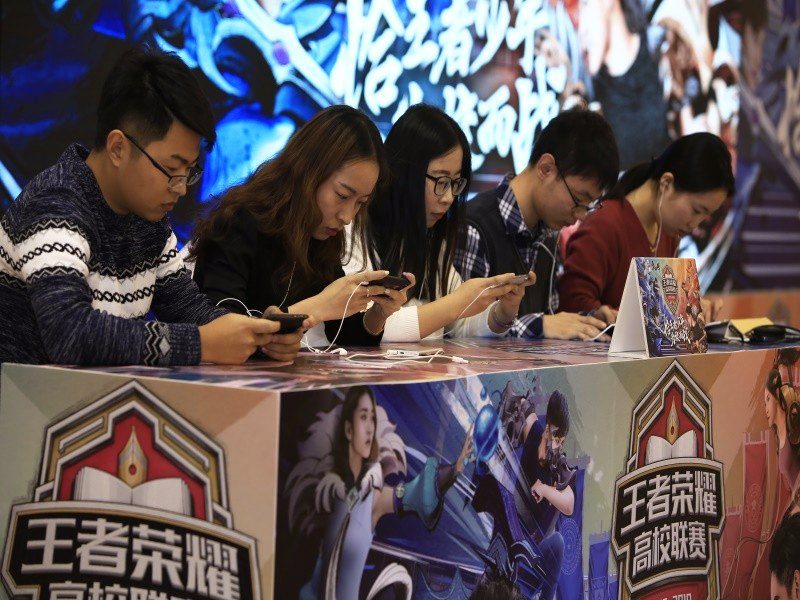
Arena of Valor university tournament in Beijing / Photo credit Tencent
The second question: if the game business is no longer offering easy money, can Tencent keep pace with Alibaba? Over the past few years, the two companies have been content to compete mostly in the abstract, acquiring startups and expanding outside of their core business areas without directly taking each other on. This was fueled by the fact that both companies could fund these expansive moves with reliable revenue streams: ecommerce for Alibaba, and gaming for Tencent. If Tencent’s games stream dries up, will it be able to keep up the fight?
Can WeChat save Tencent?
Stay ahead in Asia’s tech landscape
This is premium content. Subscribe to read the full story.
The prospects for WeChat’s development are not great.
We know this is not ideal. ⌛ Sign up in 20 seconds. Cancel anytime.
Our subscriber community includes professionals from these companies:





Stay updated on the go with our mobile app.
Get latest insights with smoother, more personalized experience through TIA mobile app.