Gilang Kharisma · · 4 min read
Sims, agents, and scaling: The AI stakes inside Nvidia’s plan
This article summarizes an episode of Y Combinator’s video series featuring Jensen Huang, founder and CEO of Nvidia.
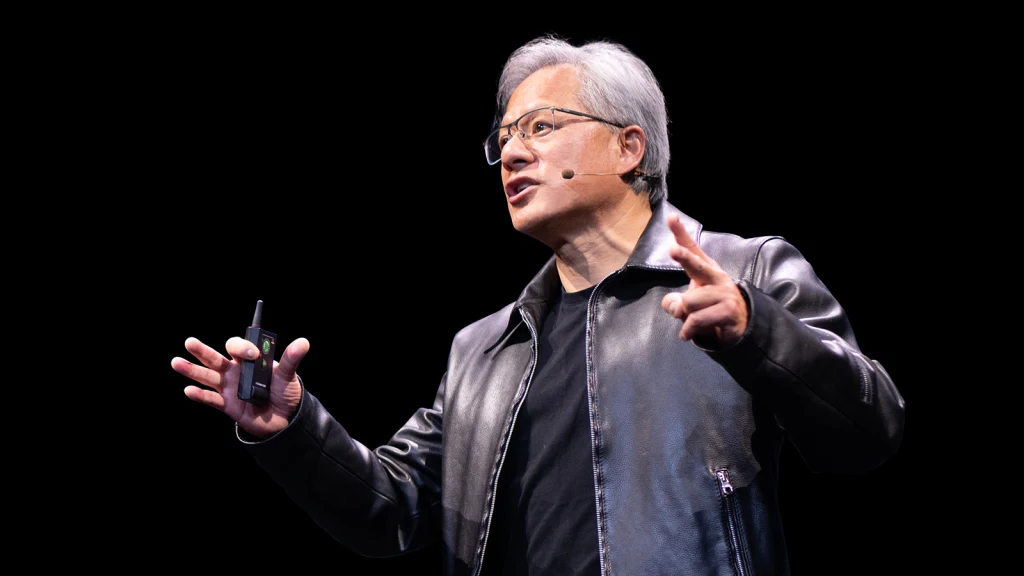
Photo credit: Nvidia
Tech companies survive major shifts by adapting before the market forces them to. Nvidia founder and CEO Jensen Huang attributes his company’s success to rapid adaptation.
He recognizes when a new algorithm unlocks fresh possibilities, then redesigns the entire hardware and software stack to capture that emerging demand.
Expanding core algorithms
Early graphics failures taught Nvidia that a single flawed product doesn’t invalidate a core computing concept. Choosing the right algorithm dictates a company’s strategic direction. To turn a breakthrough into a permanent strategy, leaders must:
- Test early: Validate technical ideas before draining resources.
- Identify scalability: Find algorithms that can become reliable computing methods.
- Rebuild the stack: Redesign hardware and software so all components work smoothly around the new task.
- Focus on fundamentals: Stay alert to spot the next major shift before competitors do.
Huang notes that Nvidia’s breakthrough came from studying AlexNet, an early AI program that proved computers could learn complex tasks like recognizing images.
Rather than seeing this as a one-time success, Huang realized this method could teach computers to do almost anything.
This sparked Nvidia to rethink how AI would eventually reshape software and entire industries.
Physical AI requires cost-effective simulation
Huang applies this full-stack philosophy to robotics. Digital models can generate video freely, but physical AI, meaning AI systems controlling machines in the real world, must obey the laws of physics.
Because real-world robotic testing is slow, dangerous, and prohibitively expensive, hyper-realistic computer simulations are the only way to scale development safely.
Nvidia’s robotics strategy relies on bridging the digital and physical worlds:
- Build AI models that understand cause and effect in physical spaces.
- Convert real-world scenes into digital training environments (real-to-sim).
- Use physics-based simulations to affordably generate extreme edge cases.
- Connect digital learning back to physical hardware (sim-to-real).
“We have to create environments for [robots] to learn in and to evaluate… We have to generate simulators that are based on simulation-grounded physics. And then the last part is sim-to-real,” notes Huang.
AI agents demand strict system design





Stay updated on the go with our mobile app.
Get latest insights with smoother, more personalized experience through TIA mobile app.