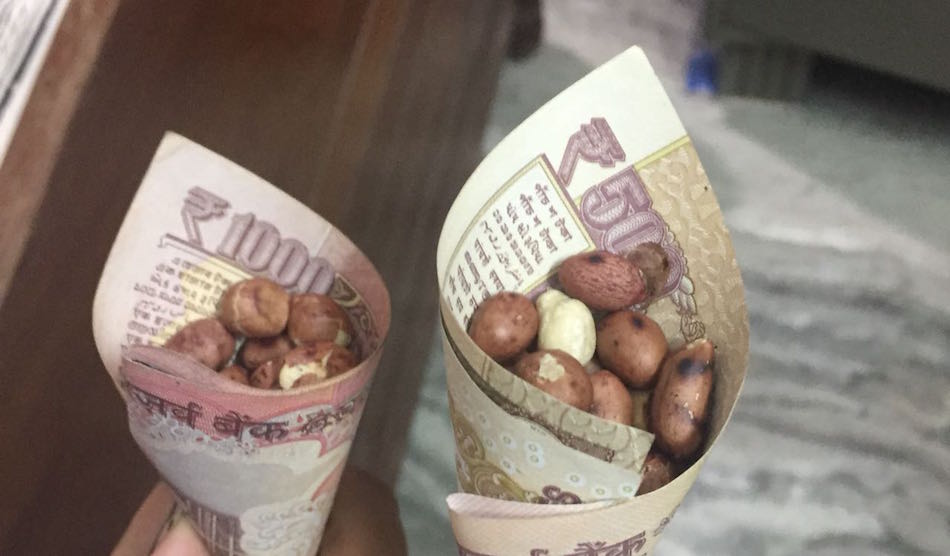
An image doing the rounds on WhatsApp.
Higher denomination currency notes of INR 500 (US$7.5) and INR 1,000 (US$15) are suddenly just pieces of paper from today. The Indian prime minister, Narendra Modi, made the shocking announcement in a speech last evening that these notes stand abolished as of midnight. They are no longer legal tender.
These drastic moves are aimed at fighting black money and the circulation of fake notes. It will also give a push towards a digital economy that lowers transaction costs and fosters innovation and growth.
Given the possible public backlash of force-feeding cashless transactions down the throats of such a large population, this is a huge move by the Modi government.
First, a quick look at the finer details of this massive withdrawal of currency.
People who have the 500 and 1,000 rupee notes can exchange them for lower denomination ones at offices of the Reserve Bank of India (RBI) or bank branches. But there’s a cap of INR 4,000 (US$60) on the amount that can be exchanged in cash. The rest will be credited to bank accounts. This can be done from tomorrow until the end of the year.
The INR 4,000 (US$60) in cash is meant for petty transactions. Cash withdrawals from ATMs are restricted to a maximum of INR 2,000 (US$30) in a day until November 18, after which the limit goes up to INR 4,000 (US$60). Cash withdrawals from banks too are restricted to INR 10,000 (US$150) in a day and INR 20,000 (US$300) in a week. But all banks and ATMs are closed today to give them time to adjust to the new rules.
See: India just banned its biggest banknotes, and startups are rejoicing
Hundreds of millions are unbanked
India has the world’s biggest unbanked population – the World Bank estimated over 400 million in 2014 and PriceWaterhouse Coopers put it at 233 million last year. The government says all these people will now have to open bank accounts to be able to exchange their old notes of INR 500 and INR 1,000. And to do that, they will have to produce an Aadhaar card (citizen’s ID), PAN card (income tax number), or voter’s ID.
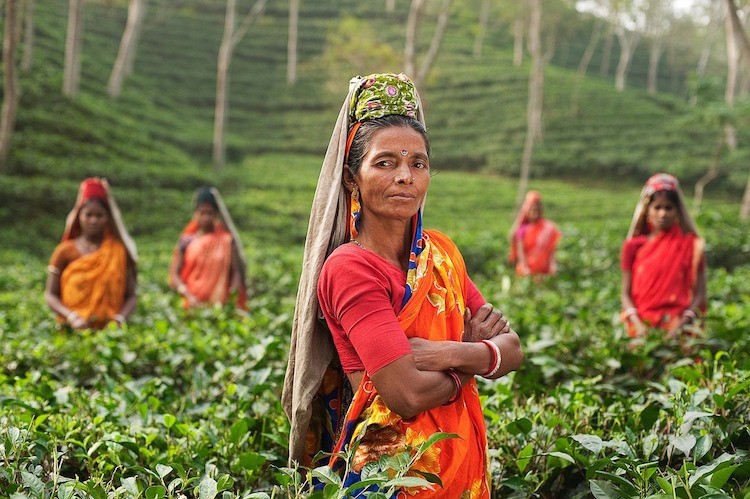
Photo credit: Pixabay
For poor people with low cash reserves, this will come as a huge blow. Many are illiterate and have never dealt with banks for a variety of reasons. Some have simply not felt the need for it because they have so little money. Others shy away from banks because they don’t have ID cards for KYC (know your customer process for verifying identity), which is a pre-requisite for opening an account. Some don’t do it because they live in remote areas where there are no banks.
The government has tried to help the unbanked by rolling out the massive Aadhaar program to give a unique identification number to every citizen of the country after physical verification. This is still a work in progress. The RBI has also given licences to payment-only banks. Fintech startups have brought in digital wallets to offer other options for financial inclusion and convenience.
See: World’s lowest internet tariff and $750m for startups: Reliance’s 2-in-1 offer to win India
Four main objectives
Commitment to Digital India vision





Stay updated on the go with our mobile app.
Get latest insights with smoother, more personalized experience through TIA mobile app.