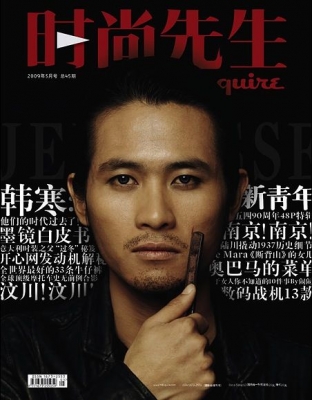
Han Han might be China’s biggest celebrity blogger, which is a pretty impressive title for an infrequently-updated traditional blog to have in the microblog age. It helps, of course, that Han is young, handsome, drives a race car, and has cultivated a rebellious political image while so far managing to keep himself out of jail.
In a recent post on his blog, Han Han also addressed why he hasn’t jumped into microblogging despite his domination of traditional blogging and his millions of followers. What’s keeping him off the Weibo wave?
First, he points out that he would be distracted by trying to woo all the girls with pretty avatars who made positive comments on his posts. With all the seeking through their Weibo accounts to find pictures and such, he’d have no time to write full articles. This is meant to be tongue-in-cheek, but Han does have a reputation as a playboy and his writings have been accused of betraying a pretty sexist attitude on more than a few occasions, so I suspect there’s more truth to this than Han meant to suggest.
He also notes, “I am a vain man,” and Weibo certainly offers enough feedback that a vain celebrity could get lost in the endless string of comments, retweets, and (for him) pretty avatar photos.
His real issue with Weibo and microblogging, though, is that its extreme speed, while an advantage when spreading breaking news, is also a weakness. His essay concludes with a story:
Last week I was racing, and I didn’t have time to go online. On Monday, after the race was over, I opened up Weibo on the car ride home. I saw a friend of mine was writing about a tragedy that had happened a week ago. He said he’d been thinking carefully about it for seven or eight days, had read through relevant materials, and that he felt perhaps it was this way [i.e., he expressed his opinion on the tragedy]. His analysis made a lot of sense, and I really approved of it. Usually this friend has many people retweeting his posts, but this one only had a few dozen retweets, and one of the first comments was: “How are there people still talking about this, this event [the tragedy] is already old [outdated].”
If you can stomach his braggadocio bullshit about wooing pretty girls, as usual Han’s article makes a good point. News of tragic events that might previously have been censored in China now spreads quickly on Weibo, but it also disappears just as quickly, leaving time only for snap-judgements and pithy witticisms and punishing users who attempt to use it as a forum for deeper analysis.
That’s not necessarily a bad thing, but it is an important thing to remember, and not just for China, as the same criticism might be fairly leveled at microblogs more or less everywhere. News spreads fast, but “traditional” blogs like Han Han’s still serve a very important purpose by offering deeper analysis. Sure, it updates slowly, and sure, plenty of people are bound to look at a big block of Han Han text and respond: tl;dr. But that doesn’t mean society doesn’t need it.





Stay updated on the go with our mobile app.
Get latest insights with smoother, more personalized experience through TIA mobile app.










📅 Upcoming Events
22 October 2026
Payoneer x CSPN Summit 2026