 Jia Xin Lim · · 5 min read
What’s next for Grab after its acquisition of Uber? Find out at TIA Singapore 2018

8 May 2018 marked the dawn of a new era in Southeast Asia as Grab’s acquisition of Uber finally took place. Much has been said about Gruber, such as winners and losers from the deal, and Grab’s potential to become a food-delivery giant.
A Southeast Asian startup proved that it could compete with a global giant. How did it take on one of the largest startups in the world?
The starting point
Grab started out to solve two major pain points – drivers weren’t making enough money, and it was unsafe for women to take taxis.
With Grab, more job opportunities were created, and it became an additional source of income for drivers. Currently, the company has over three million driver-partners who use the platform, and earn up to 55 percent more than national average hourly wages.
To ensure commuters’ safety, drivers had to go through stringent checks and trainings. Additionally, the Share My Ride feature allows commuters to share their ride details such as driver details, license plate number and real-time tracking with others. This was especially useful for women passengers to keep their loved ones updated on their whereabouts.
During Grab’s early days, when the concept of ride-hailing was still relatively new, it was a challenge to get drivers onboard. Employees had to persuade non-tech savvy taxi drivers to partner with Grab. To do so, Grab’s team travelled to places such as Bukit Merah View Market and Food Centre, and other places where drivers hung out – airports, shopping malls, and gas stations.
To keep updated with what customers want and understand their habits when using various services, Grab continues with this on-the-ground approach today, such as visiting the small stores or ‘tokos’ in Indonesia to shape Grab’s financial services offerings.
Formula to success
Grab attributes its success to several key factors, such as hiring based on culture fit and localization.

Co-founders of Grab, Anthony Tan (left), Tan Hooi Ling (right) / Photo credit: Bloomberg
Co-founder Tan Hooi Ling shared that throughout the five years she spent building the company, one of the most important lessons she has learnt was to hire based on culture fit.
Having the right people on the team can make or break a startup, and it was crucial to have people who fit well with the company culture and values, even if it meant turning down other talented potential candidates.
In another interview, CEO Anthony Tan revealed that that Grab’s local teams across Southeast Asia knows each country’s problems and challenges inside out. Due to their deep understanding, they’re able to navigate regulatory environments and local infrastructure challenges, allowing them to scale locally at a faster pace.
Solving local problems
Armed with the belief that localized services best solve local problems, Grab began providing several products to serve the market’s needs. For instance, the launch of GrabBike in Vietnam, Indonesia and Thailand came about as taking bikes was a common mode of transport in those countries.
In 2016, GrabChat was launched, allowing riders and drivers to communicate in-app. Besides saving users time and money communicating with drivers, the function also solves potential miscommunication problems due to language barriers.
GrabChat now auto-translates messages such as from English to Bahasa Indonesia for more seamless travel across the region, and drivers are able to select ready-made phrases in English such as “I’m here” and “OK” when contacting customers.
In addition, Grab understood that a good portion of the population in emerging countries does not have credit cards or bank accounts. Instead of only allowing credit card payments, they accepted cash payments early on, attracting more users to try out the platform.
It is currently moving towards creating more access to digital and financial inclusion for those in Southeast Asia. Grab Financial will provide services such as micro-lending and insurance to the unbanked and underbanked, who are underserved by traditional financial players today. This segment also makes up the majority of the population in Southeast Asia.
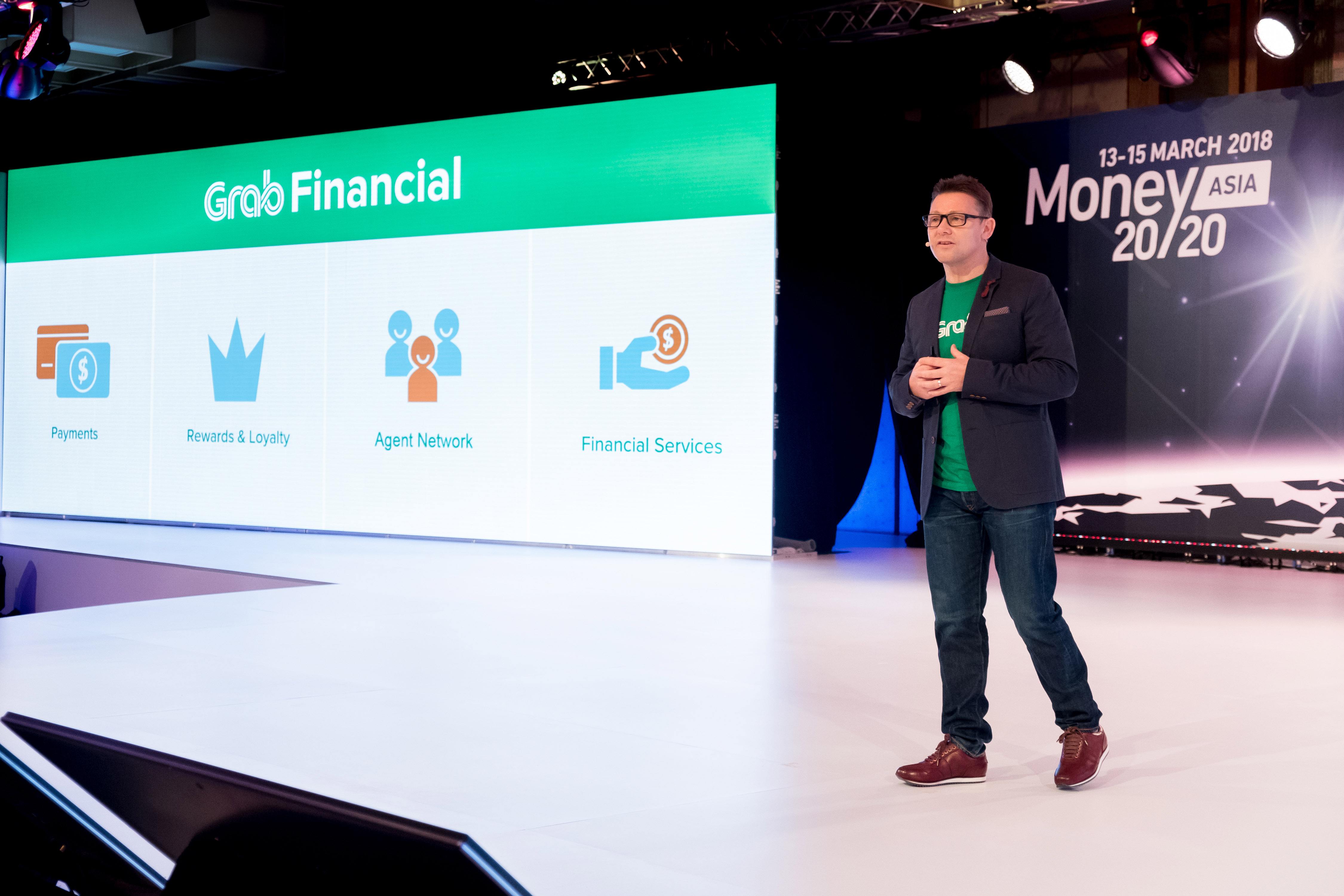
GrabPay managing director Jason Thompson unveils Grab Financial at Money 2020 conference in Singapore / Photo credit: Grab
Building Southeast Asia’s everyday app
Grab sees itself going beyond the ride-hailing sector. In line with creating digital and financial inclusion, the company is working towards building an everyday app, and envisions a near future when consumers will use Grab to complement their lifestyle. Think commuting, eating, delivering shopping and paying for your daily necessities all through the app.
Grab has the opportunity to be the gateway to the digital economy for millions of Southeast Asians, and hopes to bring more value to consumers by building an ecosystem of digital services which complement one another.
GrabFood, its food delivery service, will be available across all major Southeast Asia cities by the end of this quarter, and GrabPay, its mobile wallet, will be rolled out across Southeast Asia by the end of this year.
What does the future of Grab hold?
This May 16, join Grab’s Group VP of Marketing, Cheryl Goh at Tech in Asia Singapore 2018’s Main Stage at her session titled “Grab and our story of fierce optimism” as she shares more about the company’s journey and what lies ahead.
Less than 24 hours to go before all the action takes place, be sure to grab your tickets now!



Stay updated on the go with our mobile app.
Get latest insights with smoother, more personalized experience through TIA mobile app.
Recommended reads
 Tesla faces $2.2m fine in South Korea for overstating driving range
 Airasia super app takes off in Indonesia
 Grab digibank head Reuben Lai to exit post (Update)
 Grab to close cloud kitchen ops in Indonesia, lays off employees
 Gojek to up service fee in Singapore starting February
 Gogoro to launch EV battery stations and scooters in the Philippines
 Forbes VN removes 30 under 30 inductee on sexual harassment allegations
 AirAsia to launch car-hailing in Indonesia
 Grab appoints new head for Vietnam
 Vietnam’s F88 secures $60m loan, eyes IPO by 2024





Editing by Cheong Hui Min
(And yes, we’re serious about ethics and transparency. More information here.)




