In a bid to monetize its user-friendly but financially dragging giant, Sina recently imbued its Weibo microblogging platform with its own currency — the weibi — and games. But are these games actually any good? I dove into a few of them to find out. This is the second in a series of reviews of Sina Weibo games.
Texas Hold ‘Em Poker
Part 1: Poker and Throwing Things
Hell is other people. Sartre wrote that a long time ago, so there’s very little chance he was thinking about online poker, but he might as well have been.
Perhaps I’ll start at the beginning.
I’ve always enjoyed playing poker. When I was young, I spent a fair amount of my vacation time in a place that had no internet, television, or cell phone service (though of course I didn’t have a mobile phone or computer back then anyway) and so we played a lot of card games. The family game of choice was generally hearts, but poker was always fun too, especially because one of my younger cousins was prone to tantrums and would occasionally flip over the table and send chips flying in a colorful rainbow across the room as he went for his brother’s throat. We never played for real money, but it was still fun, because the fun of poker isn’t so much in the winning or losing of money as it is the reading and manipulation of the other players. (At least that’s true when, like us, you don’t have any money to win or lose in the first place.)
Our focus on the psychological aspect of the game intensified when we discovered a moth-eaten poker book in the study. Published in the 1930s, it promised to reveal the secrets of poker victory and we read it one by one, drinking in its wisdom. It may have been a bit “dated” — there was an entire chapter on why you should never play poker with women — but there was some useful information tucked between the sexism and the old-timey ridiculousness.
Anyway, I mention this because the psychological part of the game — the part that reduced my cousin to tears or sent him flying across the room to tear his brother’s eyes out — is completely absent in online poker. You don’t know your opponent, and you can’t see or hear them. You can’t really chat with them. The game is reduced to numbers and chance. You may occasionally want to assault your opponents, but it won’t be for the same reasons, and without a real card table and poker chips, all you can do is smash your computer, which is a lot less satisfying.
Part 2: Texas Hold ‘Em As Played Online in China
Sina Weibo’s Texas Hold ‘Em Poker (hereafter: THP for short) was never going to live up to the real-life version. The fact that it’s limited to only Texas Hold ‘Em is sort of bizarre; there are thousands of varieties of poker, and it’s not like card games are that difficult to code, but whatever. I guess no one plays five card draw these days. Anyway, THP has chosen to do one thing, and while that might not be particularly ambitious, it does do that thing pretty well.
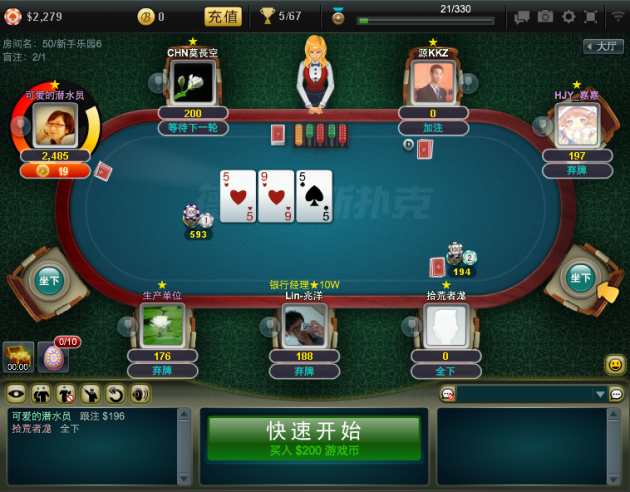
The main game screen
The game opens in a lobby, where users choose a room and enter it to begin playing. Since all the rooms are playing the same game — Texas Hold ‘Em — there’s not much difference regardless of which one you choose unless you’re trying to meet up with friends. If it’s your first time playing, you’re granted $3,000 of in game currency, and you buy into games for $200-$400 at a time. From there, the game progresses exactly as you’d expect. Cards are dealt, you make bets, and eventually someone wins.
The problem is that there seems to be a lot of griefing. In the games I’ve played over the last three days, at least one of the players — there can be up to nine per game — bets a huge sum of money right off the bat, forcing the players who haven’t already won large sums of money to fold almost instantly over and over again, or take an absolutely blind risk and go all in before even the flop (the first round of face-up cards) has hit the table. This is, of course, a perfectly legitimate (if perhaps bullying) strategy, but it’s not a lot of fun to be on the other end of. When I tried to play THP the way I would play regular poker, I found myself spending an awful lot of time waiting around for the next round as one or two gassed-up players fought it out over bets way over the $400 buy in limit I sat down with.
If you manage to avoid these kinds of players, you can have some fun with THP. I traded a few rounds in a small room with a couple other more serious players, and it was good fun. Winning is a bit of a thrill even though it’s not real money, and if you want you can even chat with other players using a small in-game chat room. However, from my experience it’s rarely used unless someone thinks something has gone wrong, so don’t count on getting a lot of information about your opponents from it.





Stay updated on the go with our mobile app.
Get latest insights with smoother, more personalized experience through TIA mobile app.










📅 Upcoming Events
22 October 2026
Payoneer x CSPN Summit 2026